
A wrap-up of posts published on Maven’s Notebook this week …
Note to readers: Sign up for weekly email service and you will receive notification of this post on Friday mornings. Readers on daily email service can add weekly email service by updating their subscription preferences. Click here to sign up!
State Water Board adopts Voluntary Agreements/Healthy Rivers and Landscapes Program
State Water Board adopts innovative new model to protect California’s Bay-Delta, water and wildlife
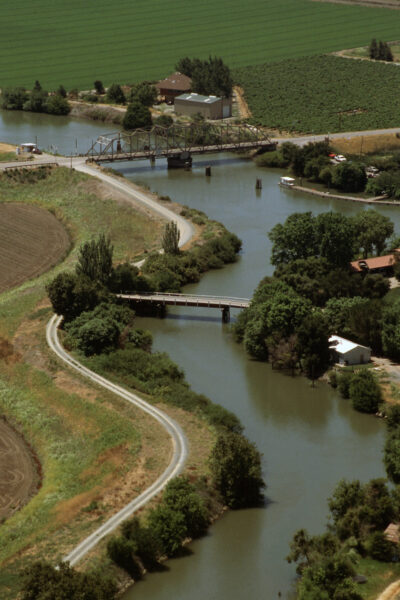
Paul Hames / California Department of Water Resources
“In a landmark development driving large-scale ecosystem restoration and creating greater security for the heart of California’s water system, the State Water Resources Control Board today adopted modernized water quality protections for the Sacramento River and San Francisco Bay-Delta. The updated Water Quality Control Plan for the San Francisco Bay/Sacramento-San Joaquin Delta Watershed (Bay-Delta Plan) strengthens protections for native fish and wildlife, provides water security, improves water quality and positions the state to better withstand the challenges of a changing climate. Today’s decision concludes a multi-year public process and reflects years of scientific study, hundreds of hours of public engagement, and significant input from environmental organizations, tribes, water agencies, and local communities. “This groundbreaking plan begins a new era of environmental protection, creating enforceable flow standards while giving communities, farms and industry the flexibility to manage their supplies and work together to restore California’s most important and overburdened watershed,” said State Water Board Chair E. Joaquin Esquivel. “The new plan also gives us the modern tools we need — especially increased monitoring and data collection — to manage the Bay-Delta for the 21st century. Today we celebrate the collective work that brought us here and the progress this represents for the entire state.” … ” Read more from the State Water Board.
Fierce debate as California changes course in central water hub
“For some, it’s a solution to ensure reliable water for millions of Californians while protecting fish and the environment. For others, it’s a travesty that will deprive the state’s rivers of vital water and push its declining native fish closer to extinction. A controversial plan that dramatically changes how the state governs the pumping of water out of the Sacramento-San Joaquin River Delta — the heart of the state water system — was adopted by California regulators late Thursday after two days of debate involving more than 200 people. The plan adopted by the five-member State Water Resources Control Board breaks from the traditional approach of requiring all water agencies to limit pumping to maintain required minimum levels of water in rivers and the estuary. Instead, it allows agencies the option of negotiated deals in which they commit to ensuring certain river flows for the environment and contribute funds for projects that restore habitat for fish in the Delta. … ” Read more from the LA Times. | Read via Yahoo News.
Has the Trump administration doomed Newsom’s water plan?
“California water regulators have approved a new plan overhauling how farms and cities take water from the Sacramento-San Joaquin Delta and rivers that feed it, setting up the next fight over Gov. Gavin Newsom’s plan to balance water supplies with the needs of a struggling ecosystem. The plan gives water agencies a choice: agree to forgo some water and restore habitats, or fall under the regulatory backup — a set of mandatory rules for how much water must remain in rivers and streams to flow through the Delta. But the compromise the Newsom administration reached four years ago with the state’s most powerful water suppliers now faces opposition from unexpected quarters. Powerful water agencies that once backed it say Newsom’s voluntary agreements have become too restrictive. The Trump administration has threatened to withdraw support and several hundred million dollars in funding. And environmental advocates, tribes, and fishing groups warn that the deal and its regulatory backup gut protections for an ecosystem already in crisis. … ” Read more from Cal Matters.
Tribes and environmental groups slam State Water Board’s anticipated adoption of updated Bay-Delta Plan, vow further action
“In anticipation of the State Water Resources Control Board’s vote to adopt the updated Bay-Delta Plan, tribal leaders, environmental advocates, and Delta residents gathered at a press conference to condemn the decision and pledge further action to defend California’s water rights, protect critical ecosystems, and ensure meaningful public participation in decisions affecting the state’s water future. Representatives from the Shingle Springs Band of Miwok Indians, the Winnemem Wintu Tribe, Little Manila Rising and Restore the Delta, alongside Delta community members, denounced the plan, arguing that it entrenches the very inequities and ecological damage the update should address while sidelining tribes and environmental justice communities. At the center of the plan newly adopted by the State Water Board are so-called “voluntary agreements”, privately negotiated deals allowing powerful water districts to offer limited flow commitments and funding in exchange for exemptions from stronger, enforceable regulatory requirements. … ” Read more from Restore the Delta.
Ahead of the State Water Board vote on the Voluntary Agreements, also known as the Healthy Rivers and Landscapes Program, Maven’s Notebook published several commentaries this week examining the many sides of the proposal.
PRO
- The science is clear: Restoring California’s salmon populations requires more than just water, by Alex Rabidoux, Assistant General Manager, Solano County Water Agency
- Restoring habitat, delivering results: The work already underway in the Sacramento Valley, by Todd Manley, Director of Government Relations, Northern California Water Association
- What the Pacific Flyway can teach us about water management, by Jeff McCreary, Director of Operations, Western Region, Ducks Unlimited
- Healthy Rivers and Landscapes: A healthier future for all of California, by Nicole Montna Van Vleck, President and CEO, Montna Farms
CON
- Why Newsom’s Voluntary Agreements Won’t Work, Part 4: The Road Not Taken (Yet), by Gary Bobker, Program Director at Friends of the River, and Eric Buescher, Managing Attorney at San Francisco Baykeeper
- Two years after Klamath Dam removal, Governor Newsom and California’s actions threaten the river’s recovery, Regina Chichizola, Managing Director, Communities United for Water Protection
- Reject the discriminatory, illegitimate, and harmful Voluntary Agreements, from the Delta Tribal Environmental Coalition
- Fatal flaws in the State Water Board’s Draft Bay-Delta Plan Update, by the Golden State Salmon Association
- Baykeeper statement: CA State Water Board poised to adopt deeply flawed Bay-Delta Plan
In other California water news this week …
Reclamation further increases Central Valley Project water supply allocations for south-of-Delta contractors from 28% to 31%; Westlands responds
“The Bureau of Reclamation is increasing Central Valley Project 2026 water supply allocations for south-of-Delta contractors, reflecting better than expected water supply conditions in the off-stream reservoir south-of-Delta. “This additional water will help meet the needs of farms and communities across California,” said Acting Regional Director Adam Nickels. “Through continued collaboration with our water users and stakeholders, Reclamation is working to improve water supply reliability and make the most of available water supplies.” … Based on current hydrology and updated forecasts, Reclamation is announcing the following changes to CVP water supply allocations: Irrigation water service and repayment contractors south-of-Delta are increased from 28% to 31% of their contract total. All other allocation amounts announced May 19 remain unchanged. … ” Read more from the Bureau of Reclamation.
Golden mussels may weaken concrete and degrade water quality, studies suggest
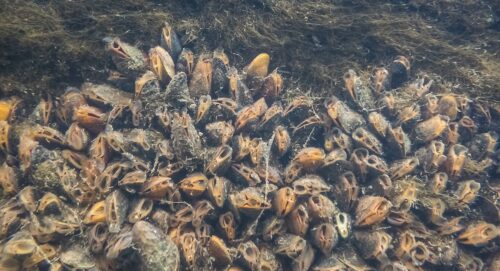
“Invasive golden mussels that have been clogging pipelines throughout the state’s water systems over the past two years may also weaken concrete and cause water quality issues, according to several studies. Westlands Water District Deputy General Manager Kelly Vandergon told the district’s board in September that a study in China showed golden mussel attachment could weaken cement. Vandergon said the study showed that the way the mussel’s byssal threads attach to concrete “essentially loosens that upper surface, allowing water to penetrate deeper into the concrete structure.” The mussels secrete byssal threads, thin strands with adhesive tips, from inside their shells. Vandergon said the concrete issue is “one of the research projects we’re trying to develop for Prop 4 funding, which has not yet been made available by the state.” … ” Read more from SJV Water.
Desalination doesn’t pencil out for Western agriculture
“The Colorado River is one of the most economically important water systems in the West, supporting communities, businesses and some of the nation’s most productive agricultural regions. It also underpins food supply chains Americans depend on most heavily during the winter, when areas such as Yuma, Arizona, and California’s Imperial Valley become major sources of fresh vegetables. At the same time, the basin faces a long-term imbalance between available water and existing demands, intensifying debate over conservation, infrastructure and potential new sources of supply. One option that regularly enters that discussion is ocean desalination. The appeal is easy to understand. Rather than reallocating an existing water supply among users, desalination can create new, drought-resistant freshwater from the ocean. It is already used in communities around the world and could supplement municipal or industrial supplies in parts of the Western U.S. For agriculture, however, the central question is not whether desalination works. It is whether the water it produces can be supplied at a price compatible with commercial food production. On that question, the economics are difficult to overcome. … ” Read more from Farm Bureau Intel.
CV-SALTS maps a path toward long-term salinity management
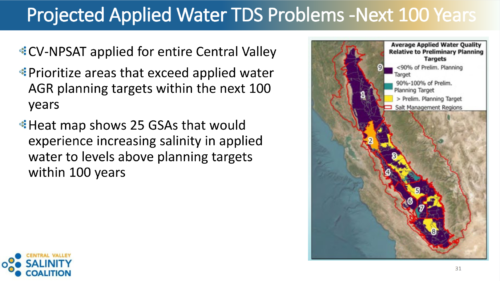 “Salinity is already affecting the Central Valley’s water supplies, agricultural lands, and communities. It has forced the retirement of hundreds of thousands of acres in the Westlands Water District and other areas. In the Tulare Lake Basin, farmers have relied on active evaporation basins and Integrated Farm Drainage Management Systems to capture and contain saline drainage water. However, these interim measures do not provide a valley-wide solution, and a long-term salinity management plan has yet to be implemented. If left unchecked, salt accumulation could impair millions of acres of productive farmland, reduce food production, and constrain the growth of Central Valley communities. At its October 6 meeting, the State Water Board received an update on efforts to address salinity through CV-SALTS, which includes separate salt and nitrate management programs. The presentation focused on the Salt Control Program, a phased effort to manage salinity impacts in surface water and groundwater. Presenters included Angela Cleaver, Central Valley Water Board program manager for the CV-SALTS Salt Control Program; Rachel Gray, executive director of the Central Valley Salinity Coalition; Tom Grovhoug, technical lead for the Salt Control Program; and David Corey, board chair of the Central Valley Salinity Coalition. … ” Read more from Maven’s Notebook.
American Canyon considers scaling back stake in Sites Reservoir
“As the proposed Sites Reservoir project approaches its next design phase, American Canyon officials are considering whether to scale back the city’s planned share to better match lower water-demand forecasts. American Canyon’s $3.6 million upfront investment in the estimated $6.8 billion project gives it access to 25,000 acre-feet of water storage capacity, or 1.8% of the project, to help meet the needs of the fast-growing city. During the City Council’s Oct. 20 meeting, City Manager Jason Holley and Phil Brun, a management aide for special projects, discussed the benefits the project could bring to the city in addressing current and future water needs. “For years, we struggled with not having enough water storage and not being able to control our own destiny,” Holley said. … ” Read more from the Napa Register.
SEE ALSO: American Canyon Weighs Shrinking Its $177M Sites Reservoir Stake, from Hoodline
In California, a $40 water bill became $3,700 — and officials found 900 faulty meters
“Residents in Fowler, California, were left shocked and confused after receiving unreasonably high water bills. According to FOX26, city leaders said at a meeting that they had been receiving complaints about bills, with residents challenging whether the charges matched the water they had actually used. Mayor Juan Mejia said faulty antennas and meters that the city never got around to replacing appeared to be driving the billing issues. The problems occurred in roughly 900 meters, affecting both residents and commercial business customers. For example, Sophia Suarez’s water bill showed more than $3,700, but the Fresno County resident typically pays less than $40 a month. “So as you can tell, I almost had a heart attack,” Suarez said. … ” Read more from The Cool Down.
Securing California’s flood-resilient future amid political and climate-driven storms
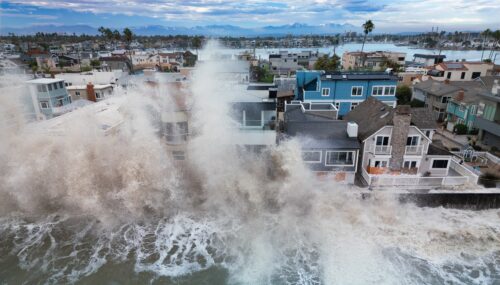
“A record-breaking El Niño winter and the potential loss or weakening of federal disaster management services are among the factors that could determine whether Californians face catastrophic floods this winter and beyond. A report released today from the Securing California’s Flood Future, or SCFF, panel outlines what California needs to consider for a durable and resilient flood future in the face of such disturbances. “Whereas we will emerge from this El Niño next spring — wet or dry — the potential damage to U.S. flood-management and disaster-management institutions may take much longer to repair,” said panel co-chair Nicholas Pinter, a professor with the UC Davis Center for Watershed Sciences and the Earth and Planetary Sciences department. “But political crises, like natural disasters themselves, open windows of opportunity for change. California possesses significant strengths on which to build.” … ” Read more from UC Davis.
Ski season forecast: Where El Niño could bring the best snow this winter
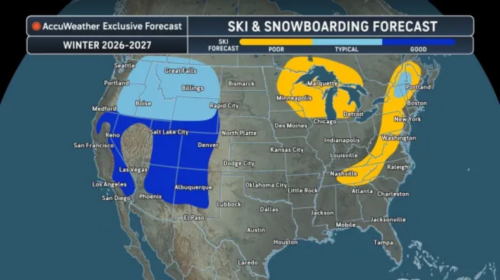 “Skiers and snowboarders are gearing up to hit the slopes, and AccuWeather forecasters say the upcoming season could look dramatically different from last winter across much of the country. El Niño is expected to be the main driver of this winter’s weather pattern, favoring more frequent storms in some of the nation’s most popular ski regions. Elsewhere, prolonged warmth and fewer snowstorms could make it harder for resorts to build and maintain a reliable snowpack. … The ski season could get off to an early start from the Sierra Nevada through the central and southern Rockies, setting the stage for a winter with frequent snow and excellent conditions on the slopes. Some ski resorts in Colorado are already open, including Arapahoe Basin Ski Area. This El Niño-fueled pattern will be a significant turnaround from last season. Salt Lake City measured only 3.7 inches of snow last winter, its least snowy season since records began in the 1880s. AccuWeather is forecasting 50-65 inches this winter, slightly above the historical average. The best ski conditions across the entire country are expected in Colorado, New Mexico, Utah, Arizona, California and Nevada. … ” Read more from AccuWeather.
California has a plan for El Niño’s torrential rain: Save it for later
 “Something ominous just hit California: rain. The life-giving water that normally hydrates people and crops brings an aura of dread this autumn, thanks to the strongest El Niño ever recorded. While the phenomenon causes severe drought and heat in many parts of the world, historically it’s brought extraordinary rainfall to the Golden State. The monstrous El Niño of 1997 and 1998, for instance, caused widespread flooding and debris flows (made not just of water and dirt, but big chunks of rock), destroying property and killing residents. The state can’t stop rain from falling, so in the last few decades it has been renegotiating its relationship with precipitation. As climate change makes California whiplash from years of intense drought to years of intense rain, water agencies have been capturing as much H2O as they can to reduce reliance on using canals to bring it in from afar. That’s set the state up to avoid at least some flooding as this El Niño takes hold and bank the bounty for the dry spells to come. “Heavy storms can affect regional infrastructure, construction schedules, and areas vulnerable to debris flow or power disruptions,” said a spokesperson with the Los Angeles Department of Water and Power in a statement provided to Grist. “However, these rain events also present a significant opportunity. Stormwater capture is a critical pillar of LADWP’s long-term plan to reduce reliance on purchased imported water.” … ” Read more from Grist.
Fresh as the microplastic-laden Sierra snow

“For the first time, UC Riverside scientists have measured how much microplastic pollution falls on the Sierra Nevada during snowstorms and were surprised to find significant amounts even in the most remote locations. Lead researcher Aleksandra Karapetrova, a UCR environmental toxicologist, could not access any of the snowfall collection sites by car or even on foot. She expected plastic to be harder to find or even nonexistent in at least a few of these locations, given their distance from human activity. “One site was accessed by chairlift. I had to ski to the rest of the remote sites. That’s how isolated they are,” Karapetrova said. “But no matter how far out the site, I always found microplastics there.” … ” Read more from UC Riverside.
The quiet collapse of America’s refuges
“Scan almost any corner of a U.S. map, and you’ll find a National Wildlife Refuge. In the far north, there’s the Arctic National Wildlife Refuge, a swath of Alaska protecting some of the nation’s remaining caribou herds, chunky salmon, and Arctic grayling. Glance southeast to find the 160,000-acre White River National Wildlife Refuge splashed across Arkansas with its bottomland forest and unparalleled waterfowl hunting. Head north again to see the John Heinz National Wildlife Refuge outside Philadelphia, offering a mentored white-tailed deer archery season on the edge of eight-lane Interstate 95. Then look West to find the tiny Mortenson Lake National Wildlife Refuge in Wyoming, one of the only places where the critically endangered Wyoming toad still croaks its mournful mating call. Chances are most people can only name a few of the nation’s more than 570 refuges, but the spaces carry an outsized importance in conserving not only endangered species like red wolves and whooping cranes but also the ducks, geese, elk, black bears, and white-tailed deer so many of us spend weeks or months of the year chasing. Unfortunately for the creatures who depend on those oases for places to eat, sleep, and raise their young, the wildlife refuge system is in a crisis like never before. … ” Read more from Re:public.
In commentary this week …
Editorial: Dam report underscores California’s poor priorities
The Southern California News Group editorial board writes, “Even as California’s government spends record levels each year, it does a terrible job maintaining and improving its basic infrastructure. The latest evidence is chilling. A report by the State Auditor finds “there are now 57 dams in poor or unsatisfactory condition, including 40 that have hazard classifications of high or extremely high.” It’s a big problem as we face an El Niño winter. We needn’t go far back into the past to understand what this could mean for California residents. In 2017, the Feather River Basin in northern California received an entire year’s worth of rain in January and February, thus overwhelming the Oroville Dam’s main spillway. After concerns about the integrity of the emergency spillway, local officials evacuated 188,000 people. The state’s system of dams is crucial not only in providing water to the state’s residents, but is crucial in protecting against massive floods. It’s imperative that this infrastructure be maintained, yet lawmakers rarely think about this crucial system until there’s a catastrophe. … ” Read more from the OC Register.
In regional water news this week …
Ukiah vineyard floats 252 solar panels on its irrigation pond
“The new solar panels at Nelson Family Vineyards don’t take up any farmland. All 252 float on the irrigation pond. “There’s nothing fancy about it. It’s just a bunch of solar panels, but they’re floating. And that makes it really, really cool,” owner Tyler Nelson said Friday. “It’s kind of fun to watch, and I love the electricity bill.” The pond array is the farm’s second. Together with older panels on the winery roof, the two now cover all the power on the ranch, Nelson said. When the family first priced the project, it was expected to save about $30,000 a year, he said. It took the family about three years to finally commit. By the time it was finished, PG&E rate increases had pushed the estimated savings to about $80,000 a year. … ” Read more from the Mendocino Voice.
Salmon habitat project along Sacramento River to improve access on and off Red Bluff floodplain
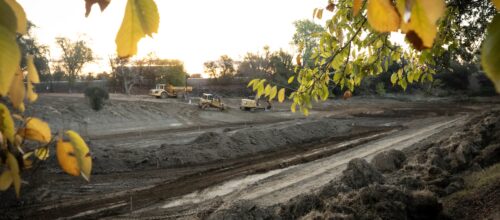 “A three-acre floodplain along the Sacramento River that has become attractive for native fish to rest and feed is receiving a critical redesign to help reduce the number of juvenile salmon and steelhead trout that end up stranded with no way back to the river once water levels recede. A coalition of farmers, cities and water districts, known as the Sacramento River Settlement Contractors, has teamed up with local, state and federal agencies to reshape a former boat harbor at the Red Bluff Elks Lodge. The project will allow the area to flood more frequently, which will provide young salmon and steelhead with a place to feed, grow and find refuge. The project will also allow for volitional passage, which means the fish will have the freedom to leave the floodplain when they are ready to continue their downstream migration. “Our native fish don’t recognize property lines or agency boundaries, so improving their migration takes collaboration across the entire Sacramento River Basin,” said Jeff Sutton, Glenn-Colusa Irrigation District General Manager and a member of the Sacramento River Settlement Contractors. “This project shows what we can accomplish when water users, landowners, scientists, fishermen and agencies work together to give young salmon and steelhead better access to productive habitat and a safer route downstream.” … ” Continue reading this press release.
Fish Creek pumped storage project: What it is, why SYRCL is concerned
“Just minutes from the town of Washington, Fish Creek begins on ridgetops high above the South Yuba River near the White Cloud Campground. It flows 1.5 miles north through forests near Lupine Point and into a narrow canyon until it meets the Wild and Scenic South Yuba River. Now, a company formed just this past spring, wants to dam it. RamaFlux Sierra PSH, LLC has asked the Federal Energy Regulatory Commission (FERC) for a two-year permit to study a 750-megawatt (MW) “pumped storage” power plant on Fish Creek. The plan would put one dam and a reservoir on the creek, 200 vertical feet above where it meets the South Yuba, and build a second reservoir high on the ridge near Jefferson Creek. … ” Read more from the South Yuba River Citizens League.
Why Folsom reservoir storage matters heading into an El Niño winter
“This summer, water managers across the Sacramento region were watching Folsom Reservoir closely. Early projections suggested summer operations might leave storage below the Water Forum’s 300,000-acre-foot (AF) end-of-December planning minimum, raising concerns about how the region would fare if the coming winter was dry. The planning minimum provides a safeguard for protecting regional water supplies and the health of the lower American River heading into a potentially dry year. Fortunately, conditions have improved. Folsom Reservoir ended the 2026 water year on September 30 with 444,000 AF in storage and is on track to stay above the 300,000 AF planning threshold through the end of the calendar year. The stronger-than-expected storage provides a cushion for regional water supplies and the lower American River in the months ahead, even as a very strong El Niño increases the likelihood of a wetter-than-average winter. … ” Read more from the Water Forum.
Cosumnes River Preserve: A special place that cranes adore
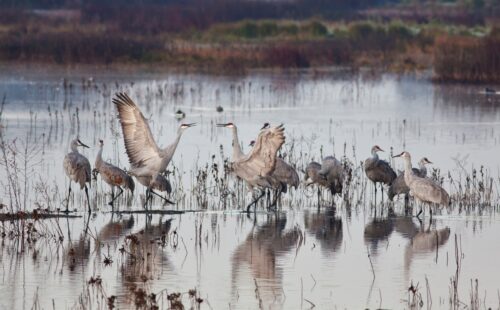
“It’s dusk on a winter’s day. Coming from the red-rimmed horizon, a primordial trumpeting grows more distinct and louder as the silhouettes of sandhill cranes materialize in undulating waves overhead. The present time, visited by the ancient past. The ducks and geese settled on the marsh for the night and continued dabbling and preening. The ruffled water reflects the dying yellow light stenciled with the incoming flocks of cranes. Long legs pivot forward and down; wings backstroke; the cranes, bugling loudly, land gingerly on mudflats, their momentum carrying them forward one or two prancing hops. Enough light remains for passersby to just discern the pearlescent gray of their plumage and the swatch of red at their crowns. This is the Cosumnes River and its wetlands. … ” Read more from the Marin Independent Journal.
Monterey: In the midst of a legal battle, Cal Am seeks to raise desalination project cost cap by 3.5.
“It’s been roughly eight years since California-American Water provided an estimate of how much it would cost to build a desalination project it argues would address the long-term water supply constraints plaguing the Monterey Peninsula. In 2018, that estimate was $239 million, a figure that has continued to be quoted in project plans as inflation, labor and material costs have been on the rise. In an application filed with the California Public Utilities Commission on Oct. 23, Cal Am has updated its estimate to $825 million, roughly 3.5 times more than the amount the CPUC approved in 2018. In its CPUC filing, the company says the desal project’s current estimate covers only Phase 1, which would produce 4.8 million gallons per day (mgd), 25-percent less than the 6.4mgd project proposed in 2018. The project is intended to be sized for future expansion to 6.4mgd, but the cost associated with that expansion hasn’t yet been estimated, and would hinge on whether there is additional future demand for water. … ” Read more from Monterey County Now.
Boeing’s demolition of a SoCal nuclear testing facility has nearby families worried about cancer
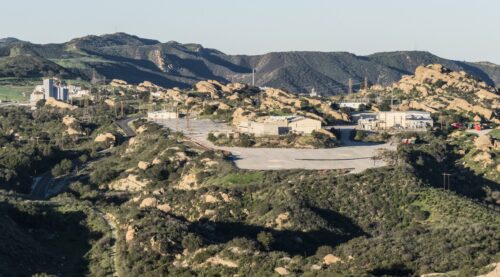 “Boeing has almost completed the demolition of five buildings at its infamous Santa Susana Field Laboratory in Southern California, even as concerns mount among nearby families about potential health harms. The buildings at the former Rocketdyne facility—where one of the worst nuclear meltdowns in U.S. history took place in 1959—were once used for Cold War-era nuclear energy research. Larry Yee, the former chair of the LA Regional Water Quality Control Board, on Wednesday called the site “a mini Chernobyl in our backyard.” Despite a groundswell of concerns about the process, the SSFL demolition at the lab between Simi Valley and Los Angeles began in late September. Four of the five buildings slated for demolition, all of which have sat unused for over 15 years, according to Boeing, have been brought down so far. The fifth demolition, at a site where more than 50 structures once stood, is slated to be completed this year. Among the already leveled structures is “Building 55,” known in its heyday as the Nuclear Materials Development Facility, which for decades was a storage, handling and processing facility for “unspent fuel rods,” explained local historian William Preston Bowling. “So they took fuel rods from all reactors from across the nation and took them to the Santa Susanna Field Laboratory and had them de-cladded and repurposed and shipped off for disposal at other sites,” Bowling said. … ” Read more from Inside Climate News.
San Bernardino County partnership with Cadiz affiliate renews water pipeline fears
“San Bernardino County has partnered with a Cadiz Inc. affiliate to establish a public financing authority that could advance the company’s controversial Mojave Desert groundwater pipeline project, which has faced years of environmental opposition and litigation. The San Bernardino Water and Power Authority announced its formation Monday, Oct. 19, following an inaugural meeting on Oct. 5. The county Board of Supervisors unanimously approved the joint powers agreement with Fenner Gap Mutual Water Co., the Cadiz affiliate, on April 21. The partnership marks another potentially significant development for Cadiz, which has spent decades trying to bring its groundwater in the Cadiz and Fenner valleys, near Amboy, to Southern California communities despite fears that pumping could dry up natural springs and damage fragile desert ecosystems. … ” Read more from the San Bernardino Sun.
Is the nuclear waste at San Onofre safe from high tides and El Niño?
“Forecasters warn of coastal flooding and high tides in Southern California, but officials at Southern California Edison say dozens of stored canisters containing nuclear waste at the now-shuttered San Onofre Nuclear Generating Station pose no public safety threats — even if rainfall in the coming months is heavier than expected. But longtime critics of the plant, which is in the midst of an eight-year dismantlement project, say they are not reassured. The National Weather Service has issued a Coastal Flood Advisory for San Diego and Orange counties through noon Friday, with high tides expected to crest near 7.25 feet. “It’s definitely seasonal,” said Adam Roser, meteorologist at the San Diego office of the weather service. “We see these higher tides every late fall into winter, but this year we have warmer than average water temperatures.” … ” Read more from the San Diego Union-Tribune.

