
New modeling identifies areas at risk and lays the groundwork for long-term management solutions
Salinity is already affecting the Central Valley’s water supplies, agricultural lands, and communities. It has forced the retirement of hundreds of thousands of acres in the Westlands Water District and other areas. In the Tulare Lake Basin, farmers have relied on active evaporation basins and Integrated Farm Drainage Management Systems to capture and contain saline drainage water. However, these interim measures do not provide a valley-wide solution, and a long-term salinity management plan has yet to be implemented. If left unchecked, salt accumulation could impair millions of acres of productive farmland, reduce food production, and constrain the growth of Central Valley communities.
At its October 6 meeting, the State Water Board received an update on efforts to address salinity through CV-SALTS, which includes separate salt and nitrate management programs. The presentation focused on the Salt Control Program, a phased effort to manage salinity impacts in surface water and groundwater. Presenters included Angela Cleaver, Central Valley Water Board program manager for the CV-SALTS Salt Control Program; Rachel Gray, executive director of the Central Valley Salinity Coalition; Tom Grovhoug, technical lead for the Salt Control Program; and David Corey, board chair of the Central Valley Salinity Coalition.
“Salt really is, for the Central Valley, a long-term limiting factor for agriculture,” said Patrick Pulupa, executive officer of the Central Valley Regional Water Quality Control Board. “We really have to figure out whether this is going to be the generation that solves the salt problem for the Central Valley. The can has been kicked down the road with the advent of the wells that initially came in, with the advent of the water projects. All of them acknowledged that there would be this salinity issue that would gradually impair millions of productive agricultural acres in the Central Valley, and without figuring out a way to manage that effectively, we would be shutting down major food production and acting as a limitation on the growth of municipalities and communities in the Central Valley.”
Salt Control Program
The Salt Control Program offers two permitting pathways. The conservative pathway applies traditional, permittee-specific limits to protect beneficial uses, while the alternative pathway requires participation in a collective effort to fund the program.
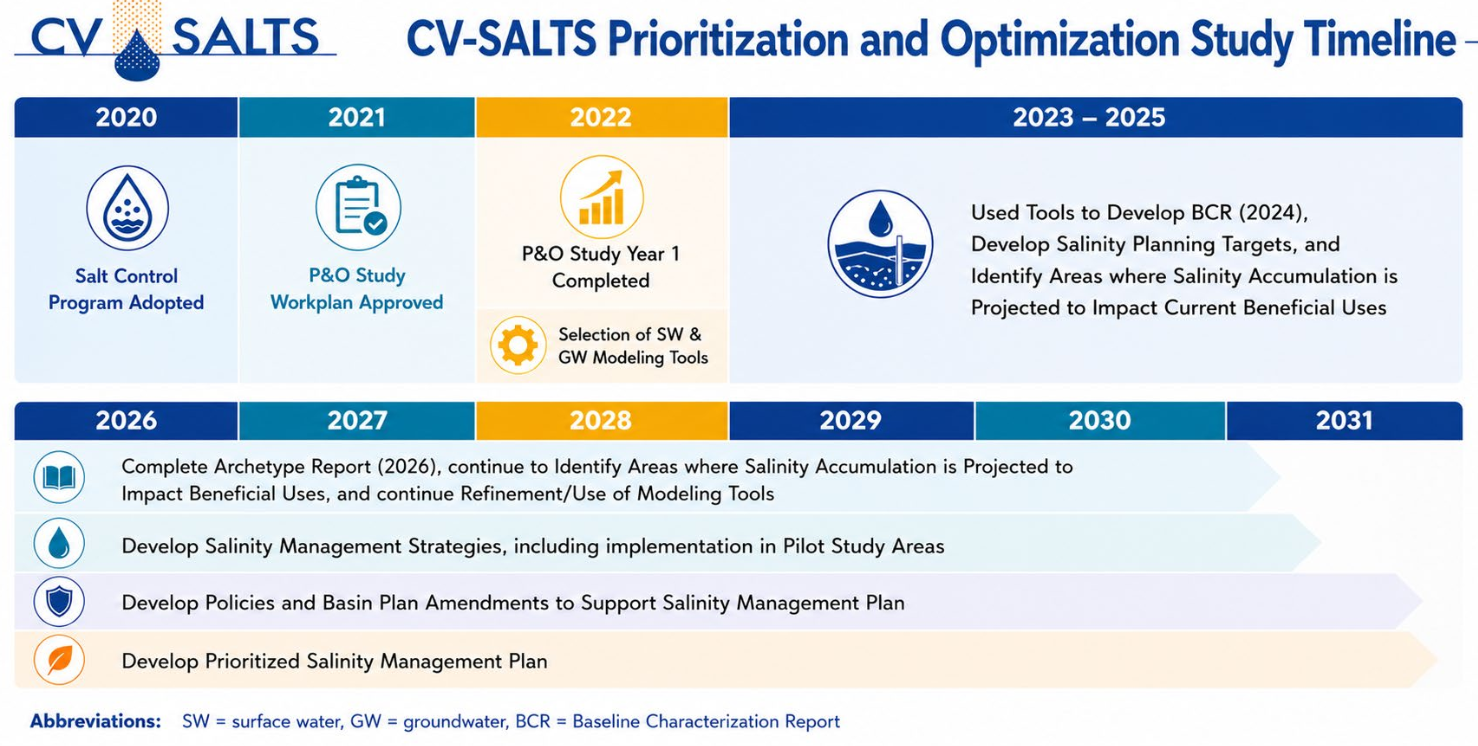
The program is structured in three phases of approximately 10 to 15 years each. Phase One, now in its fifth year and expected to continue through 2031, consists of the P&O study, which identifies salt-sensitive areas, evaluates salt sources, impacts, and management options, and develops long-term strategies. Its findings will guide Phases Two and Three.
Phase Two is expected to begin around 2032 and will focus on developing preferred projects, completing engineering design and environmental review, and securing implementation funding. Potential regulatory actions include basin plan amendments to readopt permitting approaches and policies or revise beneficial-use designations for future salt management areas.
Phase Three is expected to begin around 2042 and will focus on constructing and implementing the selected projects.
Participation and enforcement
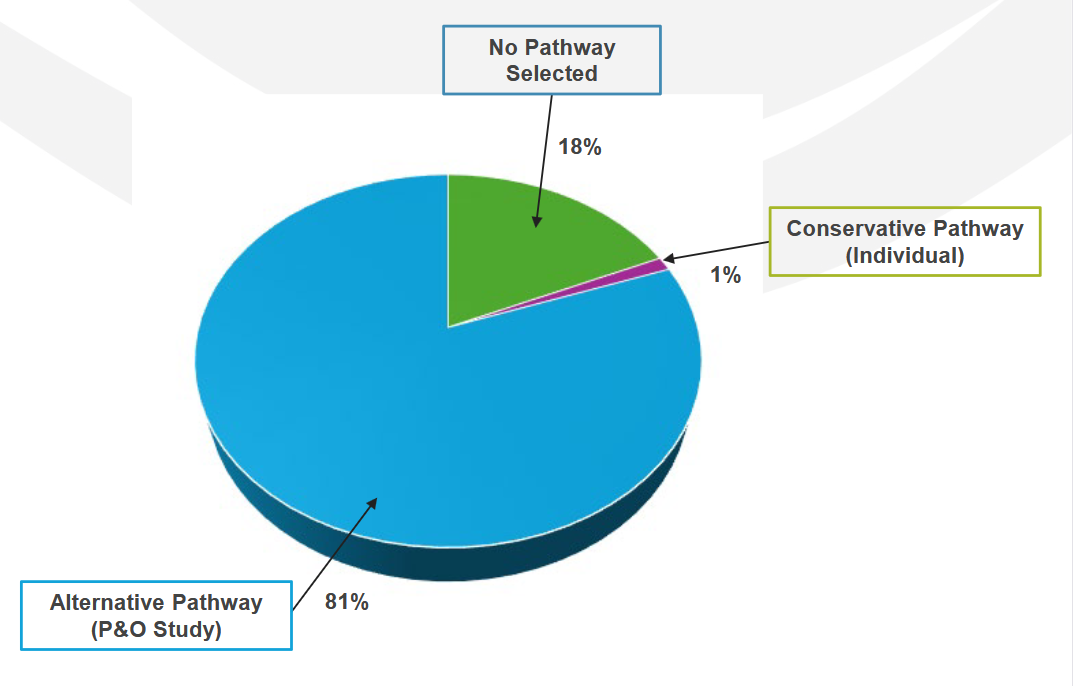 In January 2021, the Central Valley Water Board sent notices to comply to all permitted salt dischargers in the region. The board continues to enroll new dischargers in the Salt Control Program as permit applications are submitted. As of September 2026, the program included 3,030 active permittees, approximately 2,500 of whom were compliant with a selected pathway. Most permittees—81%—selected the alternative permitting pathway and support the P&O study. Another 1% selected the conservative pathway. The remaining 18% were not compliant because they had not selected a pathway or had enrolled in the P&O study but were not current on required financial contributions.
The map shows permittees participating in the Salt Control Program. Dark blue triangles identify permittees in the conservative pathway, most of which are NPDES facilities. Light green circles identify permittees in the alternative pathway that support the P&O study. The shaded areas represent the 14 Irrigated Lands Regulatory Program coalitions that also support the study.
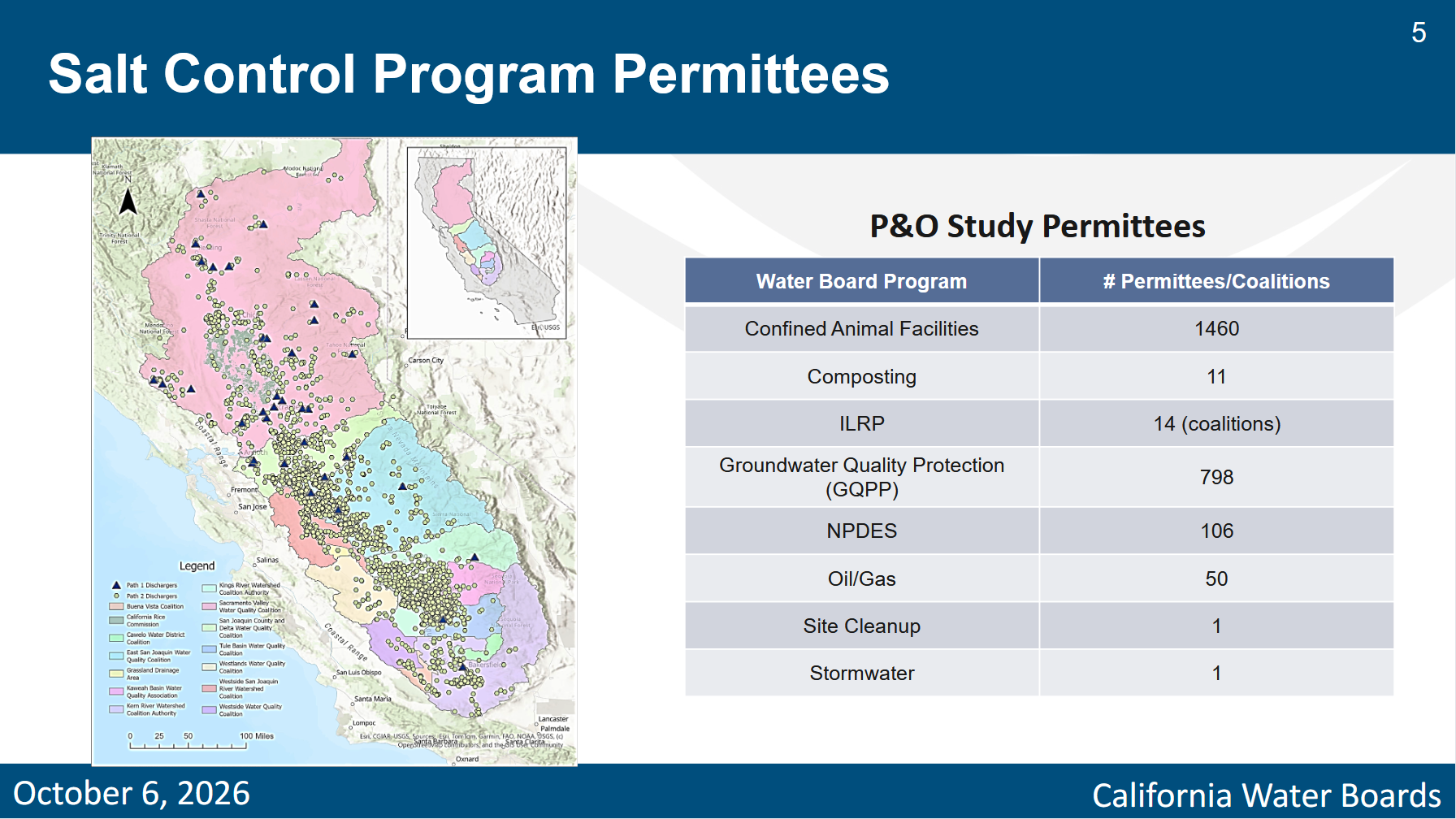
The table on the upper right further categorizes P&O study permittees by Central Valley Water Board program. These programs include confined animal facilities, composting facilities, Irrigated Lands Regulatory Program coalitions, Groundwater Quality Protection Program facilities, NPDES facilities, and oil and gas facilities. The Groundwater Quality Protection Program covers facilities with permitted waste discharges to land that could affect groundwater but are not regulated under California Code of Regulations, Title 27—the land-disposal rules formerly contained in Chapter 15. For that reason, these operations were historically called “Non-15” facilities. A small number of participating facilities are also associated with the site cleanup and stormwater programs.
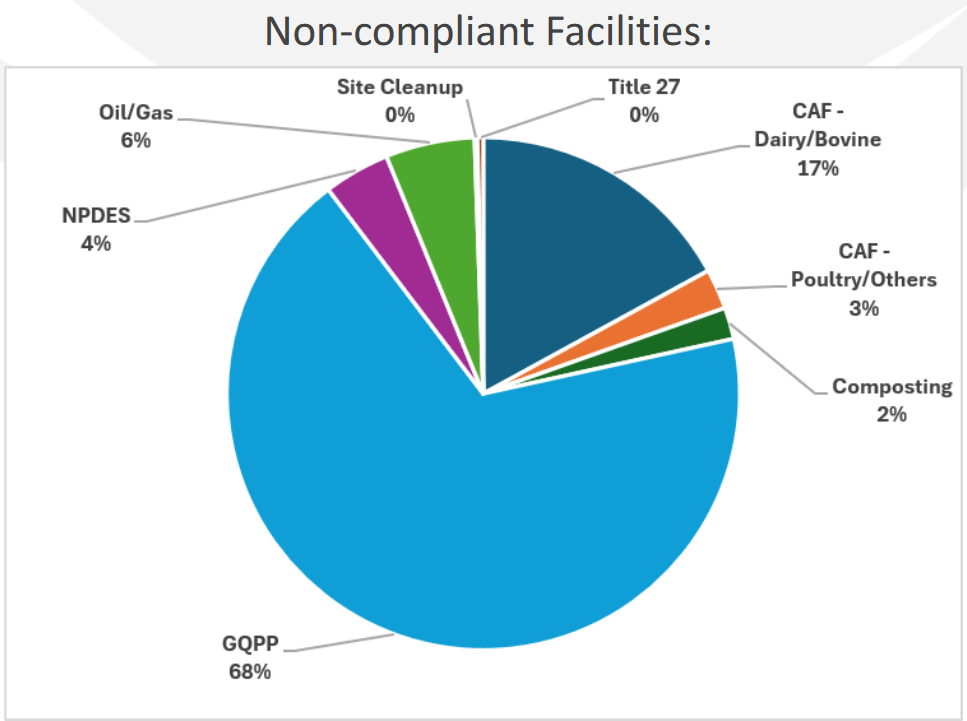 As of September 2026, 553 facilities were considered noncompliant with the Salt Control Program. The figure on the right shows the proportion of noncompliant permittees within each Central Valley Water Board program. A substantial share of the noncompliant facilities are in the Groundwater Quality Protection Program.
The Central Valley Water Board’s compliance and enforcement program continues to support CV-SALTS implementation by addressing permittees that did not respond to the initial notices to comply or have not paid annual program fees. Under the direction of the new enforcement program manager, the board is implementing a CV-SALTS compliance initiative during the current fiscal year. Program managers are coordinating enforcement strategies, with initial efforts focused on permittees in the Groundwater Quality Protection Program. Permittees in the Confined Animal Facilities Program that did not respond to the 2021 notice to comply are also a priority, and formal enforcement actions are being developed.
Phase One progress report
The Central Valley Salinity Coalition administers the CV-SALTS program. Participants include irrigated agriculture, dairies, small communities, publicly owned treatment works (POTWs), cities, food processors, oil and gas operators, wineries, and other sectors working with the Central Valley Water Board to implement the Salt Control Program.
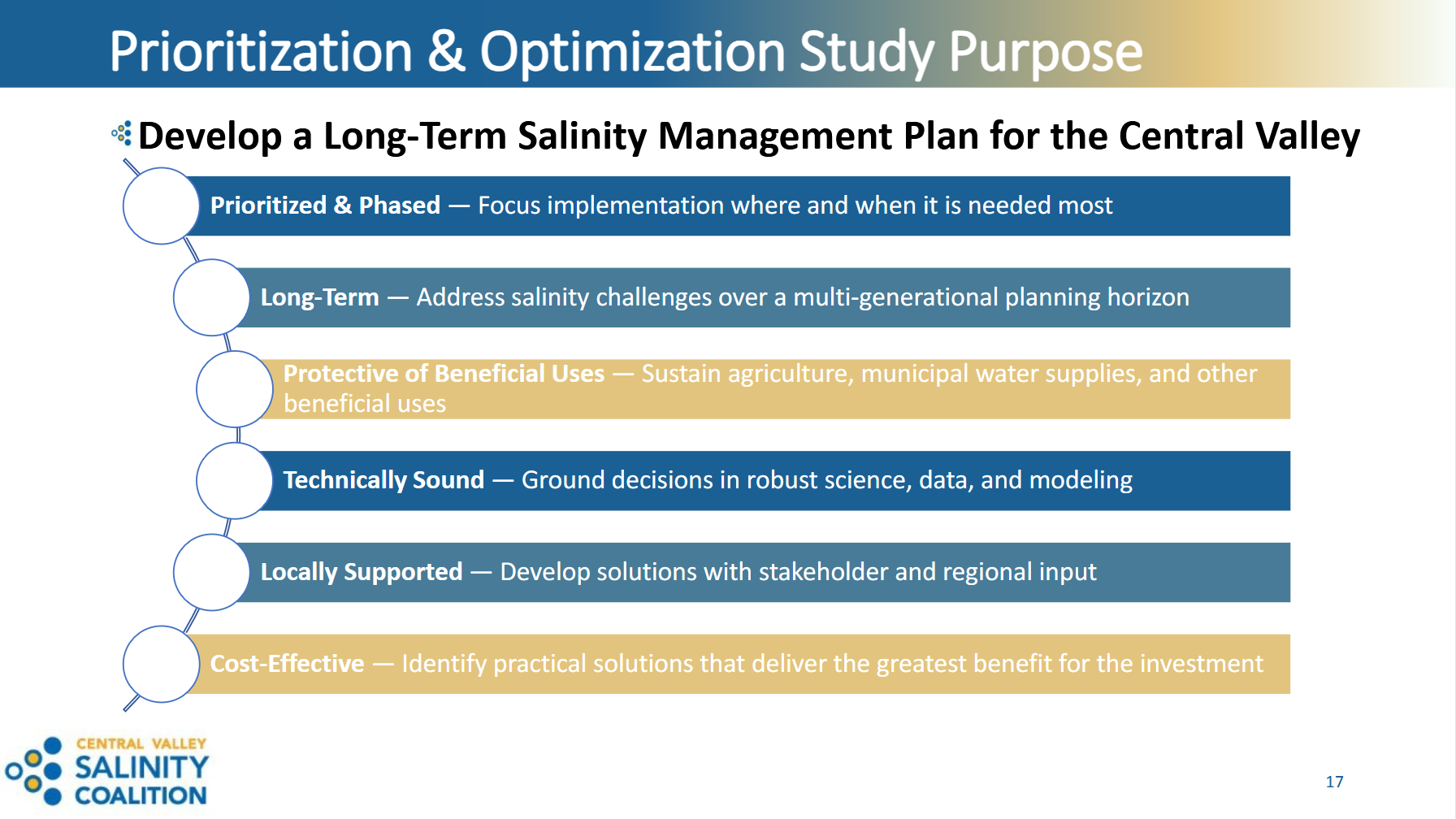 “The CV-SALTS vision is to work to maintain reliable, high-quality drinking water supplies, protect and enhance the local environment, sustain the valley’s lifestyle, support regional economic growth for the people who live here, and retain a world-class agricultural economy, which provides 25% of our nation’s food,” said Rachel Gray, executive director of the Central Valley Salinity Coalition.
The Phase One P&O study is developing a comprehensive salinity management plan for the Central Valley. The study will identify where salinity is accumulating, determine when solutions may be needed, and provide a roadmap for long-term salt management in the region’s water supplies.
“We’re looking at protecting the current beneficial uses of water into the future, ensuring that the work that we do is technically sound and that, whatever our solutions are, they’re implementable, cost-effective, and locally supported as we work with our locals and the GSAs,” said Ms. Gray.
Phase 1 2025 accomplishments
Tom Grovhoug, co-technical lead for the Central Valley Salinity Coalition, presented an update on the Phase One technical work. He reviewed the development of the program’s modeling tools and salinity planning targets, findings from the archetype analyses, work completed in 2025, and ongoing efforts to identify areas at risk and evaluate potential management solutions.
Development of the modeling tools began in 2022 with the selection of the Central Valley Soil and Water Assessment Tool (CV SWAT) for watershed modeling and the Central Valley Nonpoint Source Assessment Toolbox (CVNPSAT) for groundwater modeling. The 2024 Baseline Characterization Report documented current conditions and quantified salt sources, providing data that were then incorporated into the modeling tools.
“That created a great foundation for us to understand,” said Mr. Grovhoug. “We’re focused on salt, but what we really need to understand is water and the water resource picture as well to be able to understand salt.”
In 2024, work began to develop salinity planning targets—metrics used to assess the conditions needed to protect existing beneficial uses in the Central Valley. The targets were developed through an archetype approach that analyzes representative areas to create methods applicable across the Central Valley.
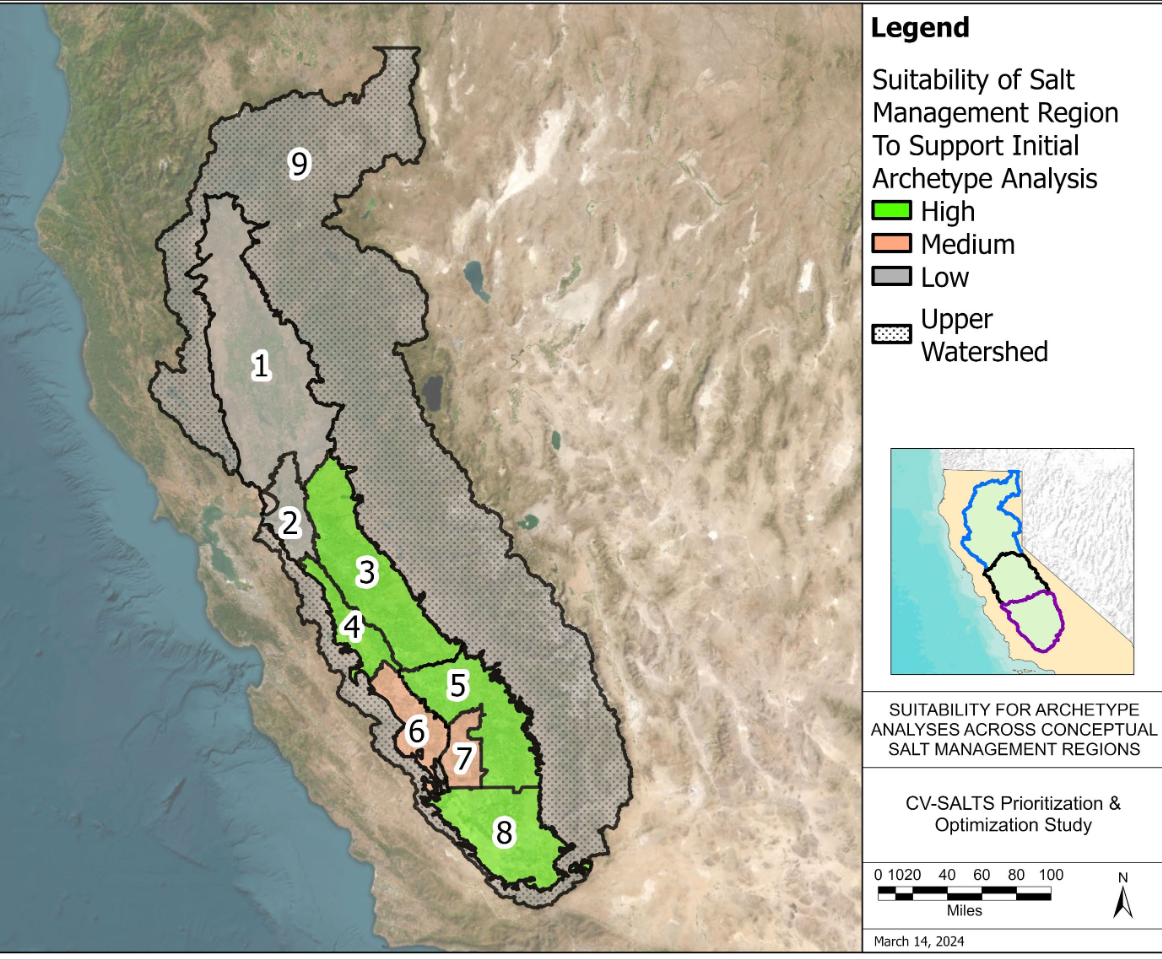 The approach began with one archetype and then applied lessons from that analysis to a second archetype, providing a basis for developing salinity planning targets across the Central Valley. During 2024 and 2025, the team developed a methodology for setting targets that protect salt-sensitive crops and drinking water uses; the selection process and findings are documented in the archetype report.
The Central Valley was divided into nine zones to reflect regional differences: eight cover distinct areas of the valley floor, while the ninth includes watersheds draining from the Coast Range and Sierra Nevada. Groundwater sustainability agencies (GSAs) were consulted during the archetype selection process because of their role in developing local groundwater sustainability plans. Their local knowledge and expertise informed the analysis. Ultimately, the Delta-Mendota area on the west side of the San Joaquin Valley and the western Kings area in the Tulare Lake Basin were selected as the two archetypes.
Archetype results and salinity planning targets
The Delta-Mendota archetype was divided into subareas to account for spatial differences within the region.
The graphic shows the northern portion of the Delta-Mendota archetype. Box-and-whisker plots on the left present modeling results for three water districts in the Delta-Mendota Subbasin under current conditions, business-as-usual conditions in 100 years, and severe climate change.
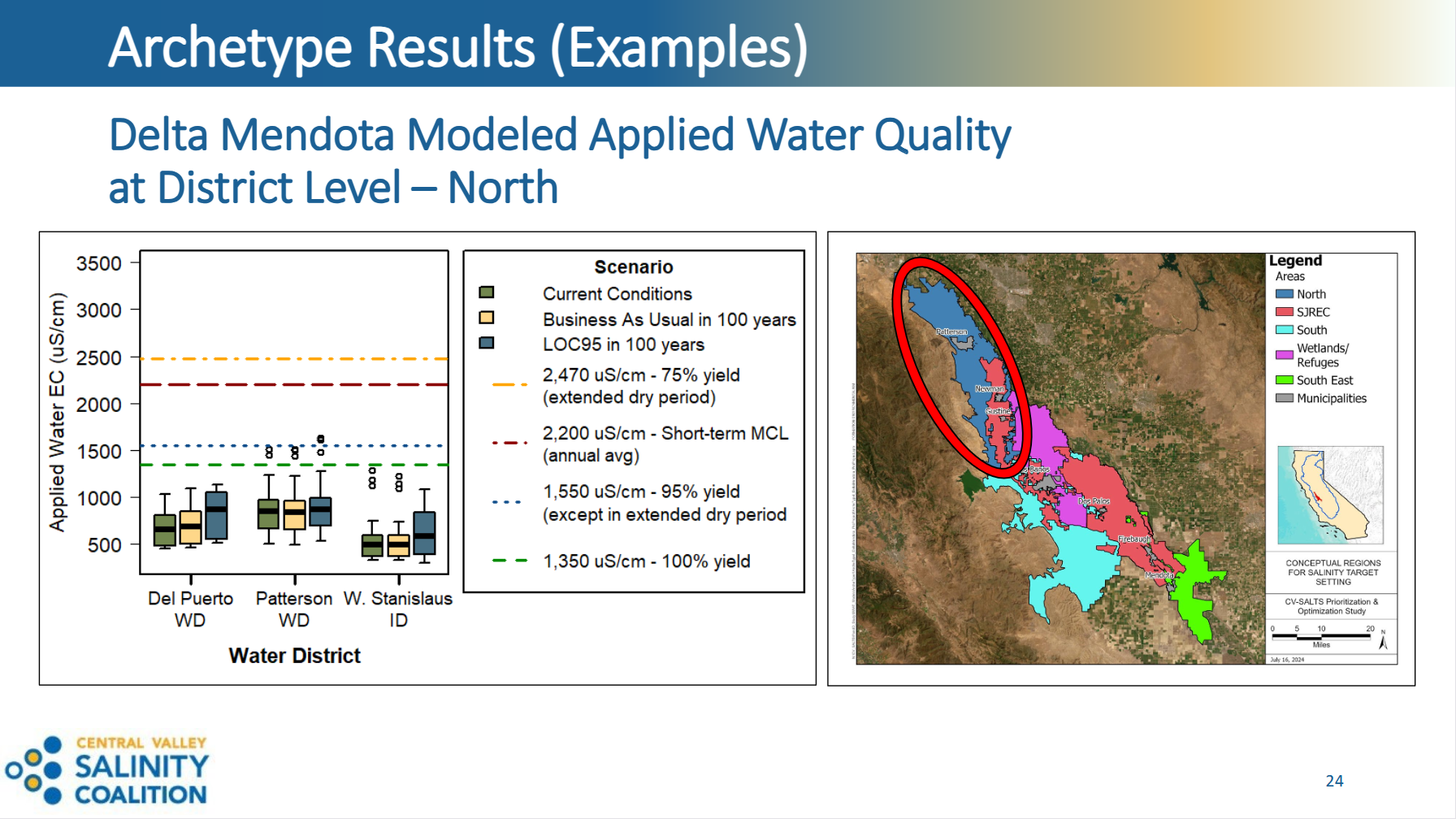
Applied water quality reflects the blend of surface water and groundwater used to irrigate crops in the area, based on stakeholder input and modeling. The dashed lines show salinity targets. The lowest green line represents the salinity level associated with 100% almond yield, while that line and the 95% yield line at 1,550 represent normal-year planning targets. The two upper dashed lines represent targets for drought and extended dry periods.
“So, our takeaway from this was that during normal years, we were not predicting a problem in this area because there’s quite a bit of surface water that’s used here,” said Mr. Grovhoug.
A similar analysis for the western Kings Subbasin (below) shows groundwater conditions. CVNPSAT estimates the average quality of water pumped from wells in this part of the valley, allowing comparison of current climate conditions with a more extreme climate scenario.
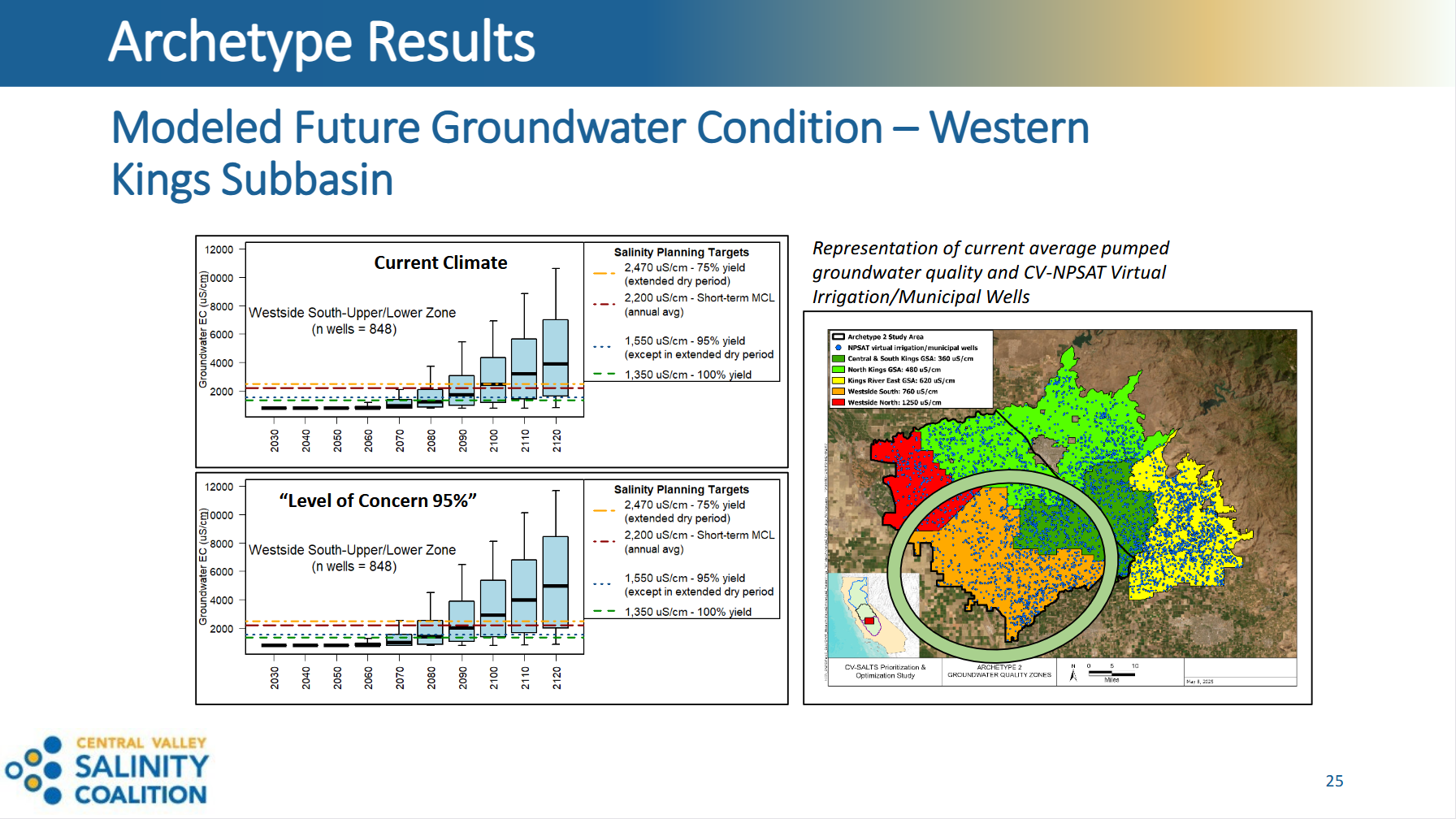
“So, in this area, just looking at groundwater and what’s predicted to come out of wells, this is an area where we are predicting problems into the future,” said Mr. Grovhoug.
A similar analysis of a less groundwater-dependent area within the same archetype (below), where surface water supplies are more available, did not project a future salinity problem.
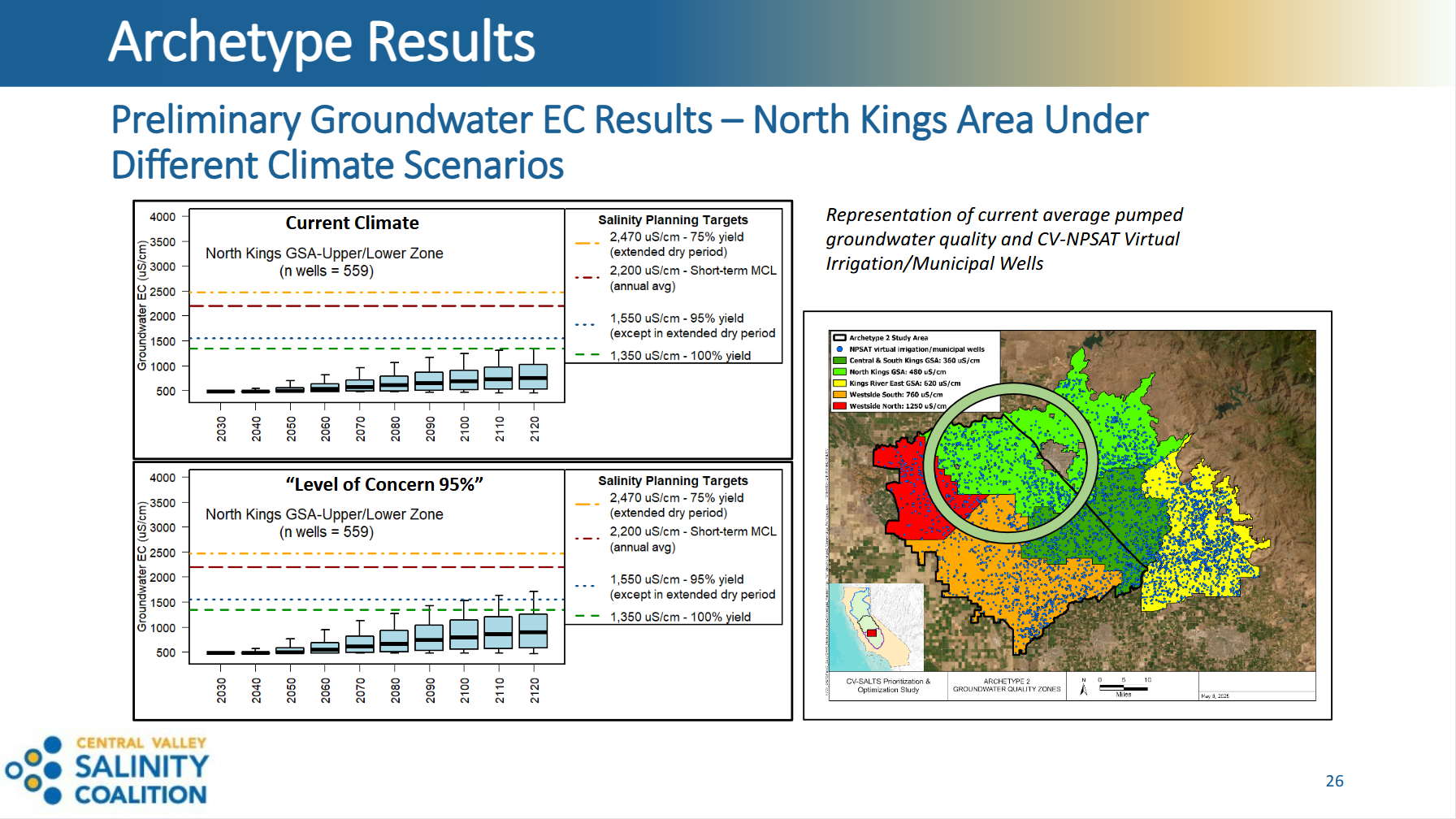
“So, all this is to say that what we did in our two archetypes was come up with a methodology to be able to do these 100-year projections of problem development in the valley,” said Tom Grovhoug.
The archetype analyses demonstrated the importance of working with local stakeholders, water districts, water managers, and GSAs to refine the models and accurately represent local conditions. They also showed the need to focus on applied water and account for the combined use of surface water and groundwater across seasons and water-year types. The work produced methods and tools for projecting future conditions.
The modeling teams then extrapolated findings from the archetype areas across the Central Valley. The analysis considered regional salt-sensitive crops and climate differences, including wetter conditions in the north and drier conditions in the south. The table on the left shows how salinity planning targets vary by location and crop type.
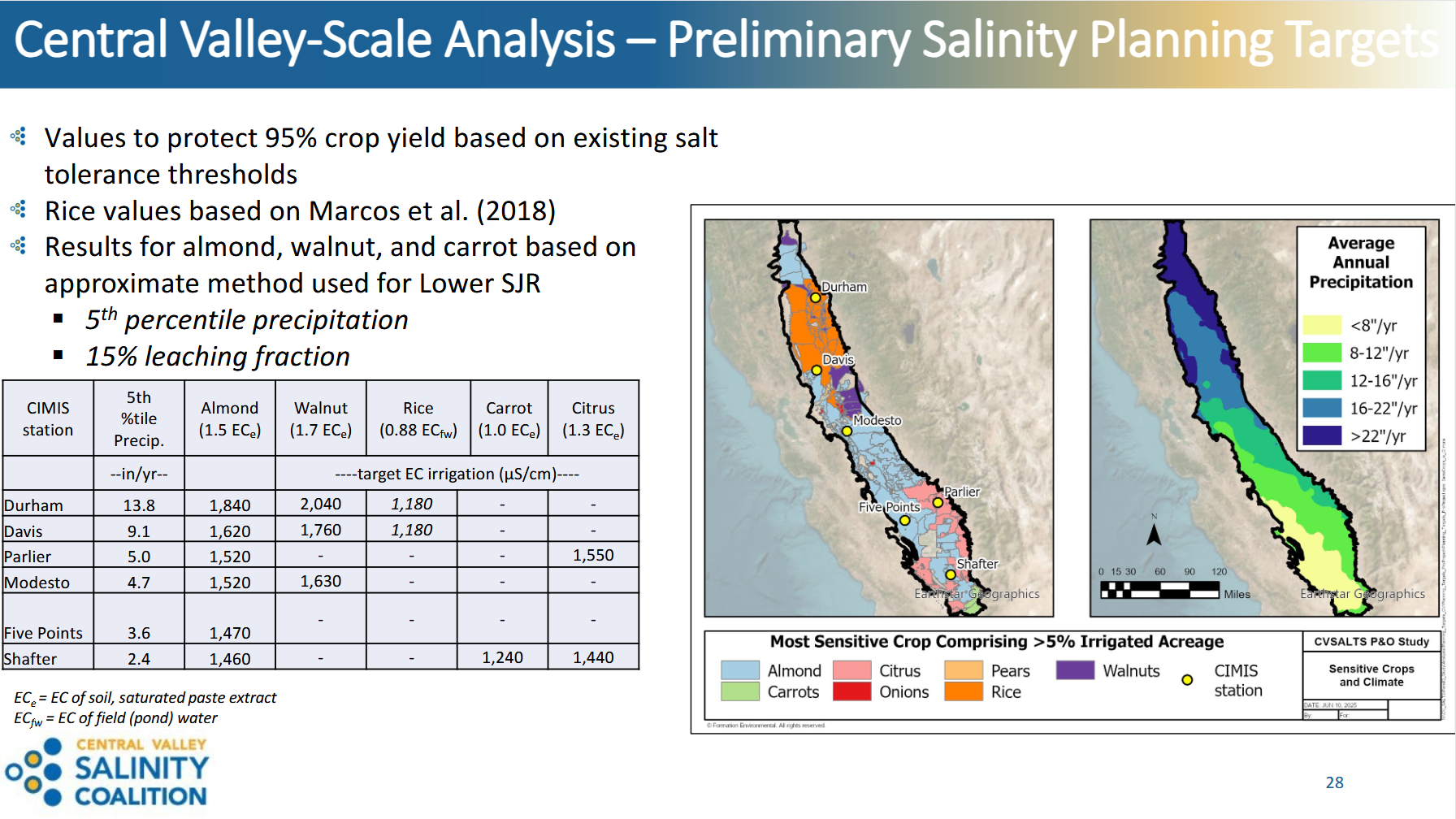
“So, we were very pleasantly surprised that we were able to use our tools to take us to this level of being able to do a Central Valley-scale prediction of problems,” said Mr. Grovhoug.
2026 ongoing Phase 1 technical work
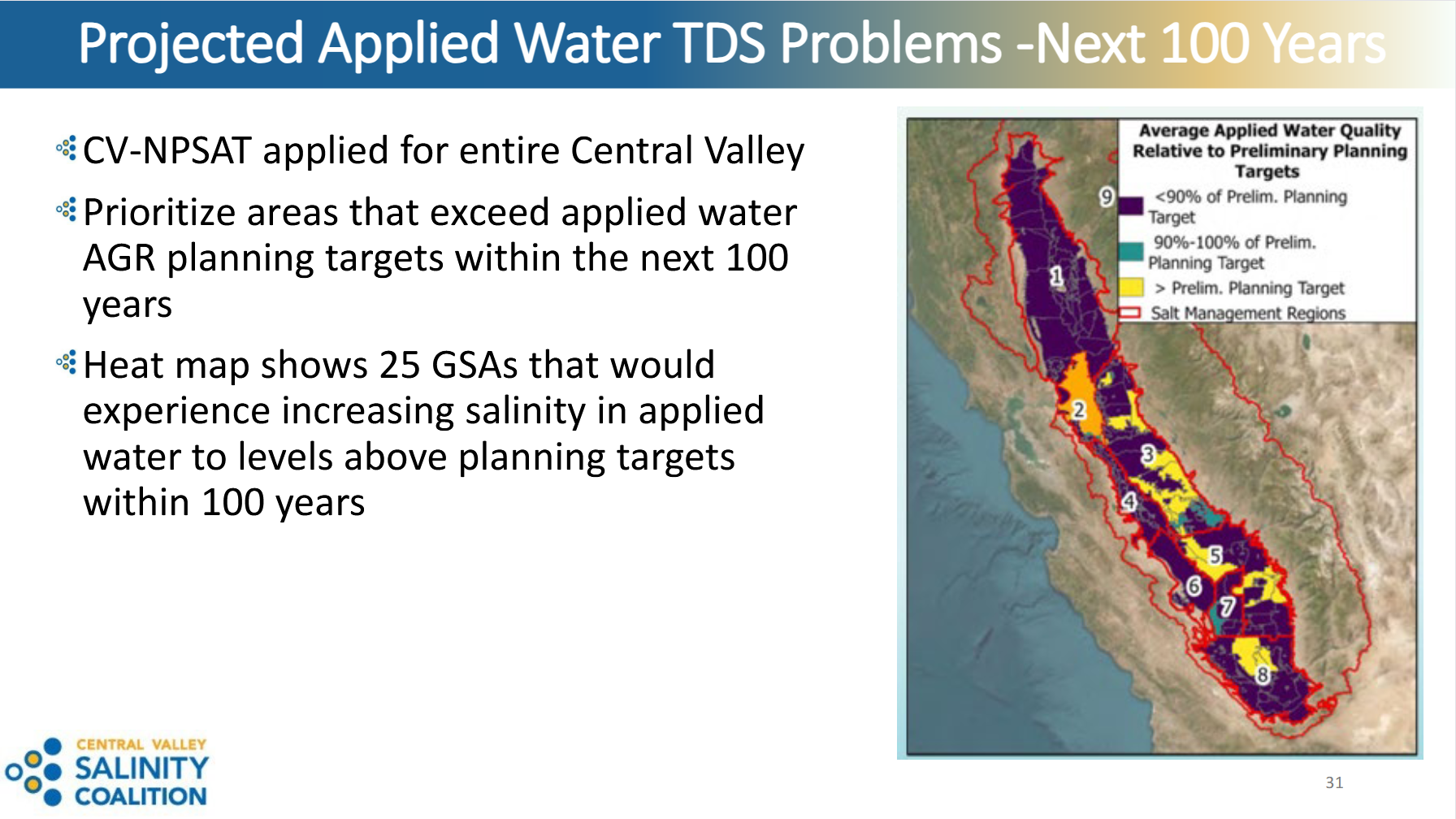
In 2026, the team evaluated 141 Central Valley GSAs and identified 25 areas where current agricultural salinity planning targets may not be met within the next 100 years. Modeling tools, particularly CVNPSAT, were used to project changing conditions in public water system wells and shallow domestic wells and identify where future problems may emerge.
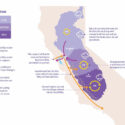
The updated heat map shows the Delta in orange and areas projected to experience salinity problems within the next 100 years in yellow.
The team selected three of the identified areas for pilot planning-level feasibility analyses of potential solutions. The studies involve coordination with GSA leaders and local stakeholders, consideration of planned GSA actions, evaluation of desalination, brine management, conveyance, and salt disposal options, and analysis of costs, energy use, trace constituents, and other factors.
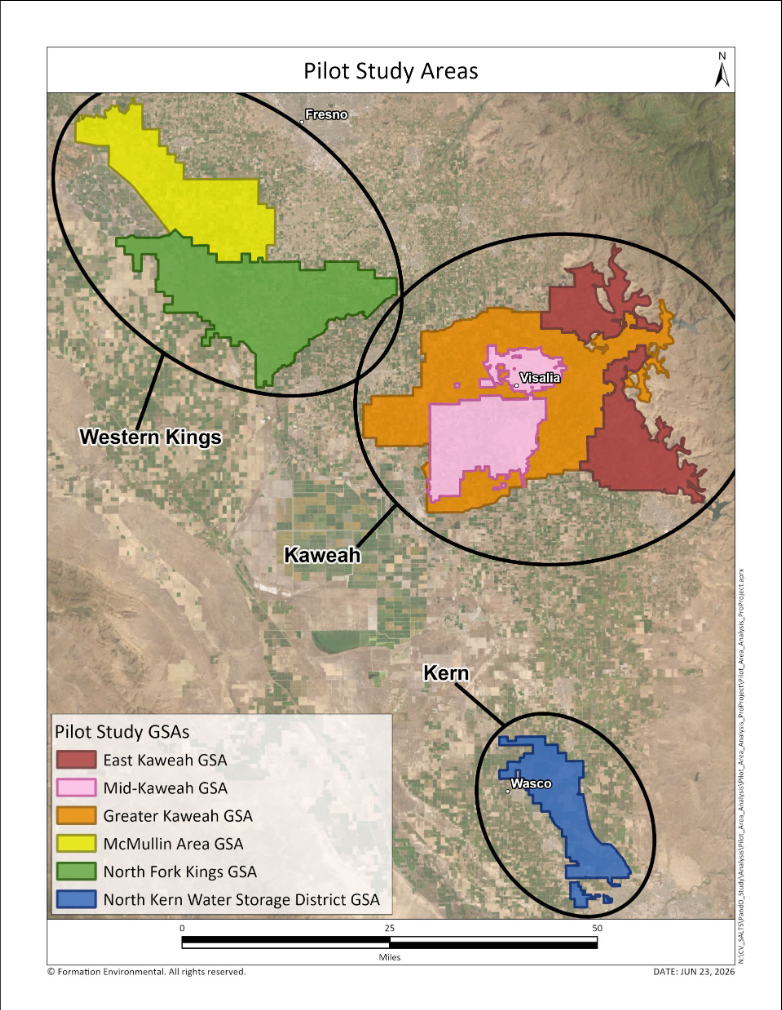 The pilot areas chosen were the McMullin Area and North Fork Kings GSAs in western Kings County; the East Kaweah, Greater Kaweah, and Mid-Kaweah GSAs in the Kaweah area; and the North Kern Water Storage District GSA in Kern County. Together, the three areas cover approximately 800,000 acres—about one-third of the 2.2 million acres represented by the 25 identified GSAs—and include an area with a proposed large water bank. The pilot projects are expected to be completed by the end of 2026, providing an initial assessment of practical, on-the-ground solutions.
“In 2027, our plan is to work with the GSA leadership to develop these SGMA scenarios,” said Mr. Grovhoug. “We’re going to model those, so we will see the effect of what’s happening in SGMA in the groundwater sustainability plans, paying a lot of attention to land use change and also recharge.”
Previous results focused primarily on business-as-usual modeling. In 2027, the team will evaluate climate change scenarios and assess how management actions could slow salt accumulation and delay projected problems, including the potential benefits of earlier implementation.
The team will also prepare a five-year interim progress report summarizing completed work and outlining the remaining study activities. The formal update will be submitted to the Central Valley Water Board by June 30.
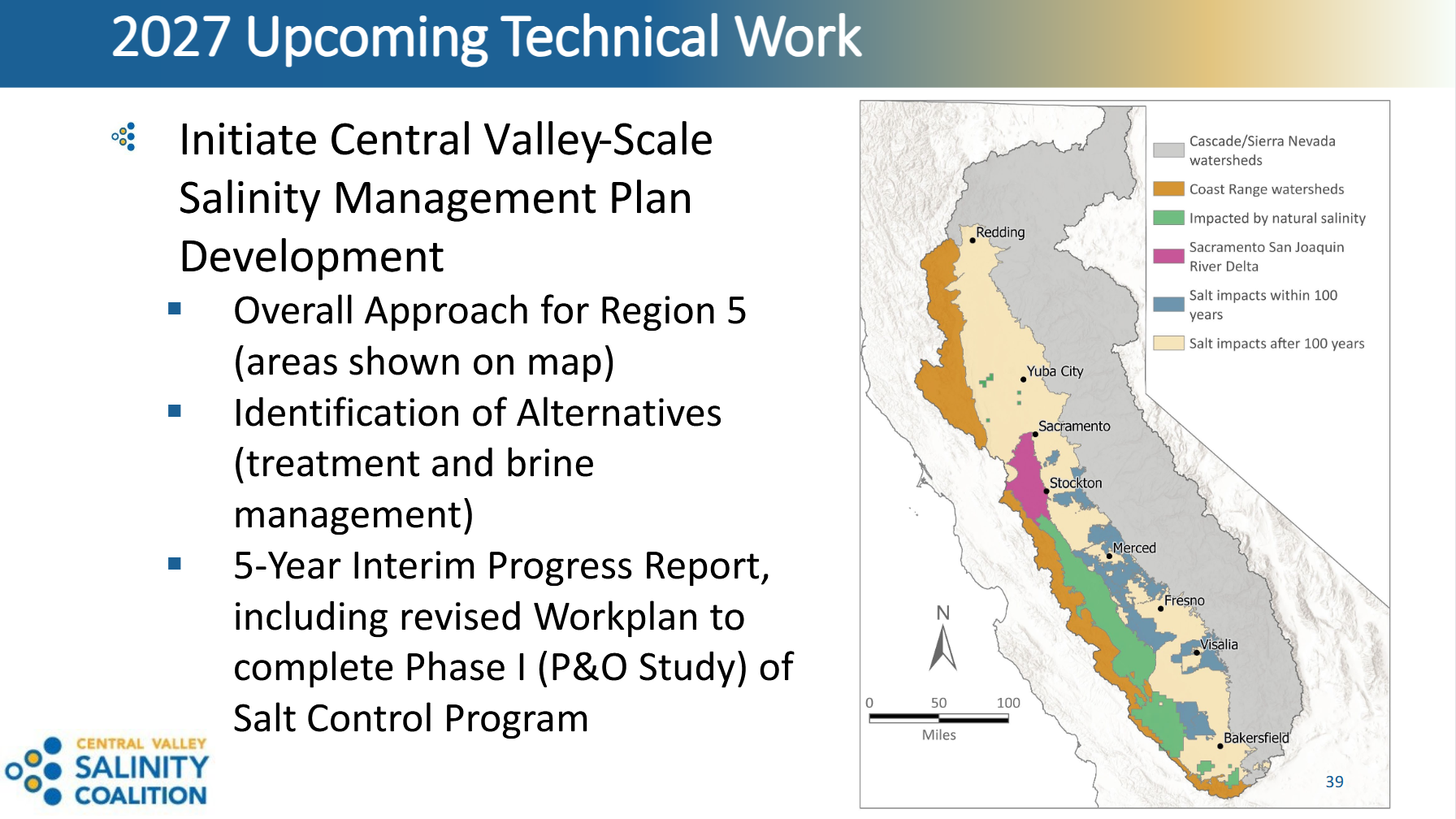
Building on the pilot studies, the team will begin developing a comprehensive salinity management plan for the Central Valley. The map identifies areas to be addressed in the plan. Blue areas represent the 25 locations projected to experience problems within 100 years, while peach areas indicate where problems are expected beyond that period. The Delta will be evaluated separately, as will Coast Range watersheds on the west side before they drain to the valley floor.
Governance and funding
A long-term governance strategy will be needed to operate and maintain any projects that are developed. The coalition is beginning to evaluate governance options and educate state and federal legislators about the scale of the issue and the funding required for implementation.
“We realize this is a long-term issue,” said David Corey, board chair with the Central Valley Salinity Coalition. “It’s going to take significant resources from both the state and federal government, from the local stakeholders, and so we need to educate them up front so that when we come to them with a concrete plan of what we need to build, they’ve heard it before.”
From study to action
Consumptive water use concentrates salts, requiring decisions about where those salts will accumulate and how they can be managed to avoid impacts to beneficial uses, according to David Corey.
Salt accumulation has been recognized for thousands of years and was identified as a management concern when the Central Valley’s water projects were developed. Although new studies have been conducted every 20 or 30 years, a comprehensive, valley-wide management plan has not been implemented.
“So, the question that we need to address right now is: Are we the generation to actually implement a plan and projects that address this issue? Or are we going to continue to kick this can down the road?” said Mr. Corey. “It’s a slow-moving crisis, so if we continually kick the can down the road and push this off to my son’s generation—future generations—it’ll be too late to address the problem, or probably much harder to do.”
“I don’t think we can answer that question today because it’s going to take more than the people in this room to get this done. But this group, CV-SALTS, this board, the regional board—as we started in 2006—we’ve taken that step, and we’ve made enormous progress. We intend to continue that progress, and hopefully, we can build the momentum from everyone else outside of this room to get this done.”
Join the upcoming webinar on Thursday, October 29
CV-SALTS 2026 Webinar: Implementing Nitrate Solutions and Building the Foundation for Long-Term Salt Management, Thursday from 12pm to 1:30pm. Catch up on the Central Valley’s long-term effort to tackle salt and nitrate. This webinar covers progress on the Nitrate Control Program, next steps for the Salt Control Program, the CV-SALTS vision, and what the latest salinity science is telling us. You’ll also hear how pilot studies and partnerships with Groundwater Sustainability Agencies are laying the groundwork for what comes next. Click here to register.
More information …
More coverage of CV-SALTS on Maven’s Notebook …
NOTEBOOK FEATURE: CV-SALTS Maps a Path Toward Long-Term Salinity Management
New modeling identifies areas at risk and lays the groundwork for long-term management solutions Salinity is already affecting the Central Valley’s water supplies, agricultural lands, and communities. It has forced the retirement of hundreds of thousands of acres in the Westlands Water District and other areas. In the Tulare Lake Basin, farmers have relied on active evaporation basins and Integrated Farm Drainage Management Systems to capture and contain saline drainage water. However, these interim measures do not provide a valley-wide […]

NOTEBOOK FEATURE: CV-SALTS Progress Report: Addressing nitrate and salt contamination in the Central Valley
In 2006, the Central Valley Regional Water Board launched the Central Valley Salinity Alternatives for Long-Term Sustainability (CV-SALTS) program to tackle the growing issue of nitrate and salt contamination in groundwater and wells across the region. This collaborative initiative brings together regulators, agricultural and industrial dischargers, municipal wastewater agencies, and environmental and environmental justice organizations to develop and implement sustainable solutions. The program’s overarching goals are to support the San Joaquin Valley’s agricultural economy, ensure access to safe drinking water, and […]
CV-SALTS: From safe drinking water to long-term solutions: CV-SALTS at five years
From the Central Valley Salinity Coalition 2025 Is a Milestone Year 2025 marks the 5-year anniversary of the launch of both the Salt and Nitrate Control Programs. To commemorate the progress of both programs, and to help lay the foundation for future progress, CV-SALTS held an online workshop on June 30, 2025, focused on water quality in the Central Valley. Workshop panelists included CV-SALTS program staff and regulated participants, elected officials, local community leaders, and State and Regional Water Board […]
SJV WATER: State wants to better understand salt build up in the Central Valley, starting with Kings County
By Monserrat Solis, SJV Water A state water quality agency hopes to tackle a problem as old as civilization itself – salt build up from irrigation. The Central Valley Salinity Alternatives for Long-Term Sustainability (CV-SALTS) is working with local water managers and using state-of-the-art engineering software to understand how groundwater moves through the western Kings and Delta-Mendota subbasins as part of a long-term salt study. The salt study, which began in 2022, aims to develop a Central Valley-wide plan to […]

CV-SALTS: Nitrate Control Program hits 5-year milestone and Drinking Water Program expands to new areas
From the Central Valley Salinity Coalition: This year marks several significant five-year milestones for CV-SALTS and its efforts to address salt and nitrate challenges in the Valley. The program has expanded its geographical reach and local networks significantly in the first quarter of 2025. With the launch of the Priority 2 Management Zones (MZs), the Nitrate Control Program now covers all basins with high nitrate concentrations in the Central Valley. The Priority 1 MZs continue to conduct well testing, deliver […]
NOTICE of opportunity to comment & public workshop: Nitrate Control Program, Priority 2 Preliminary Management Zone Proposals and Early Action Plans
From the Central Valley Water Board: Public Comment Period: December 30, 2024 to January 27, 2025 Virtual Public Workshop (Remote Participation Only): Friday, January 31, 2025 | 9:00 AM – 12:00 PM The Central Valley Regional Water Quality Control Board (Central Valley Water Board) invites interested parties to attend its upcoming staff workshop regarding the Nitrate Control Program Management Zone Proposals and Early Action Plans on January 31, 2025, from 9 AM to 12 PM. The purpose of this meeting […]
CV-SALTS: Nitrate and Salt Control Programs end 2024 with significant progress
From the Central Valley Salinity Alternatives for Long-Term Sustainability (CV-SALTS) program As 2024 ends, the CV-SALTS program continues to make significant progress. The Nitrate Control Program Priority 1 Management Zones (MZs) remain focused on implementation, conducting outreach and offering free well-testing and bottled water delivery services. They are also working with local communities to solve the Central Valley’s long-term nitrate contamination challenges. Permittees in Priority 2 MZs have until February 26, 2025 to file their Notice of Intent with the […]
CV-SALTS UPDATE: Priority 2 Basins and P&O Study Move Forward
CV-SALTS 3rd quarter update The Salt and Nitrate Control Programs continue to progress as they work to improve water quality in the Central Valley and support local communities. Within the Nitrate Control Program, Priority 1 Management Zones (MZs) continue to expand their outreach efforts to promote free well testing and bottled water delivery services, while working collaboratively to develop long-term solutions to nitrate contamination problems. Priority 2 MZs are organizing and preparing their Preliminary Management Zone Proposal with local permittees […]
CV-SALTS UPDATE: Environmental justice advocates frustrated by slow pace of the program
In parts of the Central Valley, nitrate levels in groundwater have risen so high that the drinking water in rural homes and small water systems no longer meets safety standards. Many small, rural communities in the Central Valley aren’t connected to public water systems and depend on shallow domestic wells for their water. Unfortunately, years of fertilizer use and animal farming have allowed nitrates to seep into groundwater aquifers, making drinking water unsafe in some locations. Additionally, increasing salt levels […]
CV-SALTS: Salt and nitrate control programs 2nd quarter 2024 update
From the Central Valley Salinity Alternatives for Long-Term Sustainability (CV-SALTS): As we head into summer, both the Salt and Nitrate Control Programs have made notable advancements. Within the Nitrate Control Program, Priority 1 Management Zones (MZs) continue their free drinking water testing and delivery services, while developing longer-term nitrate contamination solutions. Concurrently, Priority 2 MZs are getting organized and beginning to work with new members and starting to work on their Early Action Plans. On the Salt Control Program front, […]
