Healthy Rivers and Landscapes provides California with multiple tools and strategies to restore salmon runs, Unimpaired-Flows relies on silver bullet approach
By Roger Cornwell, Chair, Northern California Water Association
California has an opportunity to move water policy toward a healthier and more resilient future. As the State Water Board considers the update for the Bay-Delta Water Quality Control Plan (Plan), Northern California Water believes the Healthy Rivers and Landscapes approach is the best path forward—a comprehensive strategy that combines river flows, habitat restoration and floodplain reactivation, science, and collaboration to support fish and wildlife while sustaining our communities and working lands.
As the Board considers its Plan update, it faces a stark choice that matters for all Californias. The Board’s proposed update provides two pathways: Healthy Rivers and Landscapes (Healthy Rivers) for participating water users, and an old-fashioned regulatory approach that requires a percentage of unimpaired flow to remain in rivers. Modern science suggests that the Healthy Rivers pathway offers a stronger foundation for achieving lasting environmental improvements and greater water supply stability throughout California. Contrast this with the unimpaired flow approach, which would be devastating to Californians and our environment and landscape.
Marrying Water with Critical Habitat Fish Need to Thrive
Healthy rivers depend on the interaction of water, landscape, and sun. Salmon need suitable places to spawn, productive landscapes to feed and grow, appropriate temperatures, and safe passage between rivers and the ocean. River flows help provide all these conditions, and their effectiveness depends on when and where water reaches the habitat.
The Healthy Rivers and Landscapes program brings these elements together. It pairs strategically timed flows with investments in spawning habitat, riparian zones, floodplains, and other essential features of functioning river systems. This integration of habitat and flows are central to the program’s approach to ecosystem health.
In the Sacramento Valley, this approach reflects the connections we see across our landscape. Rivers, bypasses, wetlands, ricelands, and wildlife refuges form an interconnected system. Reconnecting water with productive floodplains can create food and rearing opportunities for young salmon while supporting birds and other wildlife. Healthy Rivers and Landscapes provides a framework for managing these connections deliberately and it works to mimic the natural system we had before human development.
Why an Unimpaired-Flow Requirement Falls Short
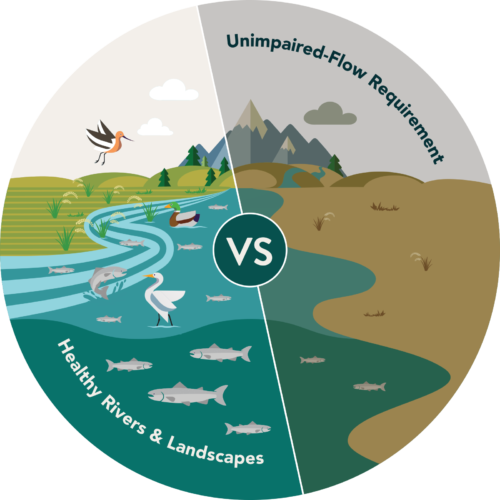 Unimpaired flow estimates the water that would move through a watershed without upstream storage, flood protection and diversions. Although this metric seems simple, this approach takes us backward to a time before human settlement by ignoring 40 million people, the fifth largest economy in the world, and the amazing environment and recreation enjoyed by people, fish and wildlife.
An approach based on flow percentages does not deliver the same integrated package of habitat investment, coordinated operations, and shared implementation commitments offered by the Healthy Rivers and Landscapes program. The consequences of unimpaired flows extend well beyond the river channel—negatively impacting reservoir storage, farms, community water systems, and the managed wetlands and ricelands that support the Pacific Flyway.
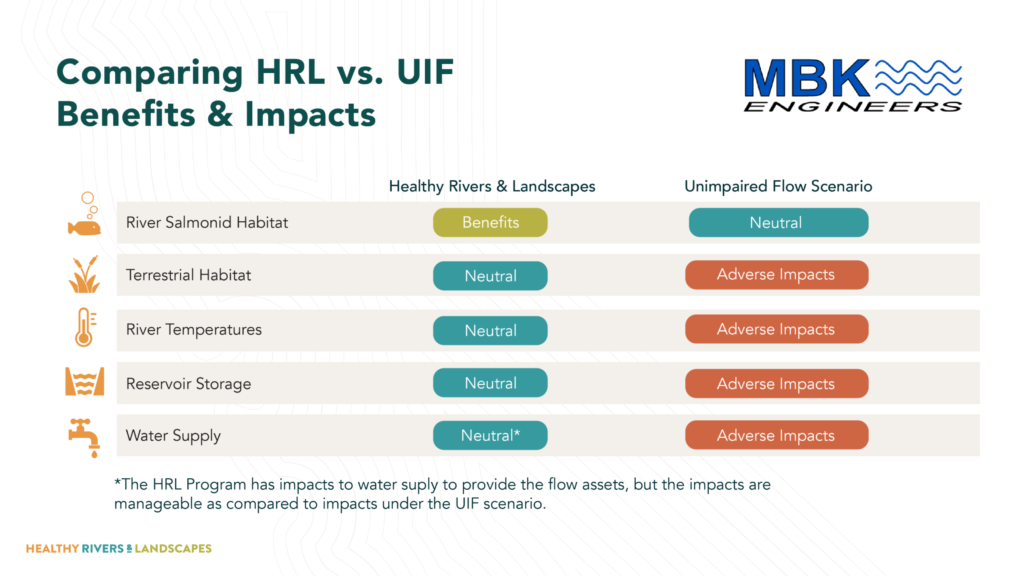
MBK Engineers has conducted a technical review that reinforces this concern. Its comparison identifies much greater benefits for Healthy Rivers and Landscapes than unimpaired flows without the significant adverse effects for reservoir storage, river temperatures, terrestrial habitat, and water supply. These analytical findings underscore the stark choice for each approach.
More Than Just Words: From Commitment to Action
The Healthy Rivers and Landscapes approach has 58 early implementation habitat projects that have been completed, are under construction, or are expected to complete final design by the end of 2026. These projects demonstrate partnerships and practical work that can advance through this approach.
The Healthy Rivers and Landscapes program also requires real water contributions and its advantage is the opportunity to manage those contributions alongside habitat improvements and the landscape to produce greater ecological value while ensuring water supplies for our communities, farms, fish and wildlife, recreation, and hydropower.
Implementation must also come with accountability. Water contributions must be tracked, habitat commitments delivered, and biological responses evaluated. The Healthy Rivers and Landscapes governance structure will include a Flow Operations Team, Habitat Team, and Science Committee, and its science program provides for assessing habitat use and biological effectiveness. These tools can help managers adjust actions as we learn what is working.
Advancing a Vibrant Future for People, Fish and Wildlife
The Sacramento Valley’s future depends on healthy rivers, thriving fish and wildlife, vibrant communities, productive farms, and access to safe, reliable, affordable water for all these purposes. These goals are deeply connected. Water management should strengthen those connections.
Healthy Rivers and Landscapes offers a practical opportunity to bring agencies, water managers, scientists, conservation partners, fishermen, and landowners together around shared commitments. It directs attention toward the work that matters: restoring habitat and our landscape, managing water thoughtfully, learning from results, and improving conditions across the watershed.
For the State Water Board, the choice is obvious. Making the final changes that will enable the Healthy Rivers and Landscapes program to succeed is the best path forward, with clear commitments, workable implementation provisions, and rigorous accountability. California needs an approach capable of delivering environmental progress while sustaining the economy, landscapes and communities that depend on water. Healthy Rivers and Landscapes provides that path.
Note: The views and opinions expressed in this commentary are those of the author and do not necessarily reflect the official policy or position of Maven’s Notebook.
More coverage of the Voluntary Agreements on Maven’s Notebook …
Posted: November 3, 2026
By Dan Walters, Cal Matters This commentary was originally published by CalMatters. Sign up for their newsletters. Gray Davis became governor in 1999 and one of his first acts was to decree that there would be no major changes in water policy for eight years, which he assumed would be his two terms in office. Davis, a veteran politician who had climbed the political ladder one rung at a time, was well aware of the decades-long stalemate on the fundamental […]
Posted: October 30, 2026
Framework combines new flows, habitat restoration, science and enforceable rules to protect the Sacramento River and Delta From the State Water Board: In a landmark development driving large-scale ecosystem restoration and creating greater security for the heart of California’s water system, the State Water Resources Control Board today adopted modernized water quality protections for the Sacramento River and San Francisco Bay-Delta. The updated Water Quality Control Plan for the San Francisco Bay/Sacramento-San Joaquin Delta Watershed (Bay-Delta Plan) strengthens protections for […]
Posted: October 30, 2026
California approved Newsom’s Delta water rules, but Trump threatens to pull out and $740M with it. Water agencies that once backed the deal call it too strict; environmentalists say it’s too weak. By Rachel Becker, Cal Matters This story was originally published by CalMatters. Sign up for their newsletters. California water regulators have approved a new plan overhauling how farms and cities take water from the Sacramento-San Joaquin Delta and rivers that feed it, setting up the next fight over Gov. […]
Posted: October 30, 2026
Under the changes, water agencies can commit to voluntary agreements governing water usage that some environmentalists and tribes argue undermine the health of the Bay-Delta system. By Alan Riquelmy, Courthouse News Service California’s water board late Thursday approved major changes to a massive water plan that drew strong emotions, and at times sharp rebukes, from hundreds of stakeholders including water agencies, conservationists and tribes. The plan sets water quality goals for the San Francisco Bay/Sacramento-San Joaquin Delta, a massive watershed […]
Posted: October 30, 2026
Groups condemn the Newsom administration’s voluntary agreement framework, pledging to fight for water rights, environmental protections, and due process From Restore the Delta: In anticipation of the State Water Resources Control Board’s vote to adopt the updated Bay-Delta Plan, tribal leaders, environmental advocates, and Delta residents gathered at a press conference to condemn the decision and pledge further action to defend California’s water rights, protect critical ecosystems, and ensure meaningful public participation in decisions affecting the state’s water future. Representatives […]
Posted: October 29, 2026
The Bay-Delta is a watershed that provides drinking and municipal water to some 30 million people, along with irrigation water for 4 million acres. From the Courthouse News Service People and agencies facing the effects of proposed changes to a major California water plan spoke in waves Wednesday, making their cases to the state’s water board. The State Water Resources Control Board is proposing amendments to the San Francisco Bay/Sacramento-San Joaquin Delta water quality control plan. The plan sets water […]
Posted: October 28, 2026
By Alex Rabidoux, Assistant General Manager, Solano County Water Agency For decades, California has debated how much water should flow through its rivers to help recover struggling salmon populations. But an equally important question deserves attention: What happens to that water once it enters the river and how much ecological benefit does it actually provide? Salmon evolved in rivers connected to expansive floodplains, wetlands and side channels. Seasonal flows created shallow, food-rich habitats where juvenile fish could feed, grow and […]
Posted: October 28, 2026
By the Delta Tribal Environmental Coalition, consisting of the Shingle Springs Band of Miwok Indians, Winnemem Wintu Tribe, Little Manila Rising, and Restore the Delta. California has formally apologized to tribes for state-sanctioned atrocities and committed to improving relationships between the state and tribal governments. Our elected leaders have also passed numerous laws intended to advance environmental justice outcomes. Yet, when it comes to decisions for the Sacramento-San Joaquin watershed, the Newsom administration has thrown tribes and environmental justice communities […]
Posted: October 28, 2026
From the Golden Gate Salmon Association Later this week, the State Water Resources Control Board is likely to adopt a final update to the Bay-Delta Plan. This plan is the state’s key document to protect the natural resources in the vast Bay-Delta estuary, as well as its Central Valley tributary rivers. This is the largest freshwater ecosystem in California and the largest estuary on the West Coast. Sacramento Valley salmon runs are the backbone of salmon fishing in California and […]

Posted: October 27, 2026
Healthy Rivers and Landscapes provides critical habitat for salmon while also ensuring our farms, cities and rural communities remain vibrant By Nicole Montna Van Vleck, President and CEO, Montna Farms Think about the last time you enjoyed a piece of sushi or took a bite of pizza. The rice wrapped around your favorite sushi roll, the tomato sauce, the cheese, perhaps a few peppers or olives sprinkled on top of that perfect slice. Chances are, you weren’t thinking about the […]
View archive


GUEST COMMENTARY: Healthy Rivers and Landscapes: A better path forward for the Bay-Delta
Healthy Rivers and Landscapes provides California with multiple tools and strategies to restore salmon runs, Unimpaired-Flows relies on silver bullet approach
By Roger Cornwell, Chair, Northern California Water Association
California has an opportunity to move water policy toward a healthier and more resilient future. As the State Water Board considers the update for the Bay-Delta Water Quality Control Plan (Plan), Northern California Water believes the Healthy Rivers and Landscapes approach is the best path forward—a comprehensive strategy that combines river flows, habitat restoration and floodplain reactivation, science, and collaboration to support fish and wildlife while sustaining our communities and working lands.
As the Board considers its Plan update, it faces a stark choice that matters for all Californias. The Board’s proposed update provides two pathways: Healthy Rivers and Landscapes (Healthy Rivers) for participating water users, and an old-fashioned regulatory approach that requires a percentage of unimpaired flow to remain in rivers. Modern science suggests that the Healthy Rivers pathway offers a stronger foundation for achieving lasting environmental improvements and greater water supply stability throughout California. Contrast this with the unimpaired flow approach, which would be devastating to Californians and our environment and landscape.
Marrying Water with Critical Habitat Fish Need to Thrive
Healthy rivers depend on the interaction of water, landscape, and sun. Salmon need suitable places to spawn, productive landscapes to feed and grow, appropriate temperatures, and safe passage between rivers and the ocean. River flows help provide all these conditions, and their effectiveness depends on when and where water reaches the habitat.
The Healthy Rivers and Landscapes program brings these elements together. It pairs strategically timed flows with investments in spawning habitat, riparian zones, floodplains, and other essential features of functioning river systems. This integration of habitat and flows are central to the program’s approach to ecosystem health.
In the Sacramento Valley, this approach reflects the connections we see across our landscape. Rivers, bypasses, wetlands, ricelands, and wildlife refuges form an interconnected system. Reconnecting water with productive floodplains can create food and rearing opportunities for young salmon while supporting birds and other wildlife. Healthy Rivers and Landscapes provides a framework for managing these connections deliberately and it works to mimic the natural system we had before human development.
Why an Unimpaired-Flow Requirement Falls Short
An approach based on flow percentages does not deliver the same integrated package of habitat investment, coordinated operations, and shared implementation commitments offered by the Healthy Rivers and Landscapes program. The consequences of unimpaired flows extend well beyond the river channel—negatively impacting reservoir storage, farms, community water systems, and the managed wetlands and ricelands that support the Pacific Flyway.
MBK Engineers has conducted a technical review that reinforces this concern. Its comparison identifies much greater benefits for Healthy Rivers and Landscapes than unimpaired flows without the significant adverse effects for reservoir storage, river temperatures, terrestrial habitat, and water supply. These analytical findings underscore the stark choice for each approach.
More Than Just Words: From Commitment to Action
The Healthy Rivers and Landscapes approach has 58 early implementation habitat projects that have been completed, are under construction, or are expected to complete final design by the end of 2026. These projects demonstrate partnerships and practical work that can advance through this approach.
The Healthy Rivers and Landscapes program also requires real water contributions and its advantage is the opportunity to manage those contributions alongside habitat improvements and the landscape to produce greater ecological value while ensuring water supplies for our communities, farms, fish and wildlife, recreation, and hydropower.
Implementation must also come with accountability. Water contributions must be tracked, habitat commitments delivered, and biological responses evaluated. The Healthy Rivers and Landscapes governance structure will include a Flow Operations Team, Habitat Team, and Science Committee, and its science program provides for assessing habitat use and biological effectiveness. These tools can help managers adjust actions as we learn what is working.
Advancing a Vibrant Future for People, Fish and Wildlife
The Sacramento Valley’s future depends on healthy rivers, thriving fish and wildlife, vibrant communities, productive farms, and access to safe, reliable, affordable water for all these purposes. These goals are deeply connected. Water management should strengthen those connections.
Healthy Rivers and Landscapes offers a practical opportunity to bring agencies, water managers, scientists, conservation partners, fishermen, and landowners together around shared commitments. It directs attention toward the work that matters: restoring habitat and our landscape, managing water thoughtfully, learning from results, and improving conditions across the watershed.
For the State Water Board, the choice is obvious. Making the final changes that will enable the Healthy Rivers and Landscapes program to succeed is the best path forward, with clear commitments, workable implementation provisions, and rigorous accountability. California needs an approach capable of delivering environmental progress while sustaining the economy, landscapes and communities that depend on water. Healthy Rivers and Landscapes provides that path.
More coverage of the Voluntary Agreements on Maven’s Notebook …
DAN WALTERS: California adopted a new water plan. It’s unlikely to end the state’s water wars
By Dan Walters, Cal Matters This commentary was originally published by CalMatters. Sign up for their newsletters. Gray Davis became governor in 1999 and one of his first acts was to decree that there would be no major changes in water policy for eight years, which he assumed would be his two terms in office. Davis, a veteran politician who had climbed the political ladder one rung at a time, was well aware of the decades-long stalemate on the fundamental […]
PRESS RELEASE: State Water Board adopts innovative new model to protect California’s Bay-Delta, water and wildlife
Framework combines new flows, habitat restoration, science and enforceable rules to protect the Sacramento River and Delta From the State Water Board: In a landmark development driving large-scale ecosystem restoration and creating greater security for the heart of California’s water system, the State Water Resources Control Board today adopted modernized water quality protections for the Sacramento River and San Francisco Bay-Delta. The updated Water Quality Control Plan for the San Francisco Bay/Sacramento-San Joaquin Delta Watershed (Bay-Delta Plan) strengthens protections for […]
CAL MATTERS: Has the Trump administration doomed Newsom’s water plan?
California approved Newsom’s Delta water rules, but Trump threatens to pull out and $740M with it. Water agencies that once backed the deal call it too strict; environmentalists say it’s too weak. By Rachel Becker, Cal Matters This story was originally published by CalMatters. Sign up for their newsletters. California water regulators have approved a new plan overhauling how farms and cities take water from the Sacramento-San Joaquin Delta and rivers that feed it, setting up the next fight over Gov. […]
COURTHOUSE NEWS: California water board passes major water plan after marathon session
Under the changes, water agencies can commit to voluntary agreements governing water usage that some environmentalists and tribes argue undermine the health of the Bay-Delta system. By Alan Riquelmy, Courthouse News Service California’s water board late Thursday approved major changes to a massive water plan that drew strong emotions, and at times sharp rebukes, from hundreds of stakeholders including water agencies, conservationists and tribes. The plan sets water quality goals for the San Francisco Bay/Sacramento-San Joaquin Delta, a massive watershed […]
RESTORE THE DELTA: Tribes and environmental groups slam State Water Board’s anticipated adoption of updated Bay-Delta Plan, vow further action
Groups condemn the Newsom administration’s voluntary agreement framework, pledging to fight for water rights, environmental protections, and due process From Restore the Delta: In anticipation of the State Water Resources Control Board’s vote to adopt the updated Bay-Delta Plan, tribal leaders, environmental advocates, and Delta residents gathered at a press conference to condemn the decision and pledge further action to defend California’s water rights, protect critical ecosystems, and ensure meaningful public participation in decisions affecting the state’s water future. Representatives […]
COURTHOUSE NEWS: California water board hears competing views on major water plan update
The Bay-Delta is a watershed that provides drinking and municipal water to some 30 million people, along with irrigation water for 4 million acres. From the Courthouse News Service People and agencies facing the effects of proposed changes to a major California water plan spoke in waves Wednesday, making their cases to the state’s water board. The State Water Resources Control Board is proposing amendments to the San Francisco Bay/Sacramento-San Joaquin Delta water quality control plan. The plan sets water […]
COMMENTARY: The science is clear: Restoring California’s salmon populations requires more than just water
By Alex Rabidoux, Assistant General Manager, Solano County Water Agency For decades, California has debated how much water should flow through its rivers to help recover struggling salmon populations. But an equally important question deserves attention: What happens to that water once it enters the river and how much ecological benefit does it actually provide? Salmon evolved in rivers connected to expansive floodplains, wetlands and side channels. Seasonal flows created shallow, food-rich habitats where juvenile fish could feed, grow and […]
COMMENTARY: Reject the discriminatory, illegitimate, and harmful Voluntary Agreements
By the Delta Tribal Environmental Coalition, consisting of the Shingle Springs Band of Miwok Indians, Winnemem Wintu Tribe, Little Manila Rising, and Restore the Delta. California has formally apologized to tribes for state-sanctioned atrocities and committed to improving relationships between the state and tribal governments. Our elected leaders have also passed numerous laws intended to advance environmental justice outcomes. Yet, when it comes to decisions for the Sacramento-San Joaquin watershed, the Newsom administration has thrown tribes and environmental justice communities […]
GUEST COMMENTARY: Fatal flaws in the State Water Board’s Draft Bay-Delta Plan Update
From the Golden Gate Salmon Association Later this week, the State Water Resources Control Board is likely to adopt a final update to the Bay-Delta Plan. This plan is the state’s key document to protect the natural resources in the vast Bay-Delta estuary, as well as its Central Valley tributary rivers. This is the largest freshwater ecosystem in California and the largest estuary on the West Coast. Sacramento Valley salmon runs are the backbone of salmon fishing in California and […]
GUEST COMMENTARY: Healthy Rivers and Landscapes: A healthier future for all of California
Healthy Rivers and Landscapes provides critical habitat for salmon while also ensuring our farms, cities and rural communities remain vibrant By Nicole Montna Van Vleck, President and CEO, Montna Farms Think about the last time you enjoyed a piece of sushi or took a bite of pizza. The rice wrapped around your favorite sushi roll, the tomato sauce, the cheese, perhaps a few peppers or olives sprinkled on top of that perfect slice. Chances are, you weren’t thinking about the […]
View archive
Tags