

Several news sources featured in the Daily Digest may limit the number of articles you can access without a subscription. However, gift articles and open-access links are provided when available. For more open access California water news articles, explore the main page at MavensNotebook.com.
On the calendar today …
- MEETING: Delta Conveyance Project Status Conference beginning at 9am. The AHO will hold a status conference on October 19, 2026, starting at 9:00 a.m. The purpose of the status conference is to address questions or objections by the parties regarding the page limits and deadlines for submission of closing and reply briefs stated in the AHO’s October 7, 2026 Procedural Ruling Letter (see Section VII. Closing Briefs, p. 20), and any other procedural matters raised by the parties. The status conference will be conducted by Zoom Webinar. Parties or interested members of the public who would like to watch this hearing without participating may do so through the Administrative Hearings Office YouTube channel at: bit.ly/aho-youtube
- STATE WATER BOARD WORKSHOP: Getting Ready to Recharge with a Permit from 10am to 11am. The State Water Resources Control Board’s Division of Water Rights will host virtual public workshops on October 19 and October 26 to share information and answer questions about temporary water right permits for groundwater recharge and the rules regarding flood recharge diversions. The workshops are meant for anyone who intends to divert surface water for groundwater recharge this winter. Scientists are observing intensified El Niño conditions in the equatorial Pacific, which could lead to increased winter precipitation with high-water storms in California. Registration link: https://waterboards.zoom.us/meeting/register/qdLsMP-9S8-GBY2rr_sH2w
- WEBINAR: NOAA Drought Seminar Series: From Hazards to Consequences: Toward Impact-Based Drought Monitoring and Prediction from 10am to 11am. Satellites and computer models have made it much easier to track droughts as they happen. However, most tools today only look at weather conditions rather than the actual damage droughts cause. They also tend to miss related problems that happen at the same time or right after, such as heatwaves, wildfires, floods, and mudslides. This presentation explains impact-based drought monitoring, an approach that links drought to its physical and societal impacts, such as lost crops, food availability, lower energy output, or job losses. Putting this impact-focused approach into practice isn’t easy. We currently lack complete data on drought impacts, accurate local information on human water use, and good ways to connect impact assessment with traditional drought monitoring tools. To fix this, we must look beyond just climate data and also consider how human dimensions contribute to and shape droughts. In this seminar, Amir AghaKouchak, University of California Irvine, will give a presentation, “From Hazards to Consequences: Toward Impact-Based Drought Monitoring and Prediction.” Click here to register.
- WEBINAR: AB1755 Water Datathon: Emerging data tools from 1pm to 2pm. This webinar will focus on emerging data tools. Speakers Glen Low, Earth Genome Co-Founder, and Ben Strong, Science and Machine Learning Lead for Earth Genome, will discuss the role of AI geospatial foundation models in water issues and uses. An AI-powered, interactive search platform, Earth Index, was developed by Earth Genome, a nonprofit organization, to allow users to search the entire surface of the planet using satellite imagery. Click here to register.
In California water news today …
Incoming storm to bring renewed flood risk to California, Southwest
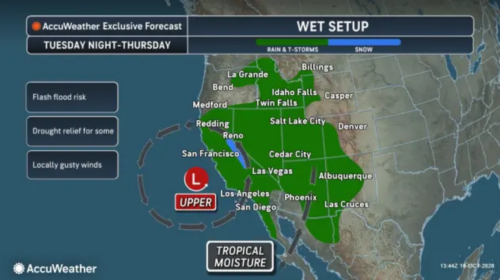 “Southern California and the Southwest have experienced multiple storms this fall that have featured an infusion of tropical moisture from the eastern Pacific Ocean, and the stage is set for that to happen again this week. This time around, moisture from Hurricane Trudy off of Mexico’s southwest coast will stream northward ahead of a non-tropical storm that is approaching the West Coast. Once again, tropically-enhanced downpours will raise the risk for flash flooding across the Southwest and Rockies beginning around midweek. The storm will initially approach California between Tuesday and Wednesday and is expected to spread rain and even some mountain snow beginning Tuesday night. As the core of the storm approaches into the day on Wednesday, pockets of heavy rain and thunderstorms can raise the risk for flash flooding across portions of central and Southern California. Los Angeles will be just one of the cities in the path of this storm that will face these risks. … ” Read more from AccuWeather.
A dramatic El Niño effect is headed for the West Coast
“One of El Niño’s most dramatic effects is waiting in the wings and could soon cause chaos along the West Coast, especially in California, forecasters warned. A historic El Niño is expected to up the intensity of atmospheric rivers – long corridors of water vapor in the atmosphere that can transport tremendous amounts of moisture and produce heavy rain or snow when they reach land. “A stronger El Niño brings stronger atmospheric rivers,” Daniel Swain, a climate scientist with the University of California Agriculture and Natural Resources, told USA TODAY. “There aren’t necessarily more of them, but atmospheric rivers are more intense during a strong El Niño like this one.” In addition, strong El Niños also increase the frequency of non-atmospheric river storms in California, he said. … ” Read more from USA Today.
What is a Kelvin wave? How El Niño can raise West Coast sea levels
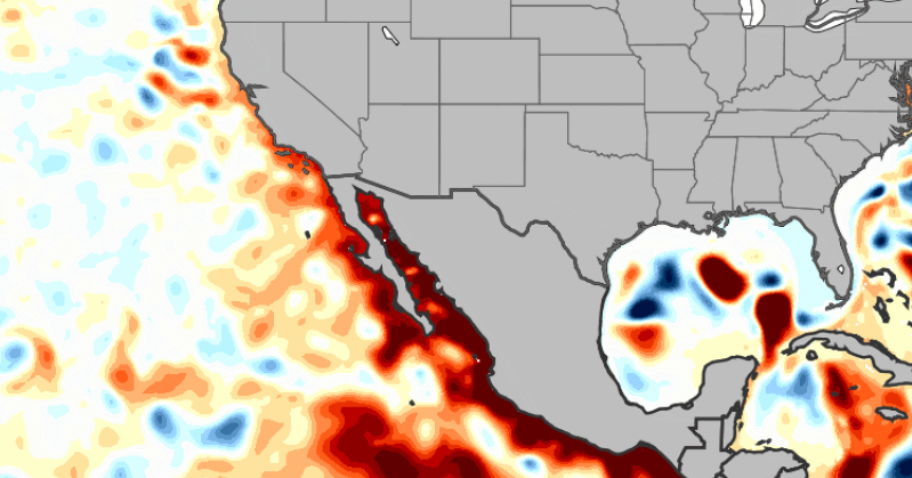
“El Niño‘s effects are already being felt on the West Coast. Communities are reeling from coastal flooding across Southern California and parts of the Bay Area. The culprit? In part, scientists say the flooding is due to what they call a Kelvin wave. But this massive wave isn’t visible like a tsunami or a wave surfers can catch; it moves slowly beneath the ocean’s surface and is one of El Niño’s first effects, which could strengthen to historic intensity this winter. “Kelvin waves are like the heartbeat of El Niño,” said Josh Willis, project scientist for sea level missions at NASA’s Jet Propulsion Laboratory in Southern California, in a recent post. … ” Read more from KQED.
El Niño brings exotic sea life to the California coast
“A powerful El Niño is delivering unusually warm waters to the California coast, and with them, an array of tropical sea creatures rarely seen there. These include flying fish, manta rays, and a venomous yellow-bellied sea snake, a species not seen in the state since the 2015 El Niño, Reuters reports. Meanwhile, anglers have landed yellowfin tuna, wahoo, and dorado, unusual catches in the typically cool waters off of California. The summer saw a spate of great white shark sightings, and more recently, fishers have spotted hammerhead sharks and whale sharks. Whale sharks “do come through when the water is warm,” fisherman Carl Sbarounis told the Los Angeles Times, “mostly during El Niño.” For the first time ever, scientists have recorded nesting sea turtles in California, near Seal Beach and in Huntington Beach. If their eggs hatch, the baby turtles “will likely one day return to nest to carry on future generations on these very same beaches,” said Jeff Flocken, president of the Aquarium of the Pacific in Long Beach. The aquarium began housing roughly 200 sea turtle eggs in September to protect them from a rare tropical storm. … ” Read more from Yale e360.
Could saving summer snow change the future of skiing?
“Skiers and snowboarders returned to the slopes at Colorado’s Snowmass ski resort in early October, carving turns on snow that had survived the state’s hottest summer on record. It wasn’t newly fallen snow, and it wasn’t made by snowmaking machines. It was leftover snow from last winter, preserved for nearly five months beneath enormous insulated blankets. The experiment worked so well that Aspen Snowmass has already purchased additional blankets for next year, raising an intriguing possibility for ski resorts confronting warmer water and growing pressure on water and energy resources: What if some of winter’s snow could simply be saved for later? In spring 2026, crews at Aspen Snowmass gathered remaining snow into large piles at Snowmass and nearby Buttermilk, covering them with insulated blankets developed by Finnish company Snow Secure. … ” Read more from AccuWeather.
Latest climate report warns of major upheaval to California way of life
“In just a few decades, summers in California will not only be much hotter, but will also stretch for months longer. Floods will become more widespread and extreme. Exposure to wildfire smoke will kill thousands more people every year. Those are the dire projections of California’s Fifth Climate Change Assessment, a report produced by California every few years that analyzes the impacts of changing weather patterns on the nation’s most-populous state. The future laid out in the report, which was published on Monday, touches on familiar warnings: more wildfires, bigger storms, longer droughts. But it illustrates in unsettling detail just how quickly the climate is being reshaped, and reveals what is likely to be major upheaval to long-established ways of life in California. … ” Read more from the New York Times.
Bringing more beavers to watersheds is a powerful drought-fighting tool, experts say
“On Jackson Ramsay’s family ranch late in the summer, there were few signs it had just weathered the worst-ever winter snowpack and record-setting heat. Water twisted unhurriedly through the land, splayed into various branches that rejoined to form pools behind mounds of piled sticks. Young willows stretched from the bank across an expanse roughly the length of a football field, fed from moisture below. Then a familiar brown head emerged from a deep pool: a beaver. “They’re thriving here,” Ramsay said, beaming at the creature. “They benefit us, and hopefully we benefit them.” The Ramsays’ ranch in southwest Wyoming is one of many areas embracing the semiaquatic rodents as nature’s engineers. Conservation groups and government agencies are increasing their use of “starter homes” made of wood and brush to encourage the creatures to move in and expand upon the initial structures. Beaver dams slow moving water in a way that promotes localized year-round availability, creates habitat for native fish and provides a natural break that slows wildfires. … ” Read more from the Associated Press.
San Joaquin River sees record 448 salmon return, but decades of work remain
“Four hundred forty-eight adult spring-run Chinook salmon swam back into the San Joaquin River Restoration Area in 2025, the highest number of captured returns recorded since the program began reintroducing juvenile fish in 2014. It is a number worth pausing on for a river that, for decades, had none of these fish at all. The figure comes from the San Joaquin River Restoration Program, which has tracked spring-run Chinook since fertilized eggs from the Feather River hatchery were first transported to the restoration area’s facilities in 2014. The 2025 count smashed the previous record of 93 captured natural returns, set in 2021, more than quadrupling it in a single season. As Fresnoland reports, most of the 448 fish were released as juveniles in 2023, according to California Department of Fish and Wildlife spokesperson Krysten Kellum, who said high Friant Dam flood releases likely benefited the young salmon during their out-migration to the ocean. … ” Read more from Hoodline.
Resilient California fishes: The legendary threespine stickleback
“The Threespine Stickleback (Gasterosteus aculeatus) is a tiny but charismatic fish (1-2 inches long) that is well known to fish enthusiasts and researchers. It is common in streams, lakes, and estuaries along the Pacific Coast, including California (Moyle 2002). It is present as well in coastal waters in eastern North America, Asia, and Europe. The keys to its resilience include its wide distribution and its ability to live in fresh and salt water. Threespine Sticklebacks have two basic life histories: freshwater resident and anadromous (sea-run). Both types can often be found in the same stream. In each stream, resident sticklebacks are most closely related to anadromous sticklebacks in the same stream, which presumably founded the population and can hybridize with the resident form. If a population is extirpated from a coastal stream, the stream can be recolonized by sea-run fish from other streams, which then give rise to resident fish in the fresh waters. This migration behavior has a genetic basis, which reflects their considerable ability to adapt to local conditions. This also results in variation between populations in characteristics such as the size of their spines and number of armor plates. … ” Read more from the California Water Blog.
The growing role of eDNA in aquatic monitoring and permitting
“A water sample is all that it takes to determine if a sensitive fish species is present in a waterbody, without capturing, trapping, or handling a single individual. Environmental DNA (eDNA) sampling makes this possible by detecting the genetic material that organisms leave behind in the water through biological materials like mucus, feces, and tissue. Recent studies have shown the value of eDNA for detecting rare fish in large rivers, tracking invasive species through complex waterways, and confirming the presence of species in difficult-to-sample environments. As eDNA methods become more widely adopted, eDNA is increasingly being incorporated into fisheries monitoring, ecological research, and environmental permitting efforts. Traditional methods such as electrofishing, seining, and trapping have long been used to collect data on species composition, abundance, and age structure. However, rare or sensitive species sometimes go undetected by these methods because they often occur in low numbers, may be elusive, or are not effectively sampled by traditional gear. Using eDNA methods alongside traditional sampling can increase the likelihood of detecting these rare or sensitive species. … ” Read more from FishBio.
California creates first tribal-led marine protected areas
“California has designated its first tribal-championed marine protected areas, often described as underwater parks. While environmentalists celebrate the historic move, commercial fishers warn they will lose access to key waters. The California Fish and Game Commission voted Thursday to create two roughly nine-square-mile State Marine Conservation Areas near Carpinteria and around Central California’s Point Sal. The efforts were co-led by the Santa Ynez Band of Chumash Indians and the Northern Chumash Tribal Council, respectively. Both areas will allow hook-and-line fishing from the shore but prohibit commercial fishing and sportfishing from a boat. The marine conservation area near Point Sal encompasses kelp forests and what’s known as Lion Rock, a haven for sea lions, seals and migratory birds, said Violet Sage Walker, chair of the Northern Chumash Tribal Council. There are ancient village sites along the coast, she added. … ” Read more from the LA Times. | Read via Yahoo News.
A carcinogenic pesticide ‘no one needs’ is found in dangerous quantities in a quarter of US rivers
“Atrazine is the second-most widely used weed killer in the U.S. after glyphosate, which you might know as Roundup. Much like glyphosate, atrazine can disrupt hormones and has been linked to serious health impacts, including cancer. In early October, California’s Office of Environmental Health Hazard Assessment announced that it plans to list the herbicide as a known carcinogen. Atrazine is also wreaking havoc on aquatic ecosystems, and recent research from the Center for Biological Diversity has been tracking the extent of the contamination. Nathan Donley is the environmental health science director at the Center for Biological Diversity and the author of a new study on atrazine. This interview has been edited for length and clarity. … ” Read more from Inside Climate News.
In regional water news and commentary today …
NORTH COAST
Shasta Konomihu natives request Tribal consultation on restoration projects within their ancestral homelands
“In the remote hinterlands of Siskiyou County, where the wild and scenic Salmon River flows through Shasta Konomihu ancestral lands, Native Elders and Culture Bearers are urgently requesting Tribal consultation from nonprofit, state, federal, and adjacent Tribal entities undertaking restoration projects within the Salmon River Watershed. Tens of millions of dollars in river restoration projects spearheaded by the Salmon River Restoration Council (SRRC) based in Sawyers Bar have focused on improving coho salmon and steelhead habitat in collaboration with the California Fish and Wildlife Department and the U.S Forest Service. SRRC also works closely with the Karuk Tribe Department of Natural Resources, citing the Karuk Tribe as the original inhabitants of the watershed. Historically and culturally, though, that attribution is incorrect. … ” Read more from the Redheaded Blackbelt.
Even with regenerative practices, skyrocketing diesel hurts Humboldt County farmers
“Gas and diesel prices in Humboldt County have come down slightly over the past two weeks, but they’re still well above what most Californians are paying. … “Since January 2025, diesel prices have gone up … over 70% from my knowledge base, and that has really made it challenging in the farming aspect. And we’ve already dialed back what we do, utilizing regenerative practices more often,” said Stratton. “So, meaning less usage of tractors on the field, and with lower amounts of inputs in utilizing tractors, such as going from small hand bales to larger one-ton bales, it has certainly made that efficiency possible for us to continue operating. If we hadn’t made those changes, it certainly would question how we would be able to continue to stay and remain in operation.” Foggy Bottoms Boys has spent the past decade reducing fuel use through regenerative practices. Stratton said the farm now milks 85 cows instead of 100 but produces the same amount of milk because the animals are healthier and have more access to forage. … ” Read more from the Eureka Times-Standard.
Why an ambitious 300-mile trail in Northern California distresses some Native Americans
“The murky, magnificent Eel River was once a highway for the Wailaki people, who navigated by canoe and hauled goods between villages in cone-shaped baskets. But the tribe was forced out during the Gold Rush and, decades later, a railroad was built along the river in this verdant stretch of Humboldt County. Perry Lincoln, whose grandmother came from one of those villages, today sees another affront — the Great Redwood Trail, a 307-mile path planned along the remnants of the long-gone railroad that cuts through his ancestral land. When they first learned of the project a few years ago, he says, some people, both Native and non-Native, thought: “But wait a minute, this is kind of wrong. You’re just kind of shoving it down our throats.” A line on the T-shirt Lincoln wore summed up his feelings: “No trail on my ancestors’ bones.” Tribal members and allies formed a group, the Kinest’e Community Coalition, to have a say in the project, protect sacred sites and ultimately reroute the trail. … ” Read more from the LA Times. | Read via Yahoo News.
SIERRA NEVADA
Was this an end to the 70s in Lake Tahoe’s forecast for 2026?
“It has been a warm fall season to date, with above-record highs, but was this weekend an end to those 70s for Lake Tahoe? Most likely yes. A pattern change will start this week after a warm and dry weekend wraps up Sunday, according to the National Weather Service (NWS) in Reno. The change will include gusty winds and increasing chances of rain, mountain snow, thunderstorms, and much cooler temperatures by mid-week for the Lake Tahoe Basin. Lower elevations will experience critical fire weather. … ” Read more from South Tahoe Now.
SACRAMENTO VALLEY
Tehama Flood Control Water Conservation board meeting Monday
“On Monday morning, the Tehama County Flood Control and Water Conservation District board will hear a presentation from the fees committee and consider a resolution setting thresholds for “de minimis” groundwater users. The board will meet in the county supervisors’ chambers at 727 Oak St., Red Bluff, starting at 1 p.m. After the board tabled fees for groundwater users following a contentious, day-long July meeting, it established two smaller committees to address some of the issues it identified. One committee will meet with Deputy Director of Public Works – Water Resources Justin Jenson to discuss corrections and issues with the fee proposals, and the second will meet with representatives from the cities of Red Bluff, Corning, and Tehama to determine how fees would be passed along to city users. … ” Read more from the Red Bluff Daily News.
Ellis Lake reborn? Marysville icon gets a renovation, mayor hopes to see return of fresh water to park
“Shovelfuls of dirt tossed in the air Friday were a signal that Marysville leaders hope to return historic Ellis Lake Park to its former glory. The City Council-approved renovations at the well-known setting will cost $3.82 million and include replacing and widening the lakeside path along B Street/Highway 70 with a combination of concrete sidewalks and a precast concrete boardwalk. Other enhancements are also in the works. “The City of Marysville is entering a new era of momentum and great things are on the way,” Assistant City Manager Dan Flores shared. “It’s a very exciting time for the community. Community input helped put this together.” These upgrades are but one of a broader list of improvements that Marysville officials hope to accomplish within a series of years. The park project is the first of these improvements and expected to be complete in roughly 12 months. … ” Read more from the Appeal Democrat.
BAY AREA
Highway 37 to close for flood-prevention work ahead of El Niño season
“A major thoroughfare connecting three North Bay counties will close down next weekend ahead of potential flooding from an incoming winter storm, according to the California Department of Transportation. … In August, the state awarded $100 million to Caltrans for climate-ready upgrades for Highway 37 to protect drivers from floods and to cut down on traffic. In September, Gov. Gavin Newsom declared a state of emergency ahead of a record-breaking El Niño season, directing agencies to get a head start on protecting roadways and other vulnerable infrastructure. … ” Read more from Local News Matters.
After devastating flooding almost a decade ago, is San Jose prepared for a ‘Super El Niño?’
“With winter only weeks away, San Jose and county water officials are taking advantage of an unseasonably warm stretch of autumn weather to ramp up preparations against potential “Super El Niño” storms. In a joint session Oct. 13, the San Jose City Council and the Santa Clara Valley Water District hashed out how to prepare for the storm and pinpointed high-risk waterways ahead of the rainy season. They also hosted a tour of San Jose’s expanded, 11,000-square-foot Emergency Operations Center, which will serve as central command during major storms. The urgency follows forecasts from scientists at the National Oceanic and Atmospheric Administration (NOAA), who report a 100% chance that a strong El Niño will persist through March, with an 83% probability of it ranking among the most powerful on record since 1950. … ” Read more from the San Jose Mercury News.
SAN JOAQUIN VALLEY
Does Fresno County’s Friant Ranch new town have enough water to get through another big drought?
“For three decades, developers have tried to build a new town at the foot of Friant Dam. On Tuesday, Fresno County supervisors may finally approve one, based on a water plan built on a claim the federal government says is false. Friant Ranch is a billion-dollar new town proposal just south of the community of Friant, aiming to grow to the size of the city of Fowler. To get through a drought, the county says, the town can count on a multi-year supply of water stored in Millerton Lake. But the U.S. Bureau of Reclamation, which controls releases from the lake, told Fresnoland that isn’t so. Water can be held behind the dam for only one year, not several, according to David Hyatt, the Bureau’s resource management division chief. “Under Reclamation’s Friant Division rescheduling guidelines, rescheduled Class 1 water [what Friant Ranch relies on] cannot be carried over through multiple consecutive water years,” Hyatt wrote in an email. … ” Read more from Local News Matters.
SOUTHERN CALIFORNIA
Southern California fires ease as Santa Ana winds die down. But rain could bring new risks
“Strong Santa Ana winds that fueled a rash of wildfires in Southern California have abated, and crews were turning a corner Sunday on the blazes that closed highways, damaged a military base and destroyed multimillion-dollar homes. But an incoming storm system could pose new risks for the region as crews continue to brace for more wild weather this fall. The most destructive of the past week’s fires, the 570-acre Norte fire in San Clemente, was 60% contained as of Sunday , according to the California Department of Forestry and Fire Protection. The blaze, which sparked around 11:30 a.m. Friday, damaged or destroyed at least seven structures and forced about 16,000 people to evacuate as 40-mph gusts fanned the flames. … But a significant cooldown is expected in Southern California through the middle of the week, with widespread rain likely Wednesday and Thursday, and possibly some thunderstorms, according to the National Weather Service, which warned that the rain could trigger debris flow near recent burn scars. … ” Read more from the LA Times. | Read via Yahoo News.
A California town’s beaches are washing away. Can its residents turn the tide?
“San Clemente is one of southern California’s most picture-perfect beach towns – a capital of American surf culture since the 1950s. In two years, 2028 Olympic surfers will compete at Lower Trestles, a world-class surfing beach. But the town’s longtime cultural and economic driver, its beaches, are now under threat. As pounding waves driven by late-summer storms in the Pacific devour chunks of the California coastline, some of San Clemente’s beaches are growing narrower, the sand increasingly eaten away. Beach erosion has become a crisis all along the southern California shoreline this year, with towns from Dana Point and Long Beach to Malibu sustaining dramatic damage. But San Clemente is a particular flash point. It’s the place where the major regional train line, which carries $1bn in freight a year and is the nation’s second-busiest passenger line, runs right along the edge of the Pacific Ocean. Severe waves and high tides during big storms at the beginning of September forced the repeated closure of the tracks. … ” Read more from The Guardian.
Construction of groundwater monitoring well to begin in Hesperia
“The Mojave Water Agency announced the October construction of a new groundwater monitoring well in the Summit Valley area of Hesperia. The Headwaters Monitoring Well will provide important scientific data to support the Apple Valley-based agency’s long-term management of the region’s groundwater resources, according to a statement on Oct. 13. The well will be constructed near Randall Street and Stonehenge Avenue, near the headwaters of the Mojave River, and will replace the Lake Arrowhead Monitoring Well, which the Mojave Water Agency can no longer access. … ” Read more from the Merced Sun-Star.
IMPERIAL/COACHELLA VALLEYS
Embattled Havasu Water Co. ordered into receivership
“After four years of drinking water violations, operational failures and legal battles, Havasu Water Co. has been placed under court-appointed receivership, stripping its owner of control of the troubled utility serving hundreds of residents along the Colorado River. But the court-ordered takeover has been anything but smooth. In a status report filed Oct. 13 in San Bernardino Superior Court, receiver Scott Sackett accused company owner and CEO Jennifer Hodges of obstructing his efforts to take control, alleging confrontations, interference with access to facilities and an incident in which she struck his assistant with her vehicle. The turmoil comes as the utility faces another threat — a federal court order requiring it to remove its pipeline from Chemehuevi tribal land or secure another water source. … ” Read more from the San Bernardino Sun.
SAN DIEGO
Pressure mounts to clean Tijuana River to prevent cross-border pollution ahead of El Niño
“When Tropical Storm Rachel slammed the region last weekend, brown, sewage-tainted water once again flowed across the U.S.-Mexico border into southern San Diego. Such scenes are not new. Cross-border pollution has long impacted the Tijuana River Valley and beyond. So, when it became apparent that the region was in for a potentially wild El Niño winter, pressure mounted to extend preparation efforts south of the border. Conversations between U.S. and Mexican agencies have been ongoing, even before the region was hit by heavier-than-expected rainfall days ago. And the recent storm might be a test of what’s to come in the months ahead, as risks of flooding and landslides increase. “It’s an opportunity to get everyone around the table to talk about preparedness gaps and take a look at opportunities to strengthen communication so that if one of these severe events does occur, there will be a protocol in place,” Michael Martucci, regional administrator for the U.S. Environmental Protection Agency’s Pacific Southwest region, said in an interview. … ” Read more from the San Diego Union-Tribune.
Fixing the South Bay plant won’t stop the Tijuana River’s industrial waste
“In 1967, the Tijuana Estuary faced a very different future. Developers wanted to dredge the estuary and transform it into a residential marina, but a coalition of neighbors, scientists and agency staff came together to fight the proposal. They succeeded, and the estuary was instead preserved and protected as an important wetland ecosystem. Nearly 60 years later, it faces a new threat. San Diego Coastkeeper’s new water quality report found industrial chemicals, heavy metals and pesticides flowing into the Tijuana River on a regular basis. Each round of testing typically found 10 to 20 chemicals that could only come from factories. The pollution threatens South Bay communities, especially San Ysidro and Imperial Beach, and reaches as far north as Coronado. … For years, the Tijuana River sewage crisis has been defined primarily as a water-quality problem. Volunteers, the county of San Diego and San Diego State University have monitored the Tijuana River and adjacent beaches for more than a decade, publishing bacterial counts to help inform the public about water quality at nearby beaches. But emerging research indicates this pollution extends beyond the water to the air people breathe. … ” Read more from the Voice of San Diego.
Along the Colorado River …
How climate change is messing with the West’s weather
“On July 11, the Rio Grande dried up at the streamflow gauge about 18 miles upstream from Truth or Consequences, New Mexico. It was notable, because this stretch of riverbed was once actually underneath Elephant Butte Reservoir, the state’s largest reservoir and an important storage facility for downstream irrigators. But by this summer, two decades of drought had reduced Elephant Butte to just 1.7% of its 652 billion-gallon capacity, leaving behind a mudflat that soon became a dry, dusty riverbed. By September, however, the previously barren riverbed was flowing at more than 3,000 cubic feet per second. Elephant Butte’s surface level rose by several feet, and the green chile-growing communities of the Lower Rio Grande Valley experienced severe flooding caused by record-breaking rainfall boosted by a hurricane in the Pacific. In many ways, this contrast of extreme dryness with surprising amounts of drenching moisture provides a snapshot of the 2026 water year, which ended on Sept. 30. In the Colorado River and Rio Grande watersheds, it was marked by both intense drought and record-breaking rains that inspired devastating wildfires later followed by catastrophic floods. One of the driest 10 months on record was bookmarked by record-breaking rainfall. … ” Read more from High Country News.
Extreme heat did not cause the Colorado River’s worst drought
“When we picture drought in the American West, we usually imagine scorching temperatures and reservoirs shrinking under a relentless sun. The deepest and longest drought the Colorado River has seen in 2,000 years came during a cool stretch, with summer nights in its headwaters below the long-term average throughout. Tree rings from 199 bristlecone pines now put a temperature on that drought and on every other one back to 600 BCE. Over those two millennia, cool droughts were almost as common as warm ones, and they took about as much water out of the river. So the river can run short on missing snow and rain alone. Today’s heat adds to that risk rather than creating it. Alexandre Nolin of the University of Arizona led the work with Connie Woodhouse of the university’s Laboratory of Tree-Ring Research and Cody Routson of Northern Arizona University. The record covers June to September minimum temperatures. It shows what the mountain nights were doing during a drought, not what the whole year was doing. … ” Read more from Earth.com.
Arizona joins Nevada lawsuit challenging federal Colorado River plan
“Arizona has filed a motion to intervene in Nevada’s lawsuit challenging the federal government’s Colorado River operating framework, arguing that the plan could impose significant water supply reductions on Lower Basin states. The Arizona Department of Water Resources announced the Oct. 16 filing, which seeks to protect the state’s water allocation and challenge provisions of the federal government’s Record of Decision governing river operations. Nevada filed its lawsuit in August against the U.S. Department of the Interior. Arizona officials contend the federal framework does not adequately account for water deliveries to Lake Mead and could expose the Lower Basin states — Arizona, California and Nevada — to additional reductions beyond those contemplated in their proposed Lower Basin Agreement. … ” Read more from Water World.
In a thirsty swing state, ‘panic’ over water shapes the election
“As the campaign team for Arizona’s attorney general crafted a recent attack ad denouncing her opponent’s “extreme record,” they weighed two options. They could zero in on their Republican opponent’s stance on abortion — one of Democrats’ strongest and most impassioned issues in recent election cycles. Or they could hit him on water policy, a perennial snooze-inducer. They went with water. The ad pans over parched desert and plays audio of state Senate President Warren Petersen asserting, “We have plenty of water.” “I don’t go to a single event where water is not brought up in some way,” the candidate behind the ad, Democrat Kris Mayes, said in an interview. “This is not an esoteric, academic issue. This is a kitchen table, existential economic issue that is facing Arizonans.” … ” Read more from the Washington Post.
Colorado River cuts push Tucson to rethink water use plans
“The Colorado River is facing a new reality. We suggest you think basin-wide and act locally. Decades of overuse are coming to roost at the same time that climate change-driven “mega-drought” is settling over the Colorado River basin. The systems of governance that have tied the seven US states and the two northern Mexican states of the basin together in uneasy harmony in recent years are facing enormous strain. Last month, the City of Tucson reduced its order for water from the Central Arizona Project (CAP) by almost half to account for the condition of the river and federal cuts to the state’s supply. This is the first time the city has dialed back its order for Colorado River water since the CAP started deliveries in the 1990s. … ” Continue reading at the Arizona Daily Star.
Arizona study finds forest thinning helps fight drought
“A dry winter can leave Arizona’s forests struggling for water long after spring arrives. But new research suggests that removing some trees and spreading shredded wood across the ground can help forests hold onto valuable soil moisture during extended droughts. A study published October 10, 2026, in the scientific journal Scientific Reports found that forest thinning, especially when combined with mulching, reduced the effects of the severe winter drought of 2024–2025. Researchers examined soil moisture in three Arizona forest and woodland areas. Their findings showed that untreated forests experienced longer periods of extremely dry soil, while thinned areas generally retained more moisture. In some locations, adding mulch made an even greater difference. … ” Read more from Western Water.
Falling water, falling visits: Desert town faces uncertain future
“Mike Farrow looked at the kids running across the emerald-green grass of this unlikely desert town and wondered what their future held. On a warm October evening, city police officers and firefighters celebrated National Night Out with their community. As he watched, Farrow, the city’s vice mayor, thought about the shrinking water level at Lake Powell and its effects on Page and the broader community, including the local Navajo and Hopi people. The lake anchors the economy of the tourist city, population 7,100, and the water level has been declining for years. Today, it sits about 21.6% full, up just slightly from the historic low it fell to this summer. Hydrologists say climate change is altering long-term precipitation trends and the lake will likely never be full again. Pointing to a child, Farrow said: “If I take the lake away from him, am I helping him or hurting him? If I take away the lake from those kids, what does that mean for jobs?” … ” Read more from the Idaho Statesman.
In national water news today …
We’re (starting to) fund water infrastructure, but who will do the work?
“Roughly a third of the water workforce is eligible to retire within the decade. The Bureau of Labor Statistics projects about 10,000 operator openings a year through 2034. Brookings found that 88 percent of treatment plant operators are 45 or older, compared with 45 percent of the national workforce. Fewer than five percent are under 25. We are starting to move funding dollars (State Revolving Funds and WIFIA grants) at higher levels toward the most decayed infrastructure in modern American history, and we are about to hand it to the smallest and least experienced workforce this sector has had in generations. Every one of those annual budgets and capital plans assumes execution capacity. Almost none of them price it. … ” Read more from Water Finance & Management.
EPA quietly backtracks on claims US has phased out toxic Pfas compounds
“The Environmental Protection Agency has quietly backtracked on a claim that the US has phased out two of the most dangerous Pfas compounds – Pfoa and Pfos. The EPA has found that virtually no level of exposure to either in drinking water is safe, and the International Agency for Research on Cancer classifies Pfoa as “carcinogenic to humans” and Pfos as “possibly carcinogenic”. Still, the EPA is allowing Houston-based Inhance to produce containers from which Pfoa has been found to leach at high levels into the containers’ contents. The company makes up to 200m barriers annually for plastic containers used across the US economy. The containers present an “ongoing serious and ongoing threat to public health,” said Kyla Bennett, a former EPA scientist who is now science policy director with the Public Employees for Environmental Responsibility (Peer) non-profit. Inhance has denied that the chemical leaches out in measurable levels, and told the Guardian in a statement that any Pfoa from its products are an “impurity”. The EPA has written that the company is “manufacturing“ PFAS. … ” Read more from The Guardian.

