

Several news sources featured in the Daily Digest may limit the number of articles you can access without a subscription. However, gift articles and open-access links are provided when available. For more open access California water news articles, explore the main page at MavensNotebook.com.
On the calendar today …
- WEBINAR: How NOAA monitors and predicts the El Niño-Southern Oscillation (ENSO) beginning at 12pm. Join Dr. Nathaniel “Nat” Johnson as he explores why seasonal El Niño-Southern Oscillation (ENSO) outlooks are important, how NOAA monitors and predicts ENSO, and the observations and models that inform those forecasts. He will also highlight how these outlooks provide valuable information for planning and decision-making across society. Click here to learn more and register.
- MEETING: Drought Resilience Interagency & Partners (DRIP) Collaborative from 10am to 5pm. Agenda items include Orientation to the Work of the DRIP Collaborative, Hydrology Report and Drought Outlook, Bulletin 161 – Annual Water Supply and Demand, Drought Indicators and Metrics, Roles & Responsibilities for Domestic Wells and State Small Water Systems, State Water Board Strategy for State Small Water Systems, Domestic Wells and Other Self-Supplied Communities, and DRIP Collaborative 2027 Activities. Click here for registration and remote access.
In California water news today …
Delta tunnel opponents renew fight to rework massive water project
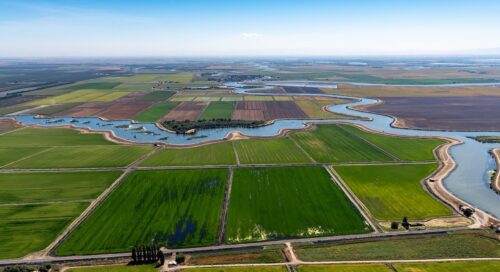
“Groups opposed to California’s Delta Conveyance Project had a second chance Thursday to argue why the massive water project fails to meet essential criteria and should return to the state water department for further workshopping. The Delta Stewardship Council heard appeals to a certificate of consistency for the massive water transfer system, making no decision that day whether to reject the appeal or send it back to the Department of Water Resources for more tweaking. The council can’t outright deny the project. A decision is expected Dec. 9. The council previously denied all appeals, except two. That led the department to rework its project certification on those two points: whether its facilities improve habitat conditions for the golden mussel, an invasive species; and if it considered and avoided, or reduced, conflicts between its twin cities complex and Sacramento Area Sewer District’s Harvest Water project. Those appealing and the Delta Protection Commission, the latter an advisory body for the council, said the water department failed to meet the mark. “It’s just too risky for our delta for all the things we’re trying to accomplish,” said Osha Meserve, representing a handful of appellants. … ” Read more from the Courthouse News Service.
Understanding the causes and impacts of 2026’s record-breaking El Niño
“Anxiety is high over this year’s El Niño. It’s breaking records, and hasn’t even peaked. So how does El Niño work? What might Southern Californians expect? And how can we prepare for a potentially rough winter? Climate, ocean and coastal-policy experts at UC Santa Barbara offer their perspective. The El Niño Southern Oscillation is a natural fluctuation of sea surface temperatures in the Pacific Ocean. The cycle repeats itself every 2 to 7 years, bringing warm water east from the tropical Pacific, toward the west coasts of North and South America for a year. Higher sea temperatures affect weather and ocean patterns, generally bringing strong storms to Southern California. So far, 2026 appears to be a superlative year. “The latest forecast out of NOAA gives a 75% chance that this will be the biggest El Niño since at least 1950,” said Samantha Stevenson, a climate scientist who specializes on the El Niño Southern Oscillation and a professor at UCSB’s Bren School of Environmental Science & Management. In fact, a recent study by Stevenson found that the cycle itself has become more intense over the last 40 years than in the previous 1,000 years. The threshold for El Niño is when surface temperatures in the tropical pacific are 0.5º Celsius higher than average for that time of year. Instruments show that the ocean surface is already 4º C higher at the equator. “And the subsurface temperatures are even higher,” Stevenson said. “It’s 10º Celsius warmer than normal along the equator.” … ” Read more from The Current.
Warm, wet winter in store for California. Here’s what to know.
“Winter is coming, and it looks warm and wet in California, according to new data. In a winter outlook published on Thursday, the National Oceanic and Atmospheric Administration provided national temperature and precipitation forecasts for December, January and February. The new outlook features how El Niño, the climate phenomenon that emerged in June and could reach historic strength this year, will influence winter weather. “As we know from decades of observations, a very strong El Nino will likely bring a southward and eastward shift to the jet stream for the contiguous U.S., which tilts the odds toward stormier weather across the South,” Ken Graham, director of NOAA’s National Weather Service, said in a statement. “While higher chances of rain and snow may bring relief to drought-afflicted areas, too much precipitation on dry soil can fuel destructive flash floods and mudslides. Now is the time for communities and individuals to plan ahead for the upcoming winter.” … ” Read more from SF Gate.
Restored riverside habitat is welcoming wildlife back across California
“Bureau of Land Management (BLM) Wildlife Biologist Tobias Felbeck stood among the grasses at Rancho Breisgau in Shasta County, where River Partners began restoring 150 acres of floodplain habitat in 2024. Looking high into the trees through his binoculars, he was surprised by what he saw. Felbeck spotted a Swainson’s hawk, a species designated as threatened under California’s Endangered Species Act (ESA), in a mature sycamore next to the restored area along the Sacramento River. The female hawk sat in a nest along with an adult male and two fledglings, the first confirmed nesting Swainson’s hawks in Shasta County in about 30 years. Habitat loss, fragmentation, and climate change have driven wildlife populations down across California, and some species have vanished from their historic range altogether. This summer, several rare bird species appeared at River Partners restoration sites. Each story is different, but together they show our restoration is working. … ” Read more from River Partners.
From the Capitol to California’s rivers: CalTrout’s 2026 policy progress
“For CalTrout, policy work is about translating what we learn on the ground into action in Sacramento. That means advancing legislation, advocating for investments in restoration and conservation, and bringing the needs of California’s native fish into broader conversations about water and natural-resource management. This year brought meaningful progress on all of those fronts. One of CalTrout’s biggest legislative successes this year was Senate Bill (SB) 1393 (authored by Senator McGuire), signed into law by Governor Newsom. CalTrout worked on and supported the steelhead provisions of SB 1393 to extend and modernize California’s Steelhead Report and Restoration Card Program. Operating since the early 1990s, the program provides the California Department of Fish and Wildlife (CDFW) with its only statewide, angler-reported dataset on steelhead catch, fishing effort, and harvest. CDFW uses this information to evaluate individual steelhead runs and inform seasons, bag limits, and other management decisions. Without legislative action this year, the program’s statutory authorization would have expired. … ” Read more from Cal Trout.
Scientists deploy a 24-armed secret weapon to save California’s kelp forests
“Off the coast of Monterey, California, a team of researchers is gearing up for its first dive of the day into the cold and choppy waters of the Pacific Ocean. On the back deck of the boat, Ashley Kidd, a co-founder of the non-profit Sunflower Star Laboratory, gave the divers their final command: “Dive No 1 … stars in the water.” The divers plunge into the water carrying plastic bags containing the true stars of this mission. On the ocean floor, they place the creatures inside specialized cages but keep the doors wide open. The goal is to encourage these alien-like predators to roam the seabed where they were once a crucial part of this underwater ecosystem. “We have a star that decided to go for a walk today,” Kidd said, tracking the progress of one particularly mobile subject. … ” Read more from The Guardian.
In commentary today …
Thanks to El Niño, California is getting a grim preview of its climate change future
Leah C. Stokes, Anton Vonk Associate Professor of Environmental Politics at UC Santa Barbara, writes, “This past weekend, Tropical Storm Rachel slammed into Southern California. High tides flooded streets in Newport Beach, and surf tore apart the Long Beach boardwalk, leaving homes on the verge of collapse. Storms like this rarely make landfall in California. But Rachel is just the latest impact from an El Niño that’s already the strongest ever recorded. It may just be the strongest in a thousand years. During El Niño years, warm water pools in the eastern Pacific, particularly off Peru, and weather around the world goes haywire. The last big El Niño to drench California came in 1997, flooding the state that winter — and this year’s is looking even stronger. In Southern California, it’s easy to feel the effects. In the past few weeks, temperatures have topped 100°F — in October. That’s around 22° above normal. To try to cool down, I’ve often taken my kids to the ocean, which, at 10° warmer than normal, has felt more like the Caribbean. Climate change already has the Pacific running a fever, and with El Niño on top, it’s smashing records. … ” Continue reading at the San Francisco Chronicle.
In regional water news and commentary today …
NORTH COAST
Lower Trinity River nearing quota; Adult fall-run chinook salmon fishery to close
“Based upon California Department of Fish and Wildlife (CDFW) projections, anglers will have met the Lower Trinity River adult fall-run Chinook salmon quota below the Denny Road Bridge at Hawkins Bar for the 2026 season as of 11:59 p.m. on Friday, Oct. 16. This triggers the closure of the adult Chinook salmon fishery on the Trinity River from the Denny Road Bridge at Hawkins Bar to the confluence with the Klamath River. The quota for this portion of the river is 536 adult fish. The reach will remain open, however, to the harvest of jack (2-year-old) Chinook salmon (less than or equal to 23 inches). All adult Chinook salmon caught must be immediately released. … ” Read more from the Department of Fish and Wildlife.
‘We are the watchdogs for the bay’: Aquaculture concerns raised in offshore wind webinar
“Shellfish growers and researchers, during a webinar on Tuesday, outlined a range of threats they believe the proposed offshore wind heavy‑lift marine terminal could pose to Humboldt Bay’s aquaculture industry, including the introduction of viral disease, dredging impacts, chemical exposure, harmful algal blooms, and long‑buried contaminants. The webinar, led by Tanner Etherton of the Schatz Energy Research Center, began with an overview of California’s offshore wind infrastructure needs and the state’s identification of Humboldt Bay as one of three viable assembly‑port sites. The proposed Humboldt Bay Offshore Wind Heavy Lift Marine Terminal would be built on the Samoa Peninsula, south of the state Route 255 bridge and adjacent to long‑established shellfish operations, historic industrial sites and Wiyot homelands. Humboldt Bay supports recreation, tourism, fisheries and one of the most important aquaculture regions on the West Coast. … ” Read more from the Eureka Times-Standard.
PG&E plans November repair of void at Cape Horn Dam in Mendocino County
“PG&E plans to start repairing a void at the base of Cape Horn Dam by Nov. 20, according to a letter the utility filed with federal dam-safety regulators Oct. 6. Cape Horn Dam holds back Van Arsdale Reservoir on the Eel River in Mendocino County. An intake 400 feet upstream of the dam sends Eel River water into the Potter Valley Project’s tunnels. The water runs to the Potter Valley powerhouse, which empties into the East Fork of the Russian River. PG&E is obligated to deliver up to 19,000 acre-feet of that water to the Potter Valley Irrigation District, according to the Federal Energy Regulatory Commission. The dam is also home to the Van Arsdale Fisheries Station, where salmon and steelhead climb a fish ladder past the dam. … ” Read more from the Mendocino Voice.
SIERRA NEVADA
More eyes on Tahoe, more protection for the lake
“Protecting Tahoe means more than preserving the lake’s beauty. It means identifying emerging threats, engaging the public, and turning science into solutions that keep the Tahoe Basin healthy and enjoyable today and for future generations. Thanks in part to a $30,000 Tahoe Community Foundation 30th Anniversary Grant, environmental nonprofit Keep Tahoe Blue is expanding its science-guided programs that empower residents, visitors, students, and volunteers to play an active role in protecting Tahoe. Keep Tahoe Blue was selected as one of four nonprofit organizations recognized through the Community Foundation’s special anniversary grant initiative celebrating 30 years of philanthropy and community impact. “Protecting Tahoe takes a village. We’re incredibly grateful to have a generous and forward-looking partner in Tahoe Community Foundation,” said Keep Tahoe Blue’s CEO Darcie Goodman Collins, PhD. “Their continuing support allows us to do the multi-year work required to transform science into solutions, so we can conserve what we all love about this natural treasure.” … ” Read more from South Tahoe Now.
Nevada City approves water and wastewater rate increases amid resident opposition
“Following months of deliberation, Nevada City Council officially moved to adopt a five-year rate schedule for water and wastewater (sewer) rate increases during its regularly scheduled meeting on Wednesday, October 14 at City Hall. The decision was made in the wake of a lengthy public hearing on the matter, in which numerous residents questioned the timing, practicality, and affordability of potential rate changes while urging the council to consider funding alternatives for improving the city’s aging infrastructure — including water and sewer lines that officials described as nearly a century old. Per city officials, under the proposed schedule, water rates will be set to a recommended increase of approximately 25% annually, while wastewater charges will rise under a separate schedule with recommended increases of roughly 12% annually. However, rate increases for each customer may vary depending on a parcel’s water usage per 1,000 gallons consumed, as well as customer classification and meter size. … ” Read more from The Union.
Placer County Water Agency breaks ground on Ophir water treatment plant
“The Placer County Water Agency on Thursday officially broke ground for construction of a new $208 million water treatment plant in Ophir that will serve the growing communities in the county’s western region. County and PCWA officials spoke about the importance of the project, which will expand treated water capacity in the region initially by 10 million gallons a day. The plant’s ultimate capacity allows for 30 million gallons of water to be treated daily, while underground pipelines have been designed to accommodate up to 60 million gallons a day “should future regional needs ever require it,” according to PCWA. “Previous generations [here] had the foresight, 70 years ago, to secure our water resources by forming the Placer County Water Agency, and over 60 years ago to build the French Meadows Reservoir (near Foresthill) and Hell Hole Dam (near Lake Tahoe) – and we didn’t even need that water here until 15 years ago,” Primo Santini, District 2 PCWA board member, told the crowd gathered at the construction site Thursday. … ” Read more from Gold Country Media.
SACRAMENTO VALLEY
Investing in life on the move: Sacramento Valley floodplains support remarkable migrations
“Every year, the Sacramento Valley is home to some of the most remarkable wildlife migrations in North America. Chinook salmon move from our rivers to the Pacific Ocean and eventually return to the waters where their lives began. At the same time, millions of ducks, geese and shorebirds travel along the Pacific Flyway, using the Sacramento Valley as an essential place to rest, feed and prepare for the next leg of their journeys. A new Floodplain Forward publication, Investing in Life on the Move, illustrates an increasingly important principle for the Sacramento Valley: healthy rivers depend on healthy landscapes, and reconnecting water with the landscape at the right time can provide extraordinary benefits for fish and wildlife. … ” Read more from the Northern California Water Association.
‘Return of the Salmon Festival’ at Coleman Hatchery Saturday
“Salmon are making their way back to the Coleman Fish Hatchery in Anderson for October spawning, and on Saturday, the facility will host its 35th annual festival, celebrating the return of the fish. The event will feature exhibits, and will have food available as a fundraiser for the Red Bluff High School class of 2028. The family friendly “Return of the Salmon Festival” at the hatchery, located at 24411 Coleman Fish Hatchery Road, Anderson, offers free parking and admission. The festival will take place from 9 a.m. to 3 p.m. on Saturday. Attendees can observe the salmon spawning operations and view the fish. Children’s activities will be offered, and there will be many educational booths. The festival offers the only weekend day of the year where all the operations at the hatchery are running, so people can observe the whole life-cycle of the fish. For those unable to make it to the festival, the hatchery is open to the public daily for self-guided tours, from 8 a.m. to 4 p.m. … ” Read more from the LA Daily News.
Vina groundwater agency says no to raising minimum water level
“The Vina Groundwater Sustainability Agency board of directors on Wednesday voted against a plan by suggested by Chico State Professor Todd Greene to protect at-risk wells from going dry. The agency is working on its 5-year review of its groundwater sustainability plan and voted in August to set new criteria for “minimum threshold” of the water table. It also established a “local management level” that triggers an assessment of domestic wells when levels fall 15 feet below the objective water level. Greene, a member of the stakeholder advisory committee for Vina GSA and an environmental services professor, said Wednesday he thinks that the minimum threshold set by the agency is too low, and would cause “irreversible consequences” if that level is met. The agency considered Green’s alternative Wednesday in the Chico City Council Chambers, which suggested raising minimum thresholds from an average of 63 feet to a flat 40 feet. … ” Read more from the Chico Enterprise-Record.
BAY AREA
The light and dark of bioluminescence in the San Francisco Bay Area
“We met at the water’s edge at dusk. The evening was warm and the sky was clear—a nearly perfect early September evening for a paddle in the dark. At this time of year, roughly 75 miles north of San Francisco, at the mouth of the Russian River, when the moon has faded and the water temperatures and tides are just right, the water glows. Our group of six had come to the small town of Jenner, along the Sonoma County coast, to experience the bioluminescence of the Russian River’s estuary. The conditions on the night of our visit, as luck would have it, were nearly perfect. The water extended to the horizon like polished glass. There was not a trace of wind and only the wispiest cloudlets hung over the typically fog-choked bay at the river’s terminus. Most importantly, the thin crescent of the waning moon would not rise until much later in the evening. … ” Read more from Bay Nature.
Commentary: West Valley residents should be prepared for problems El Niño can bring
Nai Hsueh, Valley Water Board Director for District 5, writes, “Powerful storms can change conditions quickly and leave very little time to react to flooding. Here in Santa Clara County, these risks increase during El Niño years, when warmer ocean waters in the eastern tropical Pacific influence storm patterns, leading to more moisture in the air and stronger winter storms. During a strong El Niño, as forecast for the upcoming season, our region is more likely to experience repeated heavy rainfall over extended periods. Valley Water monitors these changing conditions closely and works year-round to maintain flood protection infrastructure. However, we only own or have access to maintain about 350 of the more than 800 miles of creeks in the urbanized valley areas of Santa Clara County. The remaining stretches of creeks are owned by private property owners and by public agencies. Heavy and prolonged rainfall, like the type El Niño might bring, can challenge even well-maintained systems, and overflowing creeks or reservoirs can create situations where every minute counts. That’s why personal preparedness is so important. … ” Read more from the San Jose Mercury News.
CENTRAL COAST
Portion of Carmel Beach under advisory as Monterey County flags high indicator bacteria
“Monterey County issued an advisory for a portion of Carmel Beach on Thursday. Carmel Beach at Ocean Avenue is under an advisory because of “high indicator bacteria” found in samples collected Oct. 12, 2026. The beach will remain under an advisory until samples show that indicator bacteria levels are safe for water use under state guidelines. Higher bacteria levels are associated with an increased risk of illness. … ” Read more from KSBY.
SAN JOAQUIN VALLEY
‘I don’t think we’re completely ready’: Central California farmers prepare for El Niño winter
“In March of 2023, the Central Valley was hit by back-to-back storms. Heavy rain caused catastrophic flooding at the Tulare Lake Basin. “We had more water than what we could capture and what we could move,” says Laura Ramos. Water rushed in and overnight, over 100,000 acres were underwater. Roads turned into rivers with cars and buildings submerged. One poultry ranch was flooded. … ” Read more from Channel 30.
Webinar: Funding available for Fresno Irrigation District growers
“The Natural Resources Conservation Service (NRCS) will hold a webinar on funding opportunities for Fresno Irrigation District growers on Oct. 19. The webinar will begin at 3 p.m. The NRCS, as part of the United States Department of Agriculture, has funding available to support water conservation and improve irrigation efficiency on growers’ farms. The Fresno Irrigation District was selected for funding through two NRCS programs, the EQIP-WaterSMART Initiative and the Groundwater Recharge Pilot Program. The webinar will present step-by-step instructions for applying to both. Grant applications are due Nov. 6. … ” Read more from SJV Water.
SOUTHERN CALIFORNIA
Santa Ana winds to bring back heat, boost wildfire risk in Southern California
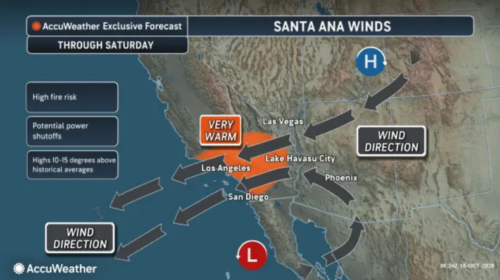 “A familiar weather pattern for October — a Santa Ana — will help temperatures surge across much of Southern California into this weekend. The dry, gusty winds will boost the risk of wildfires just days after Rachel soaked and chilled a large part of the southwestern United States. High pressure building from Northern California to Nevada and Utah, combined with a storm high in the atmosphere farther south, will help drive dry, northeasterly winds across Southern California. These Santa Ana winds are most common from September to May. As Santa Ana winds descend from the mountains toward the coast, the air will warm, bringing highs in the upper 80s and 90s to many locations, including some beach communities, through the weekend. … ” Read more from AccuWeather.
Along the Colorado River …
After strong monsoon, winter rainfall could recharge Arizona aquifers
“On the heels of the two driest winters on record, drought conditions across Arizona have slightly receded thanks to a strong monsoon boosted by tropical storms and a strong El Niño in the Pacific. Arizona received above average precipitation in September and the first half of October, especially in the Phoenix Valley and up north in Coconino and Yavapai Counties. “It’s really difficult to see any signature of drought in those areas,” National Weather Service meteorologist Mark O’Malley said of northern Arizona. O’Malley presented a silver lining to Arizona’s Drought Monitoring Technical Committee Thursday morning, but assured his fellow experts that the end of the long-term drought is still far off. “Unfortunately over the past several years we’ve been much warmer than average,” he said. … ” Read more from the Courthouse News Service.
Drought has decimated Colorado’s largest reservoir, leaving locals struggling
“Anyone can see that something is deeply wrong at Blue Mesa Reservoir on the Western Slope. It’s historically been the biggest body of water in the state. But not anymore. The deep, long-lasting drought has shrunk it so much that it lost that title to Lake Granby up north. Now it looks like someone’s opened the drain on a gigantic, rocky bathtub, with only a bit of shiny blue water pooled at the bottom. Amy Riser stood on the long boat ramp at Elk Creek Marina, which her family has run for more than 40 years. It was a sunny and hot August day, when this place should have been “jamming with people,” she said. Instead, the water was empty. Blue Mesa stood at less than 20% full, lower than it had ever been. … ” Read more from Water Education Colorado.
In national water news today …
El Niño threatens global sugar supply
“Conflict. Climate change. A withering El Niño. All are conspiring to spoil the world’s sweet tooth. Global sugar prices have soared, as a hot, dry summer scorched much of the sugar-producing parts of the world, nudging overall food prices upward. Nowhere is that felt as acutely as it is in India, the biggest sugar consumer in the world and the second-biggest producer. The worst monsoon in 11 years and fears of a poor sugarcane harvest have spiked prices amid the Hindu festival season, when gods and mortals alike are feted with sweets. Making matters worse, high sugar prices are also complicating India’s energy security goals. Sugarcane is a key crop for the country’s biofuels push, all the more so as India seeks to curb oil imports while the waterways of the Middle East are choked by war. … ” Read more from the New York Times.

