
Several news sources featured in the Daily Digest may limit the number of articles you can access without a subscription. However, gift articles and open-access links are provided when available. For more open access California water news articles, explore the main page at MavensNotebook.com.
On the calendar today …
- MEETING: State Water Resources Control Board beginning at 9am. Agenda items include Consideration of a proposed Resolution to adopt Proposition 4 Stormwater Grant Program Guidelines; Summary of Results from the 2025 Volumetric Annual Report of wastewater and recycled water in California; Informational item to provide an update on implementation of the Central Valley Salt Control Program; and a Board Workshop on the Draft Fiscal Year 2026-27 Fund Expenditure Plan for the Safe and Affordable Drinking Water Fund. Click here for the agenda.
- MEETING: State Board of Food and Agriculture from 10am to 2pm. Agenda items include a presentation on the California Climate Forecast by Michael Anderson, State Climatologist; Panel discussion on flood preparedness; a presentation on Managing Groundwater with Small Farmers in Mind; a panel discussion by Fresno State on The Forge Innovation Hub & AI Supercomputing Center; and a presentation on Agricultural Technology and Innovation in Queensland, Australia. Click here for the agenda and remote access instructions.
- WEBINAR: Reframing the Rarity of Extreme Low-Snow Years in the Upper Colorado River from 1pm to 2pm. Mountain snowpack reflects both anthropogenic warming and substantial internal climate variability, complicating efforts to determine when forced changes emerge from the historical range of variability and become consequential to water resources. In the Upper Colorado River Basin (UCRB), this challenge extends beyond detecting long-term declines in mean snowpack to understanding how warming is reshaping the occurrence of extreme low-snow years. Water year (WY) 2026 produced the lowest basin-wide snowpack on record, providing a timely benchmark for evaluating this changing risk. Google Meet video call link: https://meet.google.com/rwm-ebtk-kgn
In California water news today …
U.S. water rates soaring, with Bay Area bills among highest in nation
 “Water rates in the United States have risen more than twice as much as groceries over the past decade, and more than 1.5 times the overall rate of inflation, which has left Bay Area residents with some of the biggest water bills in the nation, according to a new report. An analysis of the country’s 500 largest community water providers, published by the consumer advocacy group Food and Water Watch on Tuesday, cites the privately held San Jose Water Company as the nation’s most expensive water retailer. The utility’s rates are more than 2.5 times the national average, the report says. Also among the 15 U.S. water providers with the highest rates are the Marin Municipal Water District, San Jose’s municipal water department and the San Francisco Public Utilities Commission. Thirteen of the 25 most expensive providers are in California, with their rates averaging more than twice the national average. … ” Read more from the San Francisco Chronicle.
SEE ALSO:
- Water Bills Surged More Than Other Costs in US Homes Over 10 Years, a ‘Striking’ New Report Shows, from Inside Climate News
- Rising Water Bills Have Added to the Squeeze on American Households, from Bloomberg
Protecting California’s water from cyberattacks
“In June, Iranian hackers breached California Water Service systems and claimed they could have shut down water service to thousands of customers. According to Cal Water, those claims were false, but the next month, more water sector cyberattacks targeted systems in at least 12 states across the United States. While most impacts were relatively minor, in Minnesota, the hardest-hit state, a coordinated attack hit more than 30 water systems over two days. California appears to have largely been spared in this summer’s cyberattacks on US water agencies, but the threat remains. In late August, another group threatened the US with “unexpected and critical events in the energy, water, and telecommunications industries.” Fortunately, water providers can take relatively simple cyber hygiene steps—like ensuring strong passwords and multifactor authentication to protect water security. In fact, it’s been reported that nearly all cyber security incidents could have been prevented with better cyber hygiene. That said, water agencies with small staffs and budgets can find it difficult to balance security with ease of use. … ” Read more from the PPIC.
SEE ALSO: The US needs a real plan to defend its water systems, from CyberScoop
Why California’s second-largest reservoir is falling faster than usual this year
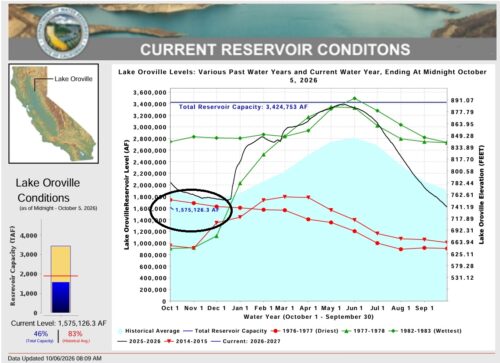 “Lake Oroville was nearly brimming in mid-May, sitting three feet from the top at 99 percent of capacity. Less than five months later, the state’s second-largest reservoir has given back roughly 145 feet of that water. The lake now sits at 752 feet in elevation, about 47 percent of capacity, and that the level is falling faster than it has in previous years. The paper tied the decline to a long dry spell that set in early in the spring. Federal reservoir data from September 28 shows how lopsided the math has been, with the Army Corps of Engineers logging about 2,400 cubic feet per second flowing into the lake and more than 9,200 flowing out. The surface was dropping close to a foot and a half per day, and the lake was at 50 percent of capacity as recently as September 23. … ” Read more from Active NorCal.
Super El Niño is here. What’s so super about it?
“Federal forecasters say this year the planet could see the strongest El Niño event on record. It’s already being called “Super El Niño” and even “Godzilla El Niño.” El Niño is a natural climate pattern that has far-reaching impacts across the planet, potentially affecting hundreds of millions of people. Where those impacts happen can vary drastically from one El Niño to the next. Here are the basics of what this historic event could bring. El Niño occurs every two to seven years. It develops when a vast amount of water in the eastern Pacific Ocean warms up around the equator. That water releases massive heat, redistributing warmth from the ocean to the atmosphere. That shifts weather patterns around the world. The flip side of El Niño is a La Niña, which is marked by relatively cool water in the tropical Pacific around the equator. These events are responsible for some of the biggest weather variability the planet experiences. … ” Read more from the LAist.
How a record-breaking El Niño could supercharge California’s winter storms
“Few states are more sensitive to what’s happening in the Pacific Ocean than California — and what’s happening in the Pacific this year has no modern precedent. Because of that, California is expected to face a much higher risk than normal for powerful, moisture-laden storms late this fall and winter, especially from December onward, driven in part by a record-breaking El Niño that resulted in a statewide emergency declaration last month. Storms, high tides and potentially unparalleled sea levels could raise the chances of coastal and inland flooding and chip away at the beach. The fallout could be a stark reminder of the longer-term challenges facing communities on an eroding shore. … ” Read more from the Washington Post.
Spring runoff may drive microplastic surges in Western rivers, study finds
“Microplastic concentrations in Nevada’s Truckee River increased nearly tenfold during spring runoff, according to new research that offers a glimpse into how plastic pollution moves through some western waterways. Researchers with the Desert Research Institute sampled the river, which flows from Lake Tahoe through Reno and eventually to Pyramid Lake, during low flows in fall 2022 and again during unusually high spring flows in 2023. On average, they detected 0.4 microplastic particles per liter in the fall and 3.7 per liter in the spring. Monica Arienzo, who leads DRI’s Microplastics and Environmental Chemistry Lab, illustrates the seasonal difference with a quart-sized mason jar. … ” Read more from KUNR.
Why federal water managers just shut the gates on the Delta, with no reopening date
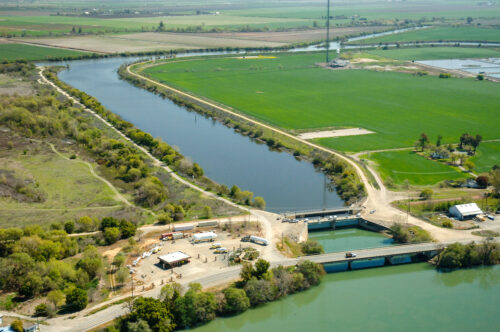
“Two radial gates weighing a combined 243 tons swung shut near Walnut Grove on Monday morning with no date set to reopen them. The Bureau of Reclamation closed the Delta Cross Channel at about 10 a.m. Oct. 5 to give adult fall-run Chinook salmon a cleaner path to their spawning grounds. Reclamation aims to protect salmon passage and keep river flows steering migrating fish toward the lower Mokelumne River, with reopening tied to Delta conditions and the latest fisheries data. Action News Now reported a shorter 24-hour closure last Thursday into Friday. The 6,000-foot channel, about 30 miles south of Sacramento, links the Sacramento River to the interior Delta. With the gates open, river water pours into the Mokelumne system and on toward the federal pumps near Tracy, which can scramble the cues Mokelumne-bound salmon use to find their way home. … ” Read more from Active NorCal.
Kings County groundwater pumping case heads to merit hearing Tuesday
“Kings County farmers will soon find out if they have to pay pumping fees after the Tulare Lake subbasin was put on probation by the state Water Resources Control Board two years ago. A Kings County Court will hear the Kings County Farm Bureau’s legal challenge on Tuesday to determine the merits of the lawsuit. The backstory: The Kings County Farm Bureau sued the Water Resources Control Board in 2024 after the Tulare Lake subbasin was placed on probation, bringing $20 per acre foot pumping fees with that designation. … ” Read more from SJV Sun.
Dave Puglia: Water and automation could shape California agriculture’s future
“On today’s episode of the AgNet News Hour, Dave Puglia, president and CEO of Western Growers, joined us for Part 2 of a wide-ranging conversation about the future of California agriculture. From water infrastructure and rising production costs to automation and the next generation of farmers, Puglia offered his perspective on where the industry goes from here. Water remains one of the biggest pieces of that conversation. Puglia said California needs additional surface storage, canals, aqueducts and groundwater storage, but argued that simply building infrastructure isn’t enough. The state also needs to address the regulatory system governing how that infrastructure is developed and operated. He also raised a bigger question about who benefits from agricultural water infrastructure—and who should pay for it. Puglia pointed to Sites Reservoir as an example, arguing that the economic activity, employment and tax revenue generated by productive farms should be considered part of the broader public benefit when projects are financed. … ” Read more from AgNet West.
LAO: The 2026-27 California Spending Plan: Natural Resources and Environmental Protection
 “This post begins by providing an overview of total spending for the departments overseen by the California Natural Resources Agency (CNRA) and California Environmental Protection Agency (CalEPA). Next, we discuss certain cross-cutting issues that affect departments in both agencies, including spending from the Greenhouse Gas Reduction Fund (GGRF). We then discuss individual departments that had notable budget changes within each of the two agencies. We conclude with a summary of budget allocations from Proposition 4, the climate bond approved by voters in November 2024.” Read the report from the LAO.
California links data center permitting and licensing to new water use disclosure and drought planning obligations
“Governor Newsom signed Assembly Bills (AB) 2469 and 2619 into law on September 21, 2026, as part of a seven-bill package his office described as “the most comprehensive data center laws in the nation.” Both bills are successors to legislation the Governor vetoed last year (AB 93) and impose new water use disclosure and planning obligations on data center developers and operators. AB 2469 and 2619 are intended to close gaps in California’s regulations and policies to specifically address data center water supply impacts by creating concrete compliance steps that did not previously exist. AB 2469 and 2619 will take effect on January 1, 2027. This alert summarizes what each bill requires and identifies the practical implications for data center development in this state. … ” Continue reading from Allen Matkins.
SEE ALSO: California enacts comprehensive regulatory framework for data centers, from the National Law Review
Newsom vetoes bill aimed at funding Sacramento-San Joaquin Delta levee repairs, water infrastructure
“The Sacramento-San Joaquin Delta is a critical part of California’s water system, connecting water supplies in Northern California with areas farther south. For years, the infrastructure that surrounds the delta has been in need of major repair. “Both the levees and the subsided conveyance infrastructure need upwards of $3 billion to repair them,” Restore the Delta Director of Policy and Programs Morgen Snyder explained. A blow came to advocates when Gov. Gavin Newsom vetoed Senate Bill 872 for the Delta Levees and Canal Subsidence Fund. It was meant to be part of the state treasury to restore water conveyance capacity and help fund delta levee projects down the road. … ” Read more from CBS Sacramento.
Newsom vetoes tribal water‑rights and sacred‑site protections as Klamath Basin rivers run dry
“Days after apologizing to California tribes for historic state‑driven harms, Gov. Gavin Newsom vetoed two bills aimed at protecting tribal sacred places and water rights. Newsom on Wednesday rejected the California Indian Freedom Act (AB 1881) and the Indigenous Water Rights Act (AB 2218), despite unanimous votes in both chambers of the State Legislature. The bills sought to strengthen tribal oversight of ancestral lands and waterways and ensure tribes had a formal role in state water‑rights and environmental decisions. “As a California Yurok and Karuk tribal person, I should not have to wonder whether a future change in state leadership or agency policy could prevent me and my family from accessing our religious and cultural sites that we have been maintaining since time immemorial,” said Brook Thompson, interim executive director of Save California Salmon. “If the governor believes these protections create uncertainty, despite bipartisan support, he should at least have the decency to tell us exactly what he wants to see for us to have these basic protections.” … ” Read more from the Eureka Times-Standard.
In commentary today …
California Sportfishing Protection Alliance and allies comment on August final draft Bay-Delta Plan
“On September 18, 2026, CSPA joined a coalition of environmental organizations, fishing organizations, and Tribal advocates in comments on the August “Final” Draft Bay-Delta Plan. The State Water Board issued the draft on August 19, 2026. At the center of the proposed August Final Draft Plan are “Voluntary Agreements.” This alternative framework substitutes small amounts of flow, and physical changes in and around rivers, for new flow requirements based on a percent of unimpaired flow into San Francisco Bay. The Voluntary Agreements will not work. The comments state: “The VAs will preserve the status quo under a new name, maintaining anemic and inadequate flows at an exorbitant cost that is highly unlikely to attain instream water quality objectives.” … ” Read more from the California Sportfishing Protection Alliance.
California Sportfishing Protection Alliance and allies comment on revised draft Water Rights Permit for Sites Reservoir
“On October 5, 2026, CSPA joined allied environmental organizations, fishing organizations, a Tribe, and Tribal advocates (“NGO Parties”) in comments on the Revised Draft Water Rights Permit and Revised Draft Water Rights Decision on the proposed Sites Reservoir. The State Water Board and its Administrative Hearing Office released the revised documents on September 3, 2026. CSPA and allies oppose granting a water right for Sites. However, the State Water Board is likely to grant a permit. Therefore, the comments of NGO Parties largely focus on the flow requirements in the Revised Draft Permit. The first (March) Draft Permit included a stand-alone requirement that 55% of the unimpaired flow must be passing into and through the Delta as a precondition to diversions to Sites Reservoir. Following political pressure and opposition from the Sites Authority and others over the summer, the Revised Draft Permit removed this requirement. Instead, Revised Draft Permit requires compliance with an updated Bay-Delta Plan, which, in its current (but not yet adopted) August Draft, includes a 55% of unimpaired flow requirement for “new water supply projects.” … ” Read more from the California Sportfishing Protection Alliance.
In regional water news and commentary today …
SIERRA NEVADA
Calaveras County Water District begins relicensing process for North Fork Stanislaus Hydroelectric Project
“The Calaveras County Water District(CCWD) has begun the federal relicensing process for its North Fork Stanislaus River Hydroelectric Project, filing initial documents with the Federal Energy Regulatory Commission. CCWD filed a Pre-Application Document and Notice of Intent to Relicense the project, marking the first major step in a process that will evaluate the project’s future operations and its environmental, cultural, and recreational impacts and benefits. The North Fork Project is CCWD’s largest source of water supply and has 258 megawatts of hydroelectric generating capacity. Its major facilities include New Spicer Meadow Reservoir and Powerhouse, McKays Point Reservoir, and the Collierville Tunnel and Powerhouse. CCWD owns the project, which is operated in collaboration with the Northern California Power Agency. The district’s current 50-year federal license was issued in 1982 and expires January 31st, 2032. … ” Read more from My Mother Lode.
SACRAMENTO VALLEY
Oroville Dam river valve outlet rehabilitation complete after nearly a decade
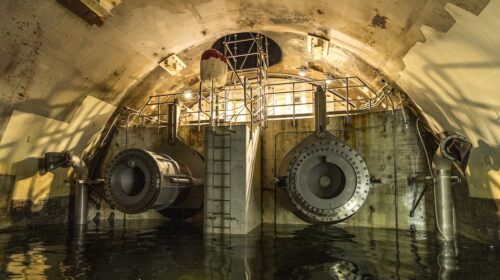
“A major rehabilitation project deep inside Oroville Dam is now complete. The project provides the California Department of Water Resources (DWR) another way to release water from the lower portions of Lake Oroville when it needs to manage water temperatures or when reservoir levels become too low to use other release points. DWR recently finished a $235 million rehabilitation of the dam’s River Valve Outlet System, or RVOS. The system sits deep inside one of Oroville Dam’s diversion tunnels and is used to release colder water from deeper parts of the lake. That water can be used to manage downstream temperatures, while the system also serves as a backup when other release points are unavailable. … ” Read more from KRCR.
Get a rare look inside Roseville’s water system
“Roseville water customers will have a rare opportunity to step inside a working groundwater facility during the City’s See What’s Beneath the Surface: Groundwater Open House on Saturday, October 10. The free, family-friendly event will run from 10 a.m. to noon at 4030 Solaire Drive. Visitors can walk through the site, meet Roseville water professionals, and see how groundwater helps support the community’s water supply. Groundwater is an important part of Roseville’s water system, say city officials. When water is plentiful, Roseville can store some of it underground for later. When conditions are drier and less surface water is available, that stored water can be brought back into the system. So far in 2026, Roseville has stored nearly 1.8 billion gallons of water underground, enough to meet the annual water needs of about 16,000 Roseville homes annually. The city currently has six groundwater wells in service and two more under construction, with a long-term goal of up to 12 wells. … ” Read more from Gold Country Media.
NAPA/SONOMA
Sonoma County’s public trust analysis for new groundwater well permitting regime upheld but CEQA exemption determination overturned
“A court of appeal has ruled that Sonoma County’s amended groundwater well permitting ordinance meets public trust requirements but does not qualify for the CEQA exemptions upon which the County relied. Russian Riverkeeper v. County of Sonoma, 122 Cal.App.5th 382 (2026). The ordinance amendments arose from the decision in Environmental Law Foundation v. State Water Resources Control Board, 29 Cal.App.5th 844 (2018), which held that California law imposes a fiduciary duty on counties, as “subdivisions of the state,” to consider the public trust in permitting groundwater wells that affect navigable waterways. Under the public trust, the sovereign owns all of its navigable waterways and the lands lying beneath them “as trustee of a public trust for the benefit of the people.” In California, the doctrine requires the state “to take the public trust into account in the planning and allocation of water resources, and to protect public trust uses whenever feasible.” … ” Continue reading at Ashurst Perkins Coie.
BAY AREA
EPA touts $82M for SF Bay water grants, while Trump administration proposes scuttling the program
“In the midst of the Trump administration’s dramatic policy shifts and contractions for the federal government’s natural resource agencies, the U.S. Environmental Protection Agency this month announced $82 million in grants for San Francisco Bay water quality projects—such as pollution cleanup and habitat restoration—the most the program has ever awarded at once. “It’s incredibly encouraging to see, because this is funding that’s actually been long delayed by the administration,” says Josh Quigley, policy manager at the nonprofit Save the Bay, which has advocated for the San Francisco Bay program. Last year the grant program was held up while the Trump administration reviewed its authority. The program has been funded at around $55 million per year since it was founded in 2022, so this year’s big pot is about a year and a half’s worth of funding, according to Luisa Valiela, the longtime program manager. Grantees are required to come up with a 25 percent match, which puts the total investment in the area at around $102.5 million. … ” Read more from Bay Nature.
CENTRAL COAST
Berry steam treatment pilot program gets underway in Santa Cruz County
“Drivers winding down San Andreas Road in La Selva Beach recently were treated to an unusual site as they gazed out onto the field of Tomatero Organic Farm: a tractor pulling a high-tech trailer that appeared to be emitting a lot of steam. What they saw was Santa Cruz County’s latest effort to test out a potential alternative to fumigation: the steam treatment pilot program. The county Agricultural Commissioner’s Office has partnered with Salinas company High Degree to test out the use of soil steaming — in which specialized equipment is used to inject high-temperature steam into the soil before berry crops are planted — as a potentially viable substitute for fumigation. The goal is to explore a technology that would not have the health risks associated with pesticides but could still protect crops against pathogens and other soil-borne pests. … ” Read more from the Monterey Herald.
SAN JOAQUIN VALLEY
The work beneath the waterline
“It is easy to imagine a flood as one dramatic event: rain pours down, a river overflows and water rushes into streets and homes. But flood danger typically begins quietly, long before the rains. It can start with high water seeping under or through a levee or moving through a burrow in a levee created by ground squirrels or other rodents. Therein lies the impetus for the San Joaquin Area Flood Control Agency’s (SJAFCA) partnership with the U.S. Army Corps of Engineers on its Lower San Joaquin River Project, a nearly $2 billion flood-protection effort to substantially reduce flood risk in north and central Stockton. Other project partners include the CA Central Valley Flood Protection Board and the CA Department of Water Resources. After a 2025 groundbreaking, the long-term project is expected to continue through 2045 and ultimately improve approximately 24 miles of levees that protect the region. … ” Read more from Comstock’s.
Workshops to help Kings County growers with new water platform set
“Hanford-area landowners and pumpers will soon be able to track their pumping allocation and groundwater usage as the Mid-Kings River Groundwater Sustainability Agency implements its new online groundwater platform. Mid-Kings set pumping allocations for farmers last year at 1.43 acre feet per acre of land. That allocation began as of Oct. 1, which is the start of the 2026-2027 water year. Mid-Kings will hold two workshops to help landowners get a feel for how to use the new platform. … ” Read more from SJV Water.
Work begins on $200mil Friant-Kern Canal modernization
“Federal and local water officials broke ground Thursday on the first phase of a major effort to modernize the Friant-Kern Canal and improve water deliveries across the southern San Joaquin Valley. The project will begin by replacing five aging pump stations along a realigned section of the canal. Eight additional stations are planned during a second phase, bringing the total to 13. The big picture: The Department of the Interior has directed $200 million in federal funding toward improvements to the Friant-Kern Canal. … ” Read more from the San Joaquin Valley Sun.
SOUTHERN CALIFORNIA
Powerful El Niño could slam Southern California. Here’s how LA is preparing
“As Southern California endures a dangerous October heat wave, Los Angeles officials are preparing for a potentially powerful El Niño season. At the new Los Angeles Department of Water and Power Emergency Operations Center, the warnings went out that the El Niño weather event that is forecast has the potential, with warmer ocean water, to deliver damaging weather conditions to Southern California. The National Weather Service said strong El Niño events can increase the likelihood of wetter-than-normal conditions across Southern California during the winter. … ” Read more from KABC.
Along the Colorado River …
Low water levels, high demand force a reckoning for the Colorado River
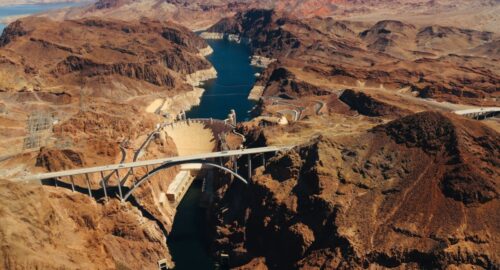 “If you lean over the top of the Glen Canyon Dam to get a full view of the concrete pillar that buttresses one of the largest dams in the United States against its second-largest reservoir, half a dozen water elevation markers will come into view. But when engineers were building Glen Canyon Dam in the mid-20th century to create another reservoir on the Colorado River, they never thought that the water would be this low. Beneath the lowest marker, there is still more than 100 feet of exposed dam before the structure disappears beneath the deep teal water of Lake Powell. The elevation in early October was 3,518 feet. That’s less than one-quarter full, lower than the prior all-time low set in 2023. By early next year, the reservoir could hit “minimum power pool” for the first time, which means the water is too low to power the dam’s eight hydroelectric turbines. Dam employees say they have no operational experience for what they’re facing now. … ” Read more from the Christian Science Monitor.
Colorado River framework faces gap between law and water supply
“Colorado River water supplies nearly 40 million people and irrigates approximately 5.5 million acres across a basin spanning more than 246,000 square miles, yet the river is delivering far less water than its foundational legal framework assumed. A Congressional Research Service (CRS) report updated Oct. 1 finds that average natural flows from 2000 to 2024 ran approximately 12.4 million acre-feet (MAF) per year, well below the combined commitments of 7.5 MAF annually allocated to each basin under the Colorado River Compact of 1922 and the additional 1.5 MAF guaranteed to Mexico under the 1944 U.S.-Mexico Water Treaty. The Bureau of Reclamation, part of the Department of the Interior, finalized a new 10-year operating framework on Aug. 21, covering 2027 through 2036, after Upper and Lower Basin states submitted separate proposals in 2024 but could not agree on a basin-wide approach. The framework took effect Oct. 1. The new framework could require Lower Basin reductions of as much as 3.6 MAF per year, and the report identifies potential needs for new federal authority, additional appropriations, tribal water-rights settlements, and infrastructure changes, including possible modifications to Glen Canyon Dam. … ” Read more from Legis 1.
The El Niño forming in the Pacific Ocean might be the strongest in history. What does that mean for Tucson?
“Over 40 years ago, Tucson residents woke up to find their houses being swept away by rivers that didn’t exist the night before. The year was 1983, and the muddy waters of the normally-dry Santa Cruz River churned violently, carrying away buildings, property, and people. Tropical Storm Octave, which hit in October of that year, was the primary cause of the flood. But there was something else that contributed to Octave’s strength and the path it took through the Southwest. It was a “Super” El Niño year. … In 2026, another Super El Niño is developing, with forecasts projecting ocean temperatures of up to 3.4 degrees above normal. It could be the strongest El Niño ever recorded. So what does that mean for Tucson? … ” Read more from Arizona Public Media.
Arizona to study water desalination, reuse projects in Mexico
“Arizona is investing nearly $8.5 million on a study of a seawater desalination project in Mexico, the second such Gulf of California proposal that the state’s water augmentation authority has agreed to investigate this year. The state Water Infrastructure Finance Authority board approved funds for the feasibility study at an Oct. 5 special meeting. The board also approved $5.7 million for study of option to purify water for reuse in Mexico, potentially to include treatment of water for use in Tijuana, Mexicali and San Luis Rio Colorado. All of the projects would lead to Arizona helping produce water for Mexico in exchange for some of that country’s Colorado River water, though the desalination plant may also include an option to pipe water north. … ” Read more from the Arizona Republic.
SEE ALSO: WIFA Advances Northern Gulf of California Desalination Project, from Mexico Business News
Las Vegas Valley Water District outlines fines for watering nonfunctional turf
“The Las Vegas Valley Water District is preparing to change some of their service rules, which includes issuing fines for those who water nonfunctional turf. The changes are due to state law. During the last Legislative Session, state lawmakers passed Assembly Bill 356, which the governor signed into law. That law bans using Colorado River water for watering nonfunctional turf. Starting Jan. 1, properties that are not zoned exclusively for single-family residences that continue to water nonfunctional turf will be subject to water waste fees. Those fees range from $80 for the first violation to $5,120 for five or more violations. … ” Read more from Channel 13.
Will a wetter fall and winter actually help Utah’s drought?
“The high winds and flooding that recently barreled through the Southwest and continue to make their way north and east are likely a preview of what’s to come in the coming months, according to meteorologists. These El Niño conditions are expected to last well into the fall and maybe even through the winter, according to the National Weather Service. That means northern states will be drier and warmer than usual. And in the Southwest, it likely means increased rainfall and storm activity in typically dry areas, which will increase flood risks. Utah is also forecasted to see more moisture than average. … ” Read more from Utah Public Radio.
In national water news today …
EPA’s atrazine clean up plan is “utterly worthless,” study finds
“A US Environmental Protection Agency (EPA) plan to reduce the amount of atrazine running off into US rivers, lakes and streams would leave 99% of watersheds contaminated at levels that exceed the agency’s threshold for harm to plants, fish and other species, according to a new study. The study by the Center for Biological Diversity, published Tuesday in the Journal of Environmental Quality, finds that an EPA strategy to clean up atrazine — a cancer-linked pesticide banned in more than 60 countries around the world — will barely make a dent in the pesticide’s widespread pollution, which has plagued waterways in US farming states for decades. The study comes on the heels of a separate Center for Biological Diversity report last month that found atrazine contaminates an estimated 25% of river and stream miles in the lower 48 US states, including many waterways used for drinking water. … ” Read more from The New Lede.

