
 The Sacramento–San Joaquin Delta is central to California’s water supply, agriculture, ecosystems, and cultural heritage. It provides water to more than 27 million Californians, supports a $4.6 billion agricultural economy, and provides habitat for more than 750 plant and animal species. The region is also highly vulnerable to climate change because land subsidence and its location at the confluence of California’s two largest rivers contribute to greater relative sea-level rise than in the San Francisco Bay Area.
California’s Climate Change Assessments are conducted about every five years by government, academic, Tribal, and community partners. Mandated by Senate Bill 1320 and led by the Governor’s Office of Land Use and Climate Innovation, the Fifth Assessment comprises research, data, and tools designed to support climate-related decision-making.
Because the statewide assessments do not typically provide a Delta-specific synthesis, the Delta Stewardship Council, Delta Protection Commission, and Delta Conservancy developed a report consolidating information on regional climate impacts and adaptation needs. It examines risks to communities, ecosystems, agriculture, and infrastructure; identifies investment and governance challenges; and supports adaptation planning.
At the 2026 Bay Delta Science Conference, Annika Ragsdale of the Delta Stewardship Council’s Climate Change and Environmental Justice Unit presented the report’s findings.
“This report is a one-stop shop for understanding climate impacts and adaptation needs in the Delta,” said Ms. Ragsdale. “So, if you ever want to understand what are the projections and what resources are there about adaptation in the Delta, this is going to be the place for you.”
Key takeaways from the report
The report identifies several climate risks with statewide implications. The Delta is a hub of California’s water system, receiving much of the Sierra Nevada runoff that supplies approximately two-thirds of Californians and one-third of the state’s farmland. Climate change could reduce State Water Project exports from the Delta by as much as 22 percent, while growing demand places additional pressure on the water supply system.
Air temperature and extreme heat
The graph presents temperature projections under several climate scenarios, ranging from a higher-emissions scenario in red to a more optimistic scenario in light blue.
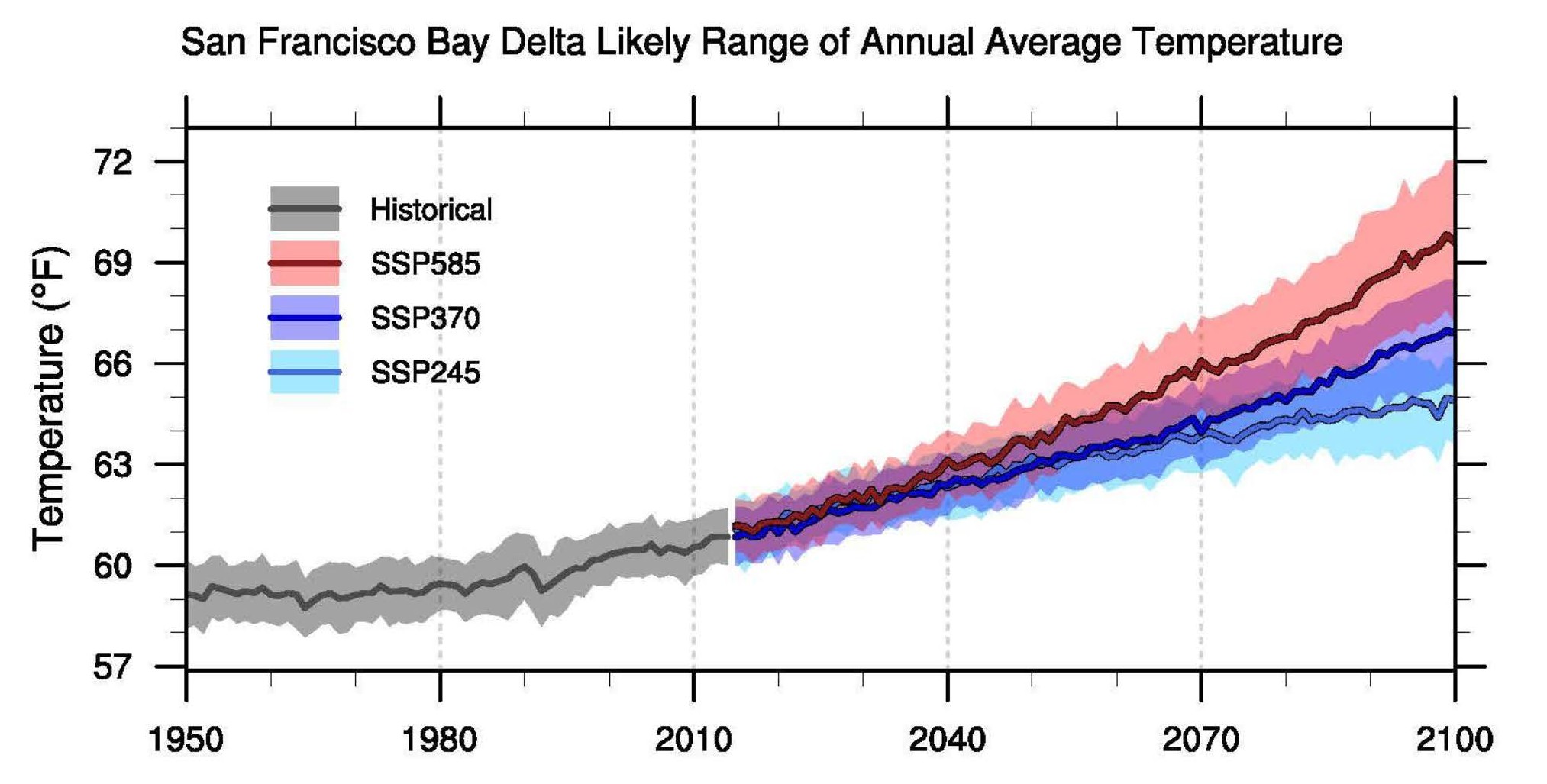
By late century, the Delta’s average annual temperature could rise by 3.5 to 7.5 degrees Fahrenheit. Higher average temperatures are also expected to increase the frequency and severity of extreme heat. By mid-century, most of the Delta could experience temperatures above 80 degrees Fahrenheit for much of the year.
Precipitation and drought
The chart presents annual average precipitation projections, which vary little across climate scenarios and could increase by about 8 percent by late century. The greater concern is increased variability in California’s already highly variable precipitation patterns.
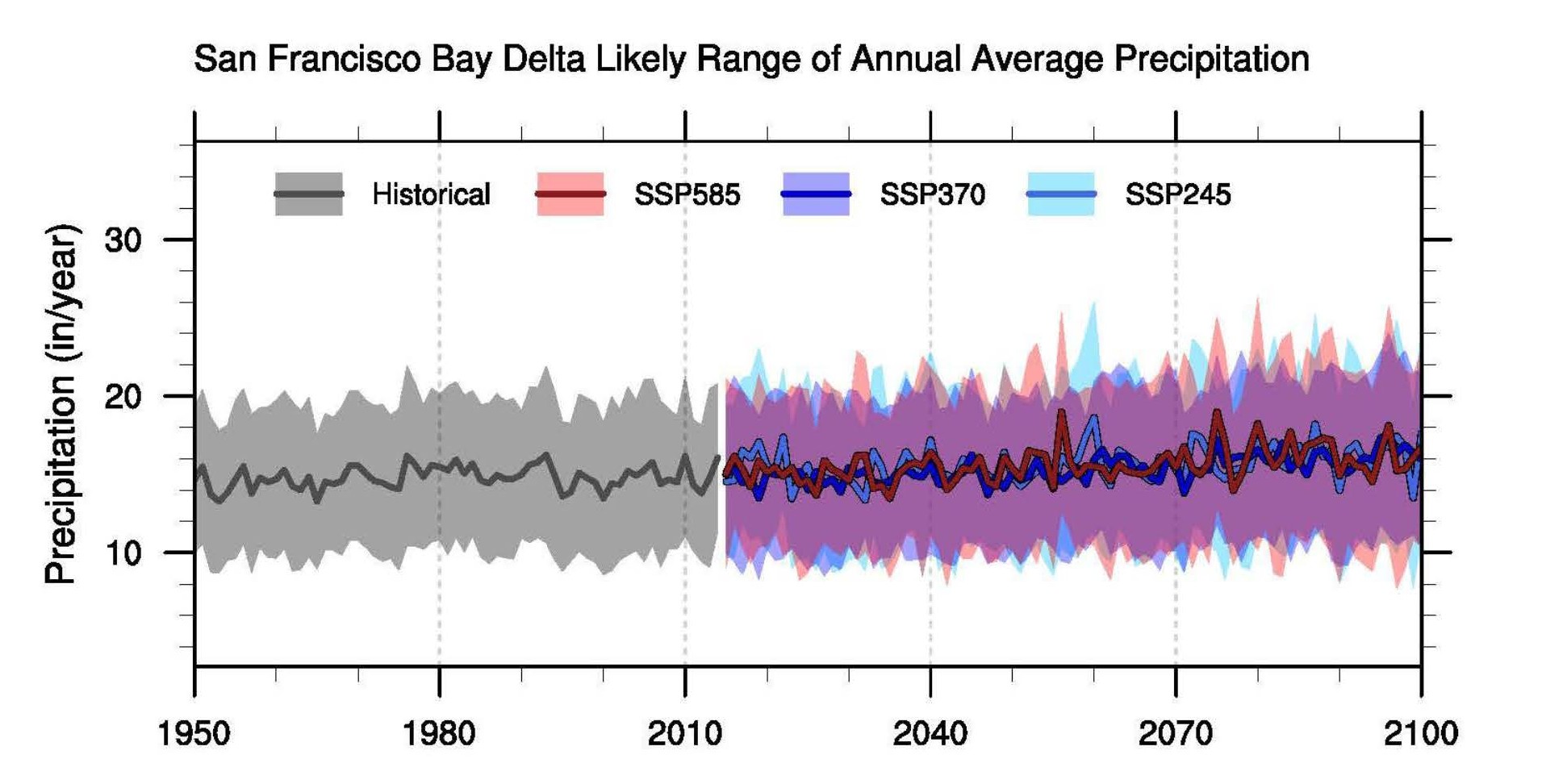
“So, we’ll have more extremely wet years and more extremely dry years, and they could happen back to back,” said Ms. Ragsdale. “Those flashy, extreme precipitation events—that’s what’s really concerning for the Delta from, like, a flood-risk perspective. You get these massive inflows into the Delta. Combined with sea-level rise or a Kelvin wave, it increases the water levels of the Delta.”
A larger share of precipitation is also expected to fall as rain rather than snow, reducing the snowpack that supports water supplies during warmer months. By mid-century, the likelihood of extreme drought in the Delta could increase by 15 to 25 percent.
Sea-level rise and flooding
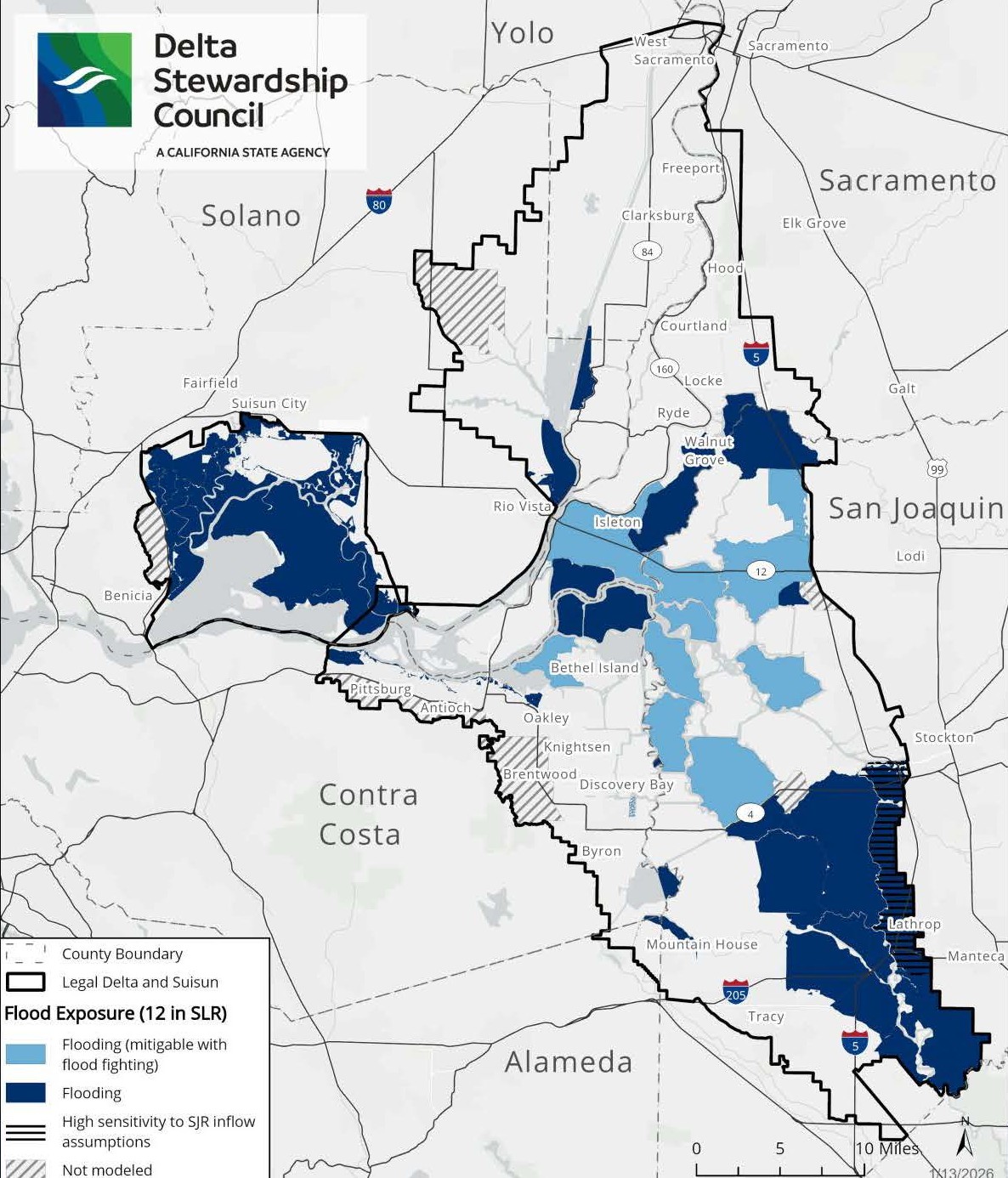 The Delta faces the combined risks of rising sea levels from San Francisco Bay and increased runoff from upstream watersheds. These forces converge in a low-lying floodplain already affected by vertical land movement and oxidation-driven soil loss. The map shows potential flood hazards from one foot of sea-level rise combined with a 100-year storm; blue areas indicate levees that could be overtopped without additional action.
“This scenario could happen by the end of the century if we’re lucky, or maybe mid-century under a more, like, intermediate scenario,” said Ms. Ragsdale. “The Delta is just extremely different, and we rely on the levee system to keep the islands of the Delta dry. And sea-level rise and extreme precipitation are really going to stress that system.”
Socially vulnerable communities in the Delta
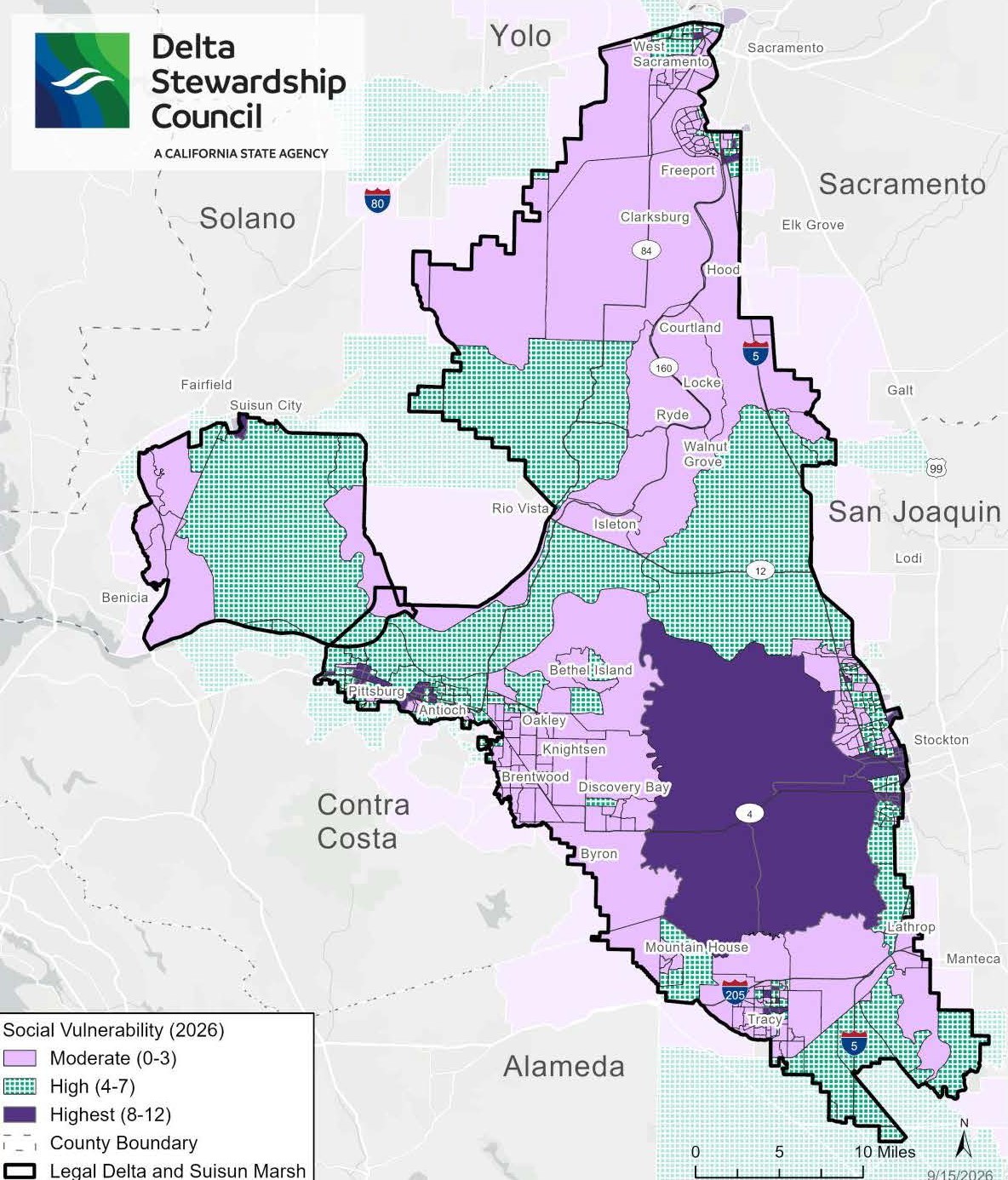 About half a million people live in the Delta, but climate impacts will not be distributed evenly. Vulnerability varies with location, exposure, adaptive capacity, and socioeconomic conditions. The Council evaluated indicators—including access to a vehicle and disability status—that may affect a person’s ability to respond to emergencies such as floods.
The resulting index identifies communities in Stockton, Antioch, Pittsburg, West Sacramento, Sacramento, and Tracy as among the region’s most vulnerable. The map shows these communities in dark purple and identifies smaller vulnerable communities elsewhere in the Delta. The Council is using the findings to guide outreach on climate change and adaptation.
Adapting the Delta for a changing climate
The Delta Stewardship Council’s Delta Adapts initiative provides a foundation for regional climate adaptation. Its vulnerability assessment and adaptation plan organize strategies around four priorities: flood-risk reduction, ecosystems, agriculture, and water-supply reliability.
The report draws on this work to summarize adaptation strategies and estimated costs. Although it does not calculate the full cost of adapting the Delta, it provides estimates for upgrading levees and restoring ecosystems.
“For Delta levees, it would be about $3.3 billion dollars to adapt it to future sea-level rise and precipitation inflows,” said Ms. Ragsdale. “Then, for ecosystem restoration, it’s about $2.5 to $5 billion dollars, and that’s for adaptation. That’s not including what needs to be done today to maintain these systems. So, it just highlights this huge gap in capital to do this work. So, this report is something we can all point to and say, this is justification for why we need the funding to do this work.”
Delta Climate Adaptation Team
The Council has also established the Delta Climate Adaptation Team (DCAT), a regional collaborative that brings together adaptation practitioners from multiple disciplines. The group is intended to include local interests, local governments, historically underrepresented communities, and agency partners.
Following its initial meeting this summer, DCAT members will build and strengthen partnerships, collaborate on adaptation plans, projects, and funding proposals, and share case studies and resources. Participation is open to anyone working on climate adaptation in the Delta.
If you would like to join future meetings or have any questions, please email the Delta Science Program at climatechange@deltacouncil.ca.gov. See this information sheet for more information.

