
At its October 6 meeting, the State Water Board reviewed the latest statewide data on wastewater and recycled water production. Kaylah Marcello, a research data specialist with the Recycled Water and Desalination Unit in the State Water Board’s Division of Water Quality, presented results from the seventh year of annual volumetric reporting. The findings provide an updated view of reporting compliance, recycled water use, regional trends, and progress toward California’s long-term recycling goals.
California has collected recycled water data since the 1970s, initially through periodic surveys rather than consistent annual reporting. Legislation, the recycled water policy, and the water supply strategy established goals to guide planning and infrastructure investment. To support consistent progress tracking, annual volumetric reporting became mandatory under the 2018 amendment to the recycled water policy.
Since 2019, wastewater treatment plants and recycled water producers statewide have reported annual influent, effluent, and recycled water volumes. The data support progress tracking, comparisons of recycled water use and effluent discharges, and identification of opportunities to redirect effluent to beneficial reuse. The reports also inform research, decision-making, and coordination among statewide programs.
For this presentation, recycled water means treated domestic wastewater used in accordance with Title 22 of the California Code of Regulations. Other forms of reuse—including gray water, oil field-produced water, and agricultural return flows—are not reported through this program and are not included in the data.
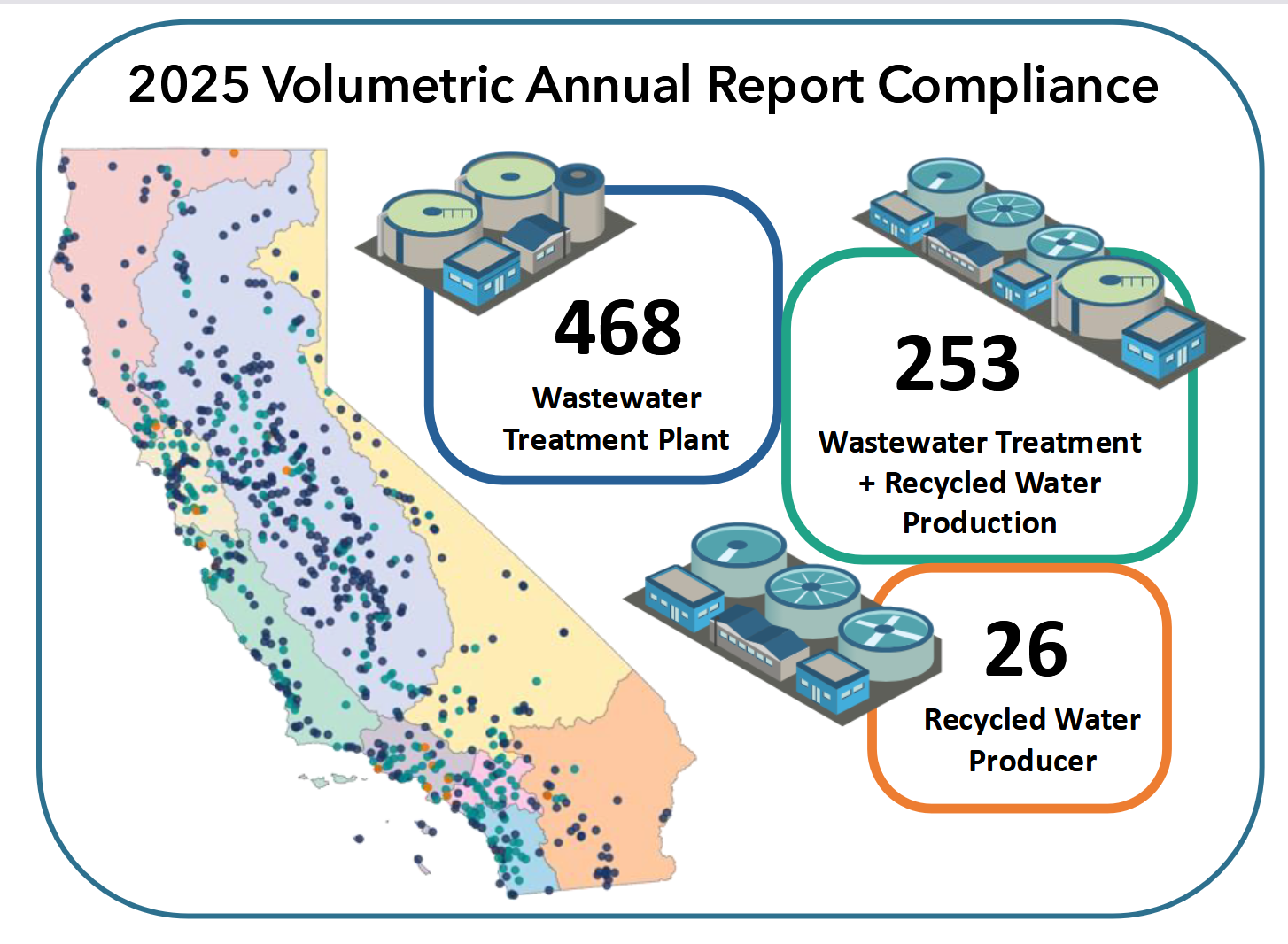 California has 467 wastewater treatment plants, 253 combined wastewater treatment and recycled water production plants, and 26 recycled water producers that receive pretreated water from other facilities for additional treatment and reuse.
In 2025, 99% of facilities complied, marking the seventh consecutive year of high reporting. This result reflects proactive outreach, education, and coordination with regional water boards, the Office of Enforcement, WateReuse California, and the California Association of Sanitation Agencies.
Hydrologic Conditions and Recycled Water Use
The graph compares statewide influent, effluent, and recycled water volumes from 2019 through 2025 with the Sacramento Valley water year type, a general indicator of wet, dry, or normal conditions.
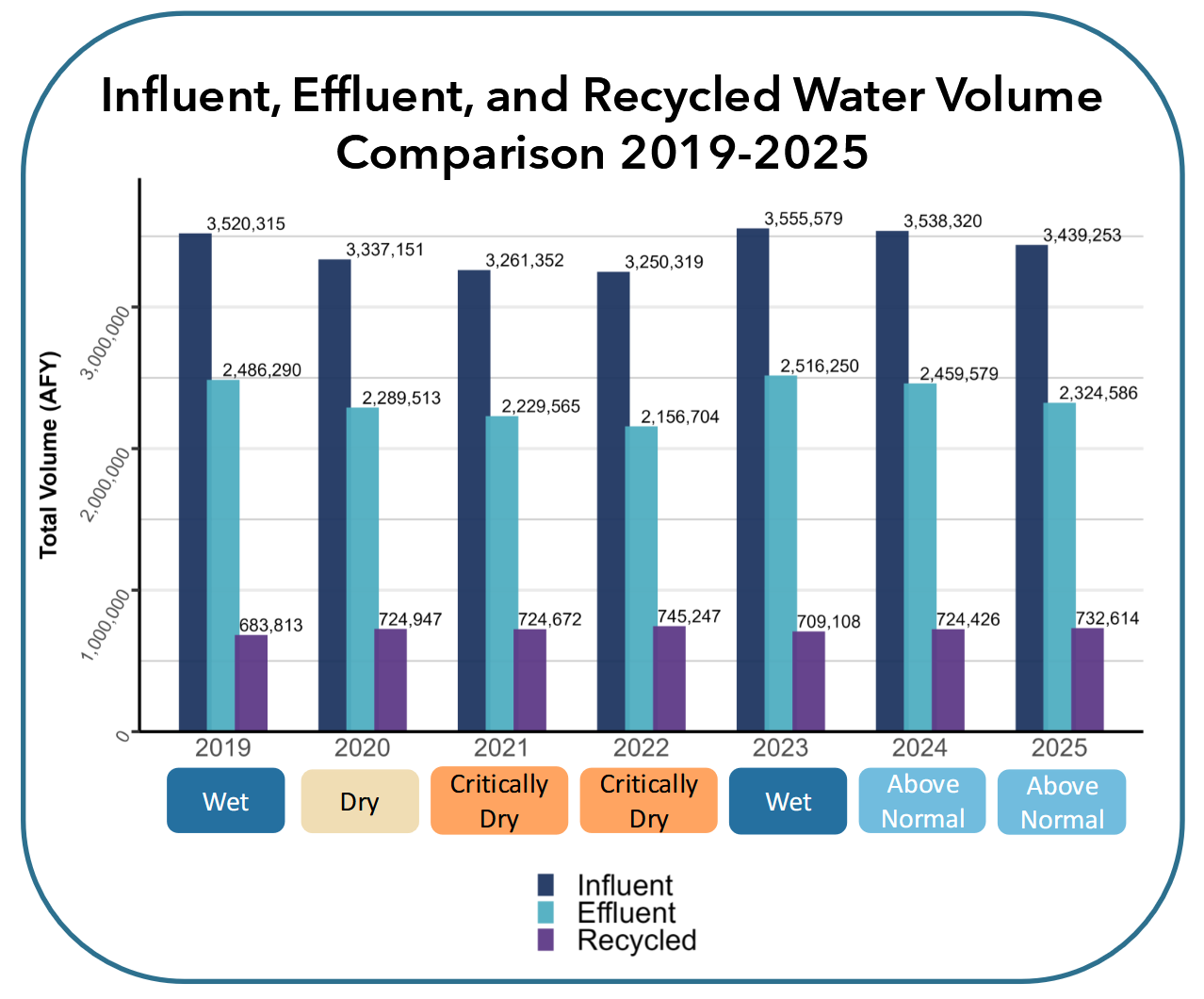
Results presented in 2023 indicated that influent volumes declined during drier periods while recycled water use increased. Data from 2024 and 2025 show a similar pattern: in 2025, recycled water production increased modestly even as influent volumes at recycled water treatment facilities declined.
The data continue to suggest that recycled water use may respond partly to changing hydrologic conditions. The graphic focuses on Regions 4, 8, and 9 in Southern California, where recycled water use is higher. Each dot represents a recycled water facility: blue indicates an increase from the previous year, red indicates a decrease, and dot size represents the magnitude of the change.
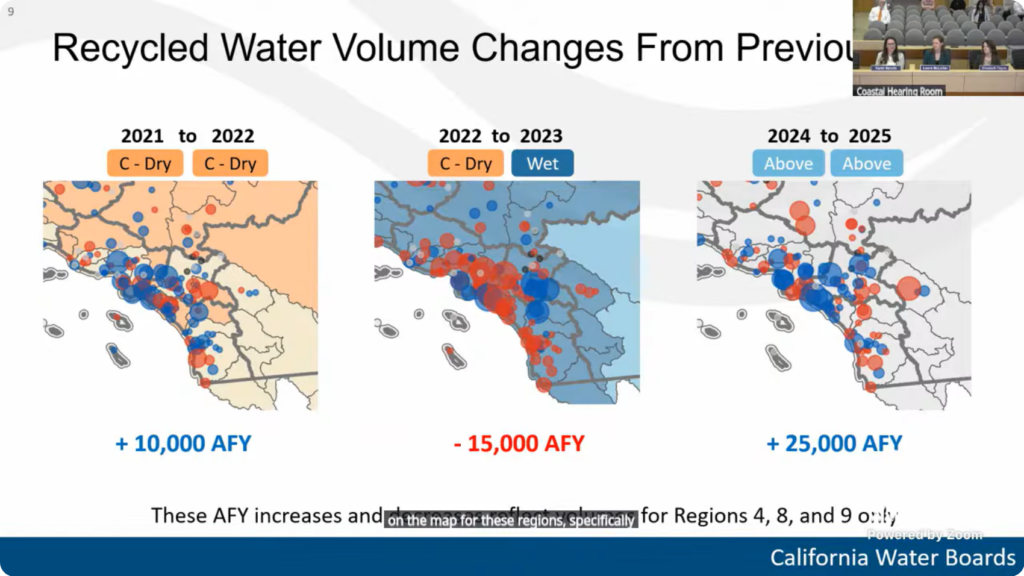
Ms. Marcello noted that recycled water use in these regions increased by 10,000 acre-feet during the critically dry years of 2021 and 2022, as reflected by the number and size of blue dots. In the wet year of 2023, use declined by 15,000 acre-feet, and more facilities appeared in red than in 2022. By 2025, use had increased by 25,000 acre-feet following above-normal conditions in 2024.
“Overall, these maps suggest that recycled water use may respond in part to changing hydrologic conditions,” she said. “If 2026 is a drier year than 2025, then we may see recycled water use increase where sufficient wastewater supplies and treatment capacity are available. If 2026 is wetter, recycled water use may decrease. Hydrologic conditions are only one factor, however, and additional years of data will help us better understand this relationship.”
Recycled Water Use by Category and Region
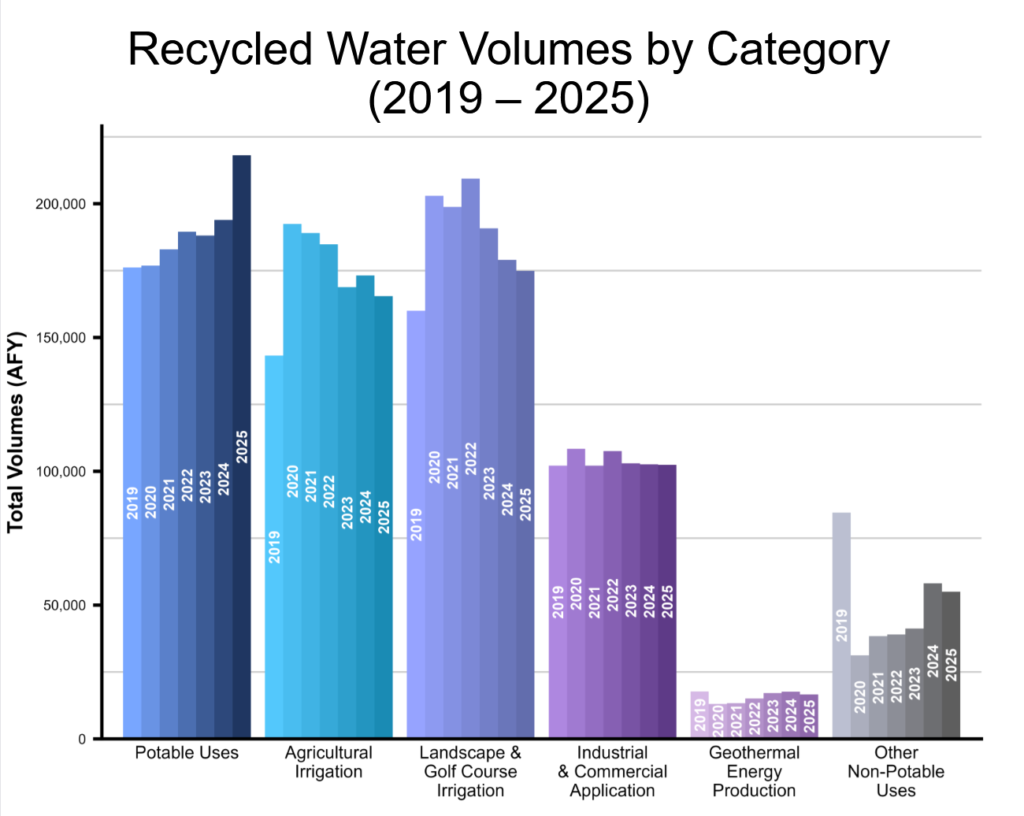
The figure shows changes in recycled water use by category from 2019 through 2025. Potable reuse—which includes groundwater recharge, seawater intrusion barriers, and reservoir augmentation—rose steadily, with a notable increase in 2025. Agricultural and landscape irrigation declined, while other categories remained relatively stable.
The heat map shows 2025 recycled water volumes by use category across California’s nine regions. The darkest purple square represents potable reuse, primarily groundwater recharge. Much of the growth came from expanded treatment at several facilities, particularly the Orange County Water District’s Groundwater Replenishment System in Region 8, which increased production by 7,000 acre-feet and reached its maximum recycled water output.
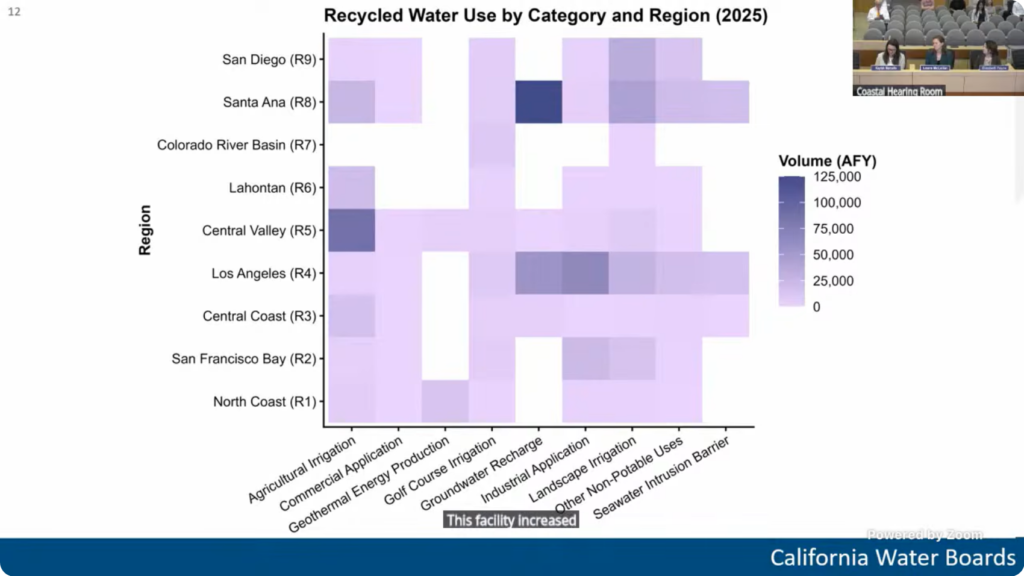 The heat map also shows regional differences: agricultural irrigation accounts for the largest recycled water volume in the Central Valley, while the Los Angeles region has the highest use for industrial applications.
Meeting California’s Recycled Water Goals
California’s 2022 Water Supply Strategy set goals of recycling at least 800,000 acre-feet annually by 2030 and 1.8 million acre-feet annually by 2040.
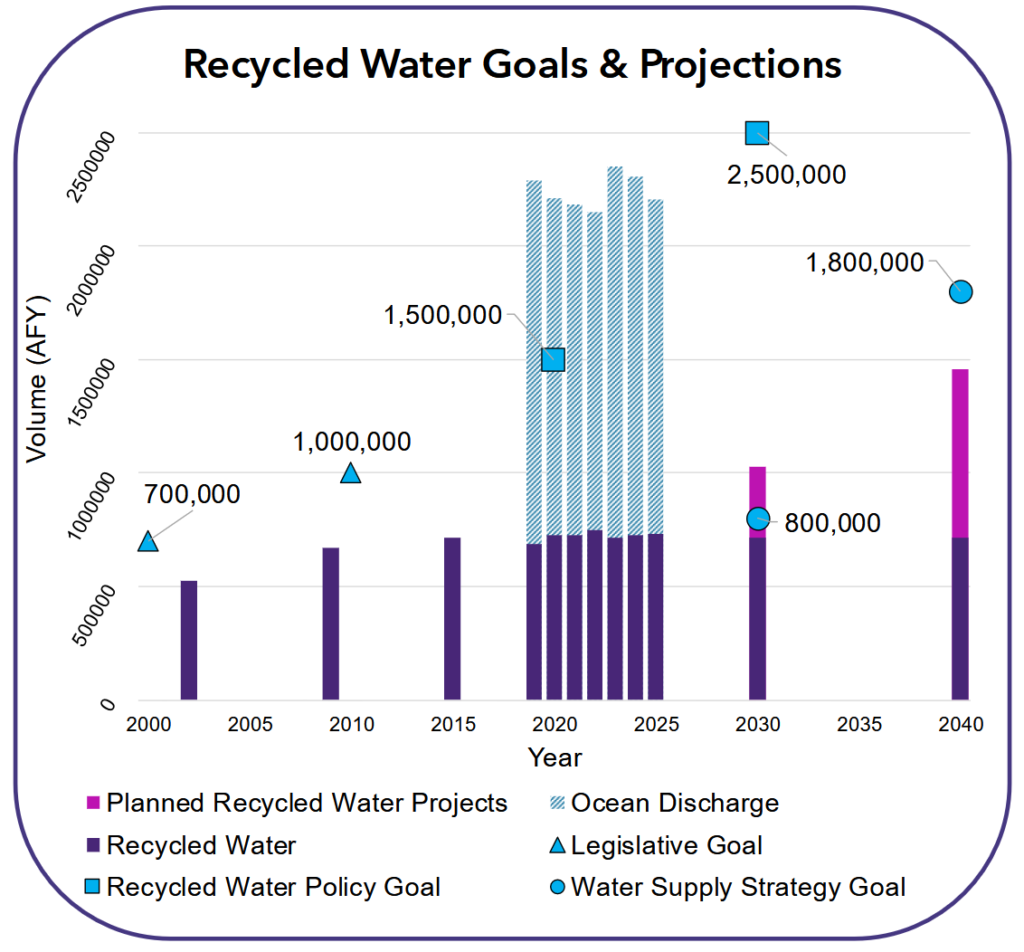
The figure shows current recycled water production in dark purple and unused ocean discharge in light blue. Much of the additional recycling needed to meet the goals is expected to come from wastewater now discharged to the ocean.
“We do know that because of technical, environmental, financial, and geographic constraints, it’s not possible to recycle all of the wastewater currently going to the ocean. However, maximizing reuse from ocean discharge has enormous potential to help the state achieve its ambitious goals for recycled water,” said Ms. Marcello.
In 2023, facilities reported planned increases in recycled water production through 2030 and 2040, shown in magenta. The projections indicate that California is on track to meet the 2030 goal, but reaching the 2040 goal will require additional planning and investment. Some projects and expansions are already coming online, and the State Water Board will continue tracking production increases.

