Proposed Bay-Delta Plan update is a bad deal for California’s rivers, San Francisco Bay, and all of us who rely on them
Guest commentary by Jon Rosenfield, Ph.D., Science Director for San Francisco Baykeeper, and Devon Pearse, Ph.D. Lead Scientist for Friends of the River
Maven’s Notebook welcomes alternate perspectives on the Voluntary Agreements (HRL), for publication consideration. Because many commentaries opposing the Voluntary Agreements (HRL) already exist, we especially invite thoughtful submissions offering supportive or alternative views. Send MN an email.
Later this month, the State Water Resources Control Board is poised to update the Bay-Delta Water Quality Control Plan, the state’s most robust tool to address the ecological crises in San Francisco Bay and its watershed and to shape California’s water future. But, rather than protect the Bay by applying the law, principles of good public policy, and lessons learned from decades of scientific research, the Water Board is instead proposing to adopt a Plan update based on voluntary agreements (VAs) negotiated by Governor Newsom with major Central Valley water districts and the federal government.
The VA Program is pitched as a collaborative suite of actions pledged by water diversion agencies to avoid state regulation and private litigation. It offers small amounts of additional water for the environment in some years, money (much of it from taxpayers) to pay for earth-moving habitat restoration and other actions, and more scientific research in this already well-studied ecosystem.
Unfortunately, the VA Program won’t work. Indeed, it is almost certain to exacerbate the Bay’s problems over time. Here, we explain some of the VA Program’s most substantive shortcomings. In future essays, we’ll explore why the VA Program is likely to collapse and its corrupt origins. Finally, we will describe what can and should be done instead—a workable approach that addresses ecological problems throughout the Bay estuary and its watershed, while preparing California for the future.
The Voluntary Agreements Pledge Inadequate Resources and Allow Continued Degradation of the Status Quo
Over the past 30 years, scientific studies of San Francisco Bay and its watershed have demonstrated the critical role that river flows play in protecting water quality, native fish and wildlife and their habitats, and the fishing, Delta, and Tribal communities that depend on vibrant aquatic ecosystems. Yet, despite all this knowledge, California’s unsustainable diversion of Central Valley rivers that create the Bay’s estuarine ecosystem has continued and even increased. Diverting large fractions of the available river flow is driving the deterioration of water quality, the decline and closure of fisheries, and the impending extinction of numerous species.
Pledges of water are too small to move the needle and are likely to be rendered meaningless by new dams and diversions
The Water Board has repeatedly observed that the San Francisco Bay estuary is in crisis. Evidence for this conclusion includes the collapse of the Bay’s native fish populations (seven of which are listed as threatened or endangered under state or federal law), loss of its once-vibrant fisheries, and proliferation of toxic algal blooms in the Delta. The Water Board, which is responsible for the reasonable protection of all beneficial uses of water, has for many years also acknowledged that the solution to this crisis must include substantial increases in the amount of water from Central Valley rivers that reaches San Francisco Bay.
Under existing regulations, the state safeguards less than 20% of the Central Valley’s unimpaired flow – flow that would reach San Francisco Bay in the absence of dams and diversions. Actual flows often exceed the regulatory minimum when infrastructure capacity is exceeded by large storm events. In a typical year, California diverts more than half of the flow in Central Valley rivers before it can reach the Bay; in dry years, the portion of river flow diverted is even higher. In 2010, the Board found that protection of public trust resources (including fish and fisheries) would require 75% of total Central Valley unimpaired flow to reach the Bay in most years. And between 2018 and 2024, the Board outlined a plan to require 45-65% of this unimpaired flow, depending on hydrological conditions.
By contrast, the VA Program pledges to add a pittance – less than 1% annually, on average – to baseline Delta outflows (Table 1). Moreover, the VA scheme does not protect the unregulated flows that make it to through the Delta to the Bay right now. (“Baseline,” in Table 1). In fact, many parties to the VA Program are also seeking permits from the Water Board to increase their capacity to capture more water. These proposals include construction and operation of Sites Reservoir and the Delta Tunnel, water development projects that would cost taxpayers and ratepayers tens of billions of dollars and further reduce flows to the Bay. So, not only does the VA Program fail to provide enough water to solve the ecological crises in the Bay and its watershed, it is intentionally designed to allow future increases in water diversions beyond levels that are already unsustainable.
Table 1: Average change in total annual Delta outflows relative to baseline expected under the VA Program. Values assume current water development infrastructure and no additional capture of unregulated river flows. TAF = Thousand Acre-Feet. Modified from Table 13.4-91 of the Water Board’s Partially Recirculated Draft SED (December 2025).
| Water Year Type |
Frequency of WY Type (%) |
Baseline (TAF/yr) |
VA Program Change from Baseline (TAF/yr) |
VA Program Change from Baseline (%) |
| Critical |
16% |
5,447 |
85 |
1.6% |
| Dry |
22% |
7,324 |
452 |
6.2% |
| Below Normal |
19% |
10,667 |
99 |
0.9% |
| Above Normal |
12% |
17,967 |
170 |
0.9% |
| Wet |
30% |
28,837 |
-106 |
-0.4% |
| Average |
––––– |
15,472 |
122 |
0.8% |
Promised restoration overemphasizes certain habitats at the expense of those that are most important
Many of our native fish require cold water to survive. And there must be enough of it to create instream habitat, cue fish migration, and meet many other needs. Simply put, for most native fishes: the flow of cold water is the habitat.
The VA Program abandons the Water Board’s previous promise to protect coldwater habitats. Because dams block access to historical coldwater habitats, rules for operating those dams are the only way to ensure the release of sufficient cold water to create habitat downstream for these native fish. The VA Program exempts participating agencies from rules that would protect coldwater habitats. Because these parties operate most of the major reservoirs in the Sacramento Valley that would provide cold river flows, there will be no improvement in coldwater habitat protection under the VA scheme.
In lieu of protecting coldwater environments and restoring adequate river flows, the VA Program proposes expansion of floodplains and shallow tidal acreage. Restoring these environments in the Central Valley is important, but the Water Board itself acknowledges:
“As flow, connectivity, and fish access are all inextricably linked, it is questionable whether physical rearing habitat (as opposed to inundating flows) within the floodplain bypasses is a limiting factor, as flow creates both access and habitat. Additionally… the beneficial rearing outcomes from higher growth rates seen in floodplains, such as enhanced survival benefits, … require further investigation and remain to be proven.”
Furthermore, these kinds of projects do not address the severe problems that species face in the portions of their life histories spent outside of floodplains and wetlands. The research community identifies the same uncertainties.
Proposed habitat acreages fall far short of what is needed to achieve Plan objectives
Even if substituting new shallow-water habitats for needed river flows could reasonably protect fish and wildlife, the extent of the VA Program’s promised new acreage is woefully inadequate. In fact, the VA parties only pledge to restore enough river floodplain acreage to meet one-quarter of the expected need for Chinook Salmon. The Water Board’s analysis shows that this target won’t be achieved on some rivers, while on others, new habitat will be created even though existing habitat already exceeds the anticipated need (Figure 1). Downstream in the estuary, both the VA Program’s plan to expand wetland acreage and the expected benefits are even less clear, whereas the relationship of fish survival and abundance to river flow is unambiguous.
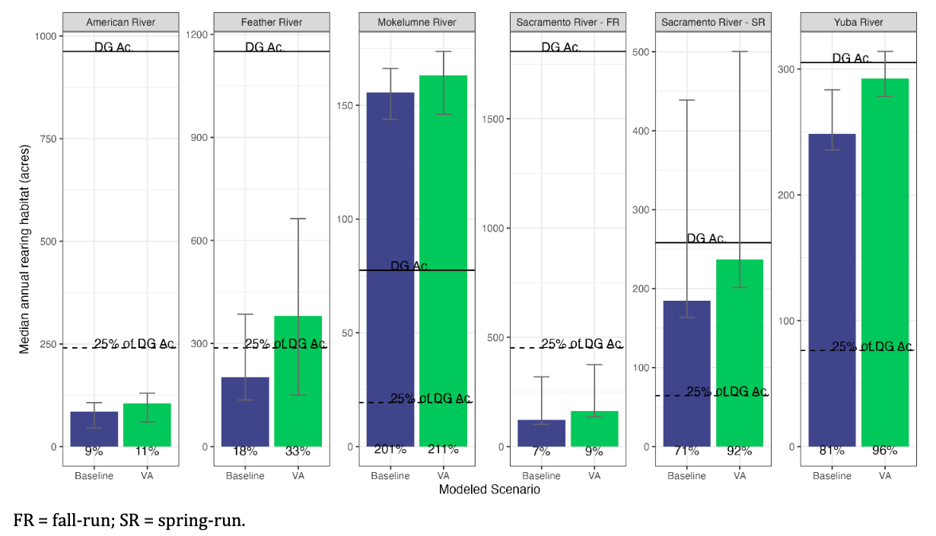
Figure 1: Modelled Chinook Salmon rearing habitat acreage under baseline and the VA Program. Dashed horizontal line represents 25% of the rearing acreage need expected for salmon populations when the Plan’s salmon protection objective (doubling of natural Chinook Salmon production above the 1967-1991 average) is attained; solid horizontal line represents total anticipated rearing habitat needed. Copied from Figure 13.5-6 of the Water Board’s Partially Recirculated Draft SED (December 2025).
The VA Program provides no path to success
California law requires that the Water Board provide a Program of Implementation that will achieve the Plan’s objectives and reasonably protect all beneficial uses of water. Unfortunately, the Water Board presents absolutely no evidence that the VA Program is capable of restoring native fish to viability or doubling natural production of salmon from its 1967-1991 baseline, as the Plan objectives require. In fact, our analyses show that, even under the rosiest of assumptions, the VA Program will not halt the ongoing ecosystem degradation that increasingly constrains the Bay’s fisheries and threatens to eradicate native fish species. Under more realistic assumptions about the VA Program’s effects –e.g., increased water diversions over time; delayed habitat restoration that provides fewer benefits than advertised – the deterioration of the Bay’s ecosystem will accelerate. This is exactly the outcome that the Water Board set out to prevent when it began its update of the Bay-Delta Water Quality Control Plan 17 years ago.
Note: The views and opinions expressed in this commentary are those of the author and do not necessarily reflect the official policy or position of Maven’s Notebook.
Jon Rosenfield, Ph.D. is the Science Director for San Francisco Baykeeper, a nonprofit organization that defends San Francisco Bay and its watershed from the biggest threats by holding polluters and government agencies accountable.
Devon Pearse, Ph.D. is the Lead Scientist for Friends of the River, a nonprofit organization which works to promote a climate-resilient future for California, with healthy rivers, equal access to clean water and outdoor recreation, and a thriving, sustainable economy.


GUEST COMMENTARY: Why Newsom’s Voluntary Agreements Won’t Work, Part 1: Inadequate Resources
Proposed Bay-Delta Plan update is a bad deal for California’s rivers, San Francisco Bay, and all of us who rely on them
Guest commentary by Jon Rosenfield, Ph.D., Science Director for San Francisco Baykeeper, and Devon Pearse, Ph.D. Lead Scientist for Friends of the River
Maven’s Notebook welcomes alternate perspectives on the Voluntary Agreements (HRL), for publication consideration. Because many commentaries opposing the Voluntary Agreements (HRL) already exist, we especially invite thoughtful submissions offering supportive or alternative views. Send MN an email.
Later this month, the State Water Resources Control Board is poised to update the Bay-Delta Water Quality Control Plan, the state’s most robust tool to address the ecological crises in San Francisco Bay and its watershed and to shape California’s water future. But, rather than protect the Bay by applying the law, principles of good public policy, and lessons learned from decades of scientific research, the Water Board is instead proposing to adopt a Plan update based on voluntary agreements (VAs) negotiated by Governor Newsom with major Central Valley water districts and the federal government.
The VA Program is pitched as a collaborative suite of actions pledged by water diversion agencies to avoid state regulation and private litigation. It offers small amounts of additional water for the environment in some years, money (much of it from taxpayers) to pay for earth-moving habitat restoration and other actions, and more scientific research in this already well-studied ecosystem.
Unfortunately, the VA Program won’t work. Indeed, it is almost certain to exacerbate the Bay’s problems over time. Here, we explain some of the VA Program’s most substantive shortcomings. In future essays, we’ll explore why the VA Program is likely to collapse and its corrupt origins. Finally, we will describe what can and should be done instead—a workable approach that addresses ecological problems throughout the Bay estuary and its watershed, while preparing California for the future.
The Voluntary Agreements Pledge Inadequate Resources and Allow Continued Degradation of the Status Quo
Over the past 30 years, scientific studies of San Francisco Bay and its watershed have demonstrated the critical role that river flows play in protecting water quality, native fish and wildlife and their habitats, and the fishing, Delta, and Tribal communities that depend on vibrant aquatic ecosystems. Yet, despite all this knowledge, California’s unsustainable diversion of Central Valley rivers that create the Bay’s estuarine ecosystem has continued and even increased. Diverting large fractions of the available river flow is driving the deterioration of water quality, the decline and closure of fisheries, and the impending extinction of numerous species.
Pledges of water are too small to move the needle and are likely to be rendered meaningless by new dams and diversions
The Water Board has repeatedly observed that the San Francisco Bay estuary is in crisis. Evidence for this conclusion includes the collapse of the Bay’s native fish populations (seven of which are listed as threatened or endangered under state or federal law), loss of its once-vibrant fisheries, and proliferation of toxic algal blooms in the Delta. The Water Board, which is responsible for the reasonable protection of all beneficial uses of water, has for many years also acknowledged that the solution to this crisis must include substantial increases in the amount of water from Central Valley rivers that reaches San Francisco Bay.
Under existing regulations, the state safeguards less than 20% of the Central Valley’s unimpaired flow – flow that would reach San Francisco Bay in the absence of dams and diversions. Actual flows often exceed the regulatory minimum when infrastructure capacity is exceeded by large storm events. In a typical year, California diverts more than half of the flow in Central Valley rivers before it can reach the Bay; in dry years, the portion of river flow diverted is even higher. In 2010, the Board found that protection of public trust resources (including fish and fisheries) would require 75% of total Central Valley unimpaired flow to reach the Bay in most years. And between 2018 and 2024, the Board outlined a plan to require 45-65% of this unimpaired flow, depending on hydrological conditions.
By contrast, the VA Program pledges to add a pittance – less than 1% annually, on average – to baseline Delta outflows (Table 1). Moreover, the VA scheme does not protect the unregulated flows that make it to through the Delta to the Bay right now. (“Baseline,” in Table 1). In fact, many parties to the VA Program are also seeking permits from the Water Board to increase their capacity to capture more water. These proposals include construction and operation of Sites Reservoir and the Delta Tunnel, water development projects that would cost taxpayers and ratepayers tens of billions of dollars and further reduce flows to the Bay. So, not only does the VA Program fail to provide enough water to solve the ecological crises in the Bay and its watershed, it is intentionally designed to allow future increases in water diversions beyond levels that are already unsustainable.
Table 1: Average change in total annual Delta outflows relative to baseline expected under the VA Program. Values assume current water development infrastructure and no additional capture of unregulated river flows. TAF = Thousand Acre-Feet. Modified from Table 13.4-91 of the Water Board’s Partially Recirculated Draft SED (December 2025).
Promised restoration overemphasizes certain habitats at the expense of those that are most important
Many of our native fish require cold water to survive. And there must be enough of it to create instream habitat, cue fish migration, and meet many other needs. Simply put, for most native fishes: the flow of cold water is the habitat.
The VA Program abandons the Water Board’s previous promise to protect coldwater habitats. Because dams block access to historical coldwater habitats, rules for operating those dams are the only way to ensure the release of sufficient cold water to create habitat downstream for these native fish. The VA Program exempts participating agencies from rules that would protect coldwater habitats. Because these parties operate most of the major reservoirs in the Sacramento Valley that would provide cold river flows, there will be no improvement in coldwater habitat protection under the VA scheme.
In lieu of protecting coldwater environments and restoring adequate river flows, the VA Program proposes expansion of floodplains and shallow tidal acreage. Restoring these environments in the Central Valley is important, but the Water Board itself acknowledges:
“As flow, connectivity, and fish access are all inextricably linked, it is questionable whether physical rearing habitat (as opposed to inundating flows) within the floodplain bypasses is a limiting factor, as flow creates both access and habitat. Additionally… the beneficial rearing outcomes from higher growth rates seen in floodplains, such as enhanced survival benefits, … require further investigation and remain to be proven.”
Furthermore, these kinds of projects do not address the severe problems that species face in the portions of their life histories spent outside of floodplains and wetlands. The research community identifies the same uncertainties.
Proposed habitat acreages fall far short of what is needed to achieve Plan objectives
Even if substituting new shallow-water habitats for needed river flows could reasonably protect fish and wildlife, the extent of the VA Program’s promised new acreage is woefully inadequate. In fact, the VA parties only pledge to restore enough river floodplain acreage to meet one-quarter of the expected need for Chinook Salmon. The Water Board’s analysis shows that this target won’t be achieved on some rivers, while on others, new habitat will be created even though existing habitat already exceeds the anticipated need (Figure 1). Downstream in the estuary, both the VA Program’s plan to expand wetland acreage and the expected benefits are even less clear, whereas the relationship of fish survival and abundance to river flow is unambiguous.
Figure 1: Modelled Chinook Salmon rearing habitat acreage under baseline and the VA Program. Dashed horizontal line represents 25% of the rearing acreage need expected for salmon populations when the Plan’s salmon protection objective (doubling of natural Chinook Salmon production above the 1967-1991 average) is attained; solid horizontal line represents total anticipated rearing habitat needed. Copied from Figure 13.5-6 of the Water Board’s Partially Recirculated Draft SED (December 2025).
The VA Program provides no path to success
California law requires that the Water Board provide a Program of Implementation that will achieve the Plan’s objectives and reasonably protect all beneficial uses of water. Unfortunately, the Water Board presents absolutely no evidence that the VA Program is capable of restoring native fish to viability or doubling natural production of salmon from its 1967-1991 baseline, as the Plan objectives require. In fact, our analyses show that, even under the rosiest of assumptions, the VA Program will not halt the ongoing ecosystem degradation that increasingly constrains the Bay’s fisheries and threatens to eradicate native fish species. Under more realistic assumptions about the VA Program’s effects –e.g., increased water diversions over time; delayed habitat restoration that provides fewer benefits than advertised – the deterioration of the Bay’s ecosystem will accelerate. This is exactly the outcome that the Water Board set out to prevent when it began its update of the Bay-Delta Water Quality Control Plan 17 years ago.
Jon Rosenfield, Ph.D. is the Science Director for San Francisco Baykeeper, a nonprofit organization that defends San Francisco Bay and its watershed from the biggest threats by holding polluters and government agencies accountable.
Devon Pearse, Ph.D. is the Lead Scientist for Friends of the River, a nonprofit organization which works to promote a climate-resilient future for California, with healthy rivers, equal access to clean water and outdoor recreation, and a thriving, sustainable economy.
Tags