
From the Department of Water Resources:
This is not a job for the squeamish or faint-hearted, but the goals of science are not always clean and neat.
The job? Pulling Chinook salmon carcasses from the water, onto a boat, and performing an open-air autopsy of sorts to answer important questions about the iconic fish.
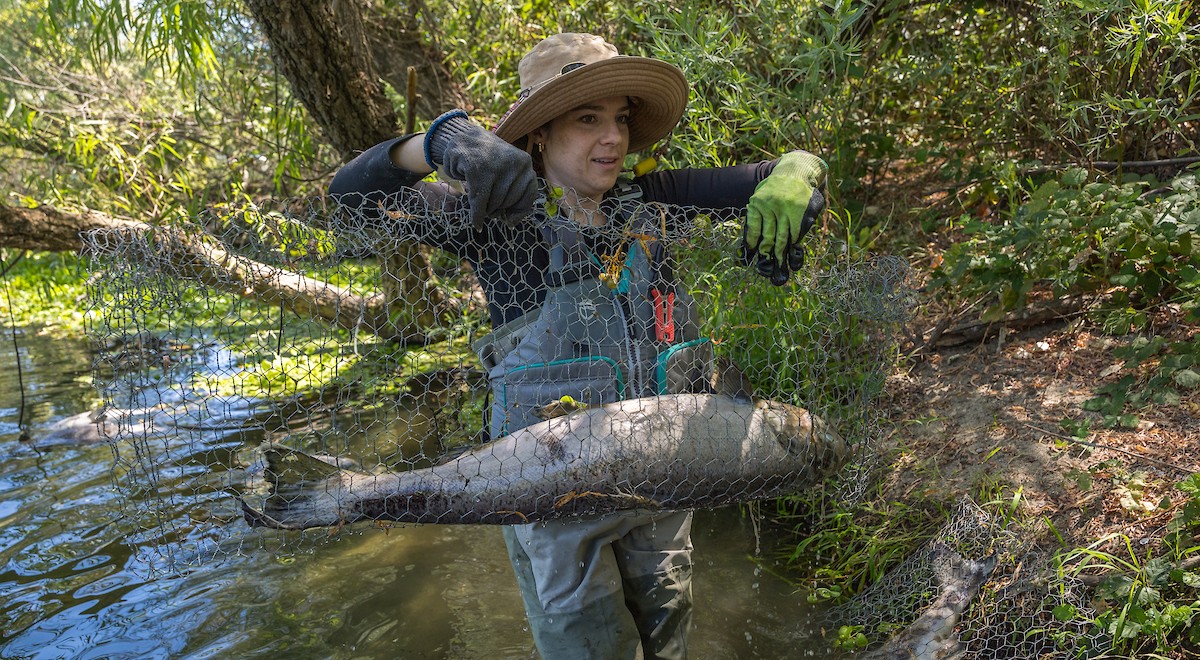
DWR senior environmental scientist Michelle Pepping did just that on the Feather River. Under a bright sun, she sampled decaying salmon carcasses in the summer heat. It’s part of a unique study to identify which salmon tissues provide the best DNA.
“By identifying better tissue types for DNA sequencing, we are increasing the information for many groups,” she said. “This information is used for university research, management decisions, and regular monitoring of our salmon.”
Seven tissues, one genetic goal
Historically, DWR has collected fin clips from deceased Chinook salmon as a source of DNA. Samples collected from the Sacramento River, San Joaquin River, and their tributaries are deposited in the Central Valley Tissue Archive for scientific use. Data obtained from the tissue samples include population metrics, migration time, and lineage. But timing is critical: tissue and DNA rapidly degrade in the river environment. Depending on carcass freshness, many fin clip samples don’t provide suitable DNA for genetic analysis.
“This means there is a lot of wasted effort collecting and genetically testing samples that can’t be used to give us information,” Pepping said. “This study aims to identify a tissue collection method from carcasses that is easy to do in the field and also produces reliable and accurate genetic results.”
That’s where the work gets messy and maybe a little gross. Fins, gills, muscles, hearts, brains, bones, and teeth are collected from the carcasses. Pepping said the seven tissue types were chosen to compare their ease of collection in the field and the DNA quality obtained as carcasses decompose.
“We hope there’s more than one good tissue type and groups can use the information to find a system that works for them,” she said.
State of Decay
The experiment placed fish into three degradation levels — fresh, some decomposition, and advanced decomposition.
“When carcasses are encountered in the field, they are at different levels of decay,” Pepping said. “Some are fully submerged in the water, while others wash up to the bank.”
Fifteen samples were collected for each category, for a total of 90 fish. Fish were also placed in chicken wire cages on the bank or suspended on a rope to compare DNA from fresh and advanced-decomposition fish. Given the right conditions, nature works fast. A large salmon can go from fresh to advanced decomposition in as little as a day and a half, especially in hot conditions.
Results showed large variation in DNA concentrations across tissue types and degradation levels. The findings confirmed that fin tissue has high DNA concentrations when a carcass is fresh, but concentrations drop rapidly as it decomposes. Heart and bone emerged as promising sources for degraded carcasses. DWR’s Genetic Monitoring Laboratory collaborates with field crews to test more tissue types and refine tissue preservation in the field.
The findings could extend well beyond DWR. Other organizations that collect salmon carcasses for genetic analysis could also use these results.
“We’re hoping that other groups can take our information and they can pick and choose what best fit their needs,” Pepping said.
Another exciting part of this project was how quickly it has moved. Researchers expect to go from the initial idea to results in roughly 10 weeks — an unusually fast turnaround for a scientific study.
Ultimately, the goal is simple: make the most of every fish and every sample.
“We’re trying to improve sampling and make sure people’s efforts are worth something for everyone that’s collecting tissue from dead fish,” Pepping said.

