Visit the Water Shelf main page
 First published on the To Know Water Is To Love Water blog February 3, 2026
By Jim Lauria
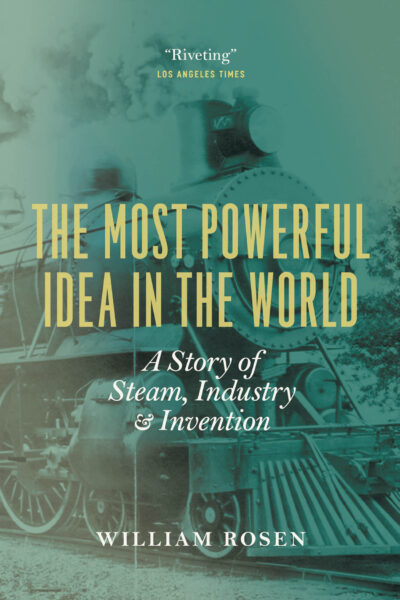
The Most Powerful Idea in the World: A Story of Steam, Industry, and Invention (University of Chicago Press, 2012) by William Rosen is one of those rare books that makes you see modern life — industry, commerce, even intellectual property — as the downstream consequence of a very simple human insight: boiling water can be turned into motion.
Rosen tells the story of how humanity learned to harness the expansive force of steam, tracing a line from humble waterwheels to steam engines and ultimately to the foundations of the Industrial Revolution. This is not just a tale of machines, but of ideas…how they emerge, how they spread, and how societies choose to value them.
One of the book’s central contributions is its framing of innovation as something inseparable from institutions. The Industrial Revolution didn’t just happen because inventors were clever; it flourished because national governments supported innovation financially and legally. Rosen’s exploration of ideas as a form of property is especially compelling. Labor, he argues, was no longer just muscle power; it became brain power. The emergence of patenting formalized this shift. The very word patent dates back to 1449, when Henry VI issued an openly published “letter patent,” establishing the principle that ideas could be protected, rewarded, and commercialized. Patent royalties became a new means of payment, aligning inventors’ creativity with economic incentive.
The book shines in its treatment of steam technology entering the world of commerce. Rosen brings to life Thomas Newcomen’s early steam engine, developed to pump water out of coal mines. Coal was needed for heating, but mining coal required burning more coal to remove water, an almost comically self-reinforcing loop, a perpetual motion machine of consumption that nonetheless powered progress.
Rosen also situates these mechanical advances within a broader intellectual tradition. Leonardo da Vinci appears as a bridge figure, seeing creativity as existing in two parallel worlds: the artistic and the inventive. That duality carries forward to James Watt, whose critical insight — that steam must be efficiently condensed back into water — led to the separate condenser and transformed the steam engine from a brute-force pump into a scalable industrial workhorse.
Equally important are the supporting characters of experimentation and materials science. Rosen highlights John Smeaton’s careful experiments measuring the work produced by waterwheels, underscoring that progress depended as much on systematic testing as on flashes of genius. Advances in materials enabled machines to operate at higher pressures, temperatures, and reliability — quiet breakthroughs that made loud revolutions possible.
As the narrative unfolds, steam escapes the coal mine and reshapes the world: powering textile mills, spinning cotton, weaving cloth, propelling steamboats and locomotives, and eventually generating electricity through steam turbines. What begins as a solution to a localized drainage problem becomes the backbone of global industrial society.
Rosen closes the book with words from Abraham Lincoln, immortalized at the U.S. Department of Commerce: “The patent system added the fuel of interest to the fire of genius.” It’s a fitting conclusion. Steam may have provided the physical power, but incentives, institutions, and imagination supplied the pressure.
For anyone interested in technology, water, energy, or the hidden systems that turn ideas into civilization-scale change, The Most Powerful Idea in the World is essential reading. It reminds us that progress is never just about invention; it’s about creating the conditions that allow invention to matter.