
Proposition 1, approved by California voters in 2014, authorized $2.65 billion for public benefits associated with water storage projects, administered by the California Water Commission through the Water Storage Investment Program. Five of the eight conditionally accepted projects remain active, including the Inland Empire Utilities Agency’s Chino Basin Program, which would improve groundwater quality, support ecosystem flows, and provide emergency supplies. At the Commission’s August meeting, program manager Elizabeth Hurst updated commissioners on the project’s status, proposed public-benefit contracts, and remaining requirements for a final funding award.
PROGRAM OVERVIEW
The Chino Basin Program is located in western San Bernardino County in Southern California and overlies the Chino Groundwater Basin. All program facilities will be constructed in the Rancho Cucamonga and Fontana portions of the Inland Empire Utilities Agency’s service area. The program will build on IEUA’s existing wastewater treatment and recycled water systems to expand regional treatment capacity and access to recycled water.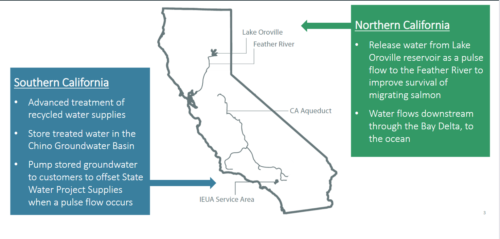
Planned infrastructure upgrades include a new Advanced Water Purification Facility, expanded replenishment wells and extraction facilities, and a broader pipeline network. These improvements will advance capital projects identified in long-range plans and support the delivery and storage of advanced-treated recycled water in the Chino Groundwater Basin. Phased operations could begin as early as 2032.
Construction is underway on the Advanced Water Purification Demonstration Facility, which is scheduled to open to the public in spring 2027. The facility is expected to process approximately 90 gallons per minute and provide performance data to inform the design of the full-scale facility. Project goals include testing and refining high-recovery reverse osmosis processes under varying source-water conditions, training plant operators in advanced treatment technologies, and providing public education through tours and outreach events.
PUBLIC BENEFITS
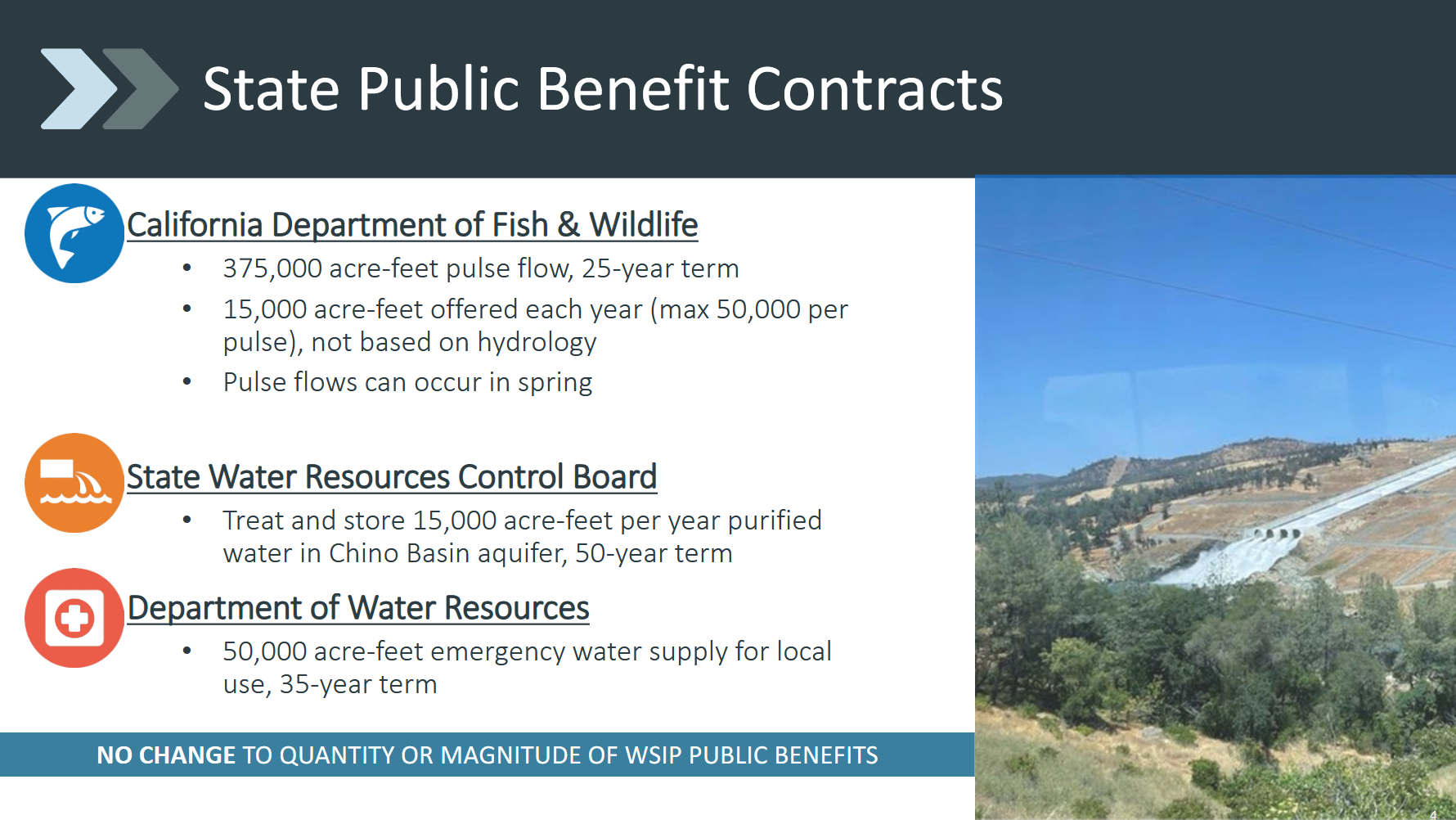 The project is expected to provide three public benefits:
- 375,000 acre-feet of pulse-flow releases over 25 years, administered by the California Department of Fish and Wildlife;
- Water quality improvements through the storage of advanced-treated, purified water in the groundwater basin over a 50-year term; and
- An emergency-response benefit totaling 50,000 acre-feet over a 35-year term.
The Advanced Water Purification Facility, recycled water pipeline, and pure water recharge facilities support the water quality benefit. The extraction facilities and the Metropolitan Water District interconnection support the emergency-response benefit. A series of agreements with Metropolitan would also enable ecosystem benefits through pulse-flow releases in the Feather River in Northern California.
“Together, this combination of the facilities to treat, store, and extract the water is what allows those pulse-flow releases to happen through coordination with Metropolitan,” she said.
CONTRACTS FOR PUBLIC BENEFITS
The three public-benefit contracts were presented to the Commission. Before receiving a final funding award, applicants must execute contracts with the state agencies responsible for administering the benefits. Draft contracts are presented to the Commission for public and commissioner review before they are finalized. The agencies and applicants may consider comments during negotiations, but the Commission reviews rather than approves the contracts.
Ecosystem Benefits
Kristal Davis Fadtke of the California Department of Fish and Wildlife presented a 30-year ecosystem-benefits contract. The project would provide up to 50,000 acre-feet of pulse-flow releases during drier years to improve conditions and survival for spring-run Chinook salmon in the Feather River. Performance measures would track water production, replenishment, pulse flows, and ecological responses.
The contract provides five years for construction and recharge operations, followed by 25 years of pulse flows. Available water would depend on recharge volumes and Metropolitan Water District’s State Water Project allocation. Adaptive management provisions allow changes to facilities or pulse-flow timing and duration if expected benefits do not occur.
Water Quality Benefits
Dorena Goding, senior environmental scientist with the State Water Resources Control Board, presented a draft 50-year water-quality contract. The program would recharge the Chino Groundwater Basin with up to 15,000 acre-feet of advanced-treated recycled water annually. Its lower salt concentration is expected to improve groundwater quality and remove approximately 11,000 tons of salt each year.
Performance measures would track water treatment, delivery, recharge, and total dissolved solids. An adaptive management plan would set monitoring requirements, performance thresholds, and corrective actions. The State Water Resources Control Board plans to finalize the contract by next summer after reviewing environmental documents and related wastewater change petitions.
Emergency Response
David Okita presented a 35-year emergency-response contract. Stored groundwater could meet municipal and industrial needs during qualifying events, including levee failures, accidents, terrorism, earthquakes, and eligible declared droughts. Up to 40,000 acre-feet could be extracted in one year, with the benefiting party responsible for replenishing the supply.
Although the water volume remained unchanged, the contract term was shortened from 50 to 35 years. Ms. Hurst said implementing and monitoring projects over several decades can become unwieldy. “It becomes a huge, confusing administrative burden for people who are trying to implement projects 30, 40, 50 years down the road,” she said.
Commissioner Makler questioned whether shortening the emergency-response term from 50 to 35 years reduced the benefit’s value. “Even though the volume is static, it’s an option that the state has. It’s a risk-management tool; you’re saying that there’s going to be 50,000 acre-feet that are available in emergency situations. Say in the first 35 years, it’s not drawn. Great, we didn’t have an emergency. We didn’t need to hit the insurance policy. Now we’ve cut 15 years. That 15 years certainly has a value.”
FUNDING
Ms. Hurst said the project is expected to cost approximately $1 billion. A rate study is evaluating the $687 million local share, while the agency continues to work with economists and program staff on other Water Storage Investment Program options and pursue additional state and federal grants.
Preliminary design work for the extraction facilities was completed earlier this summer, and work is underway on local performance agreements. The agency is also exploring value-engineering opportunities to streamline infrastructure and preparing an environmental consistency finding now that the well locations have been identified. A final funding award is anticipated in fall 2027.
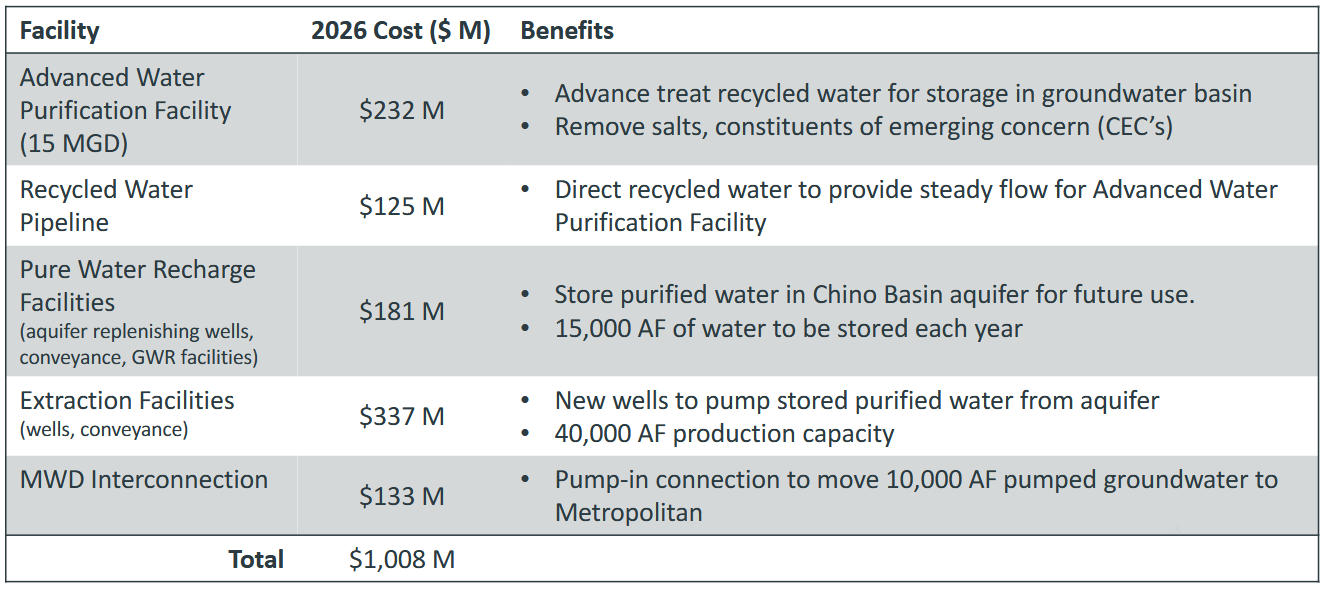
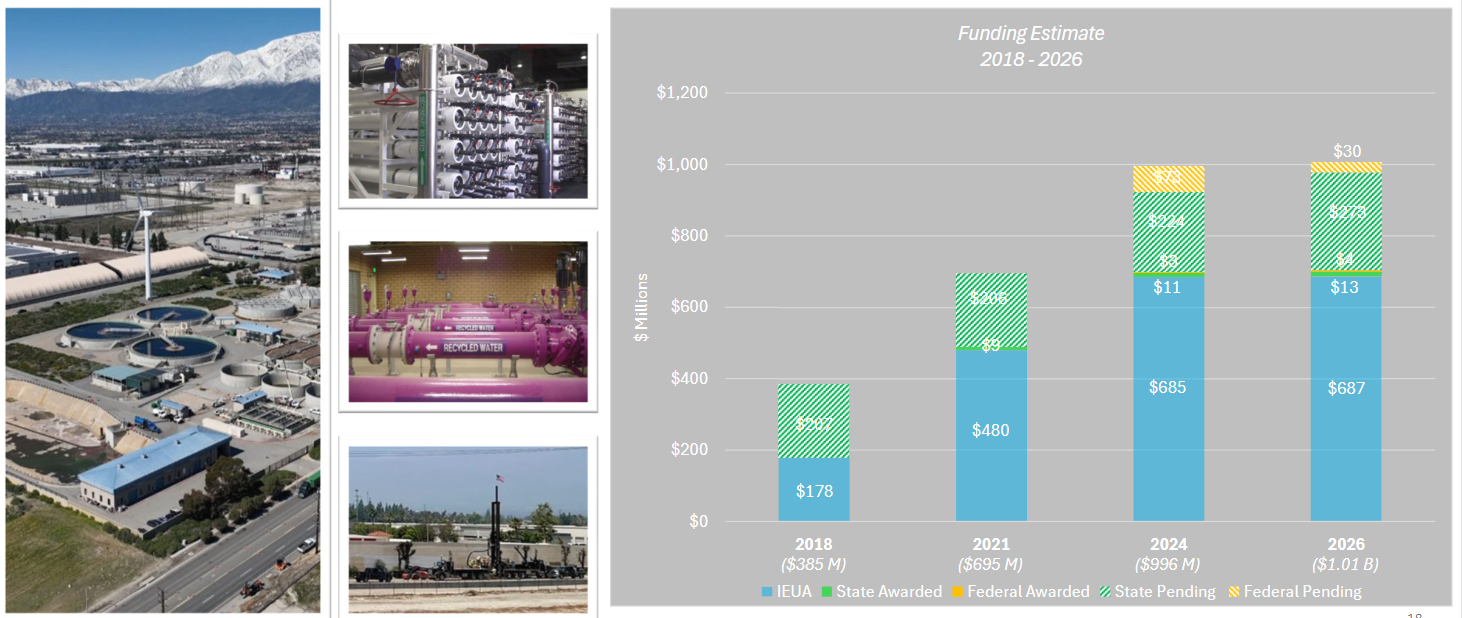
“This is actually a significantly downscaled amount of infrastructure from our original proposal, as the costs have just skyrocketed beyond what I think anybody imagined,” Ms. Hurst said. “In our original application in 2018, we were envisioning about double the amount of pipelines and double the amount of wells, and so we’ve trimmed that back. And now, we’re looking at whether they can be scaled down beyond what we’re doing now.”
The interconnection with Metropolitan is among the project’s most expensive components, and the agencies are evaluating potential efficiencies. “I would say that the billion dollars is the ceiling, and we’re just trying to ratchet it down as much as we can. I don’t foresee it going above the current price that we have on there,” Ms. Hurst said.

