
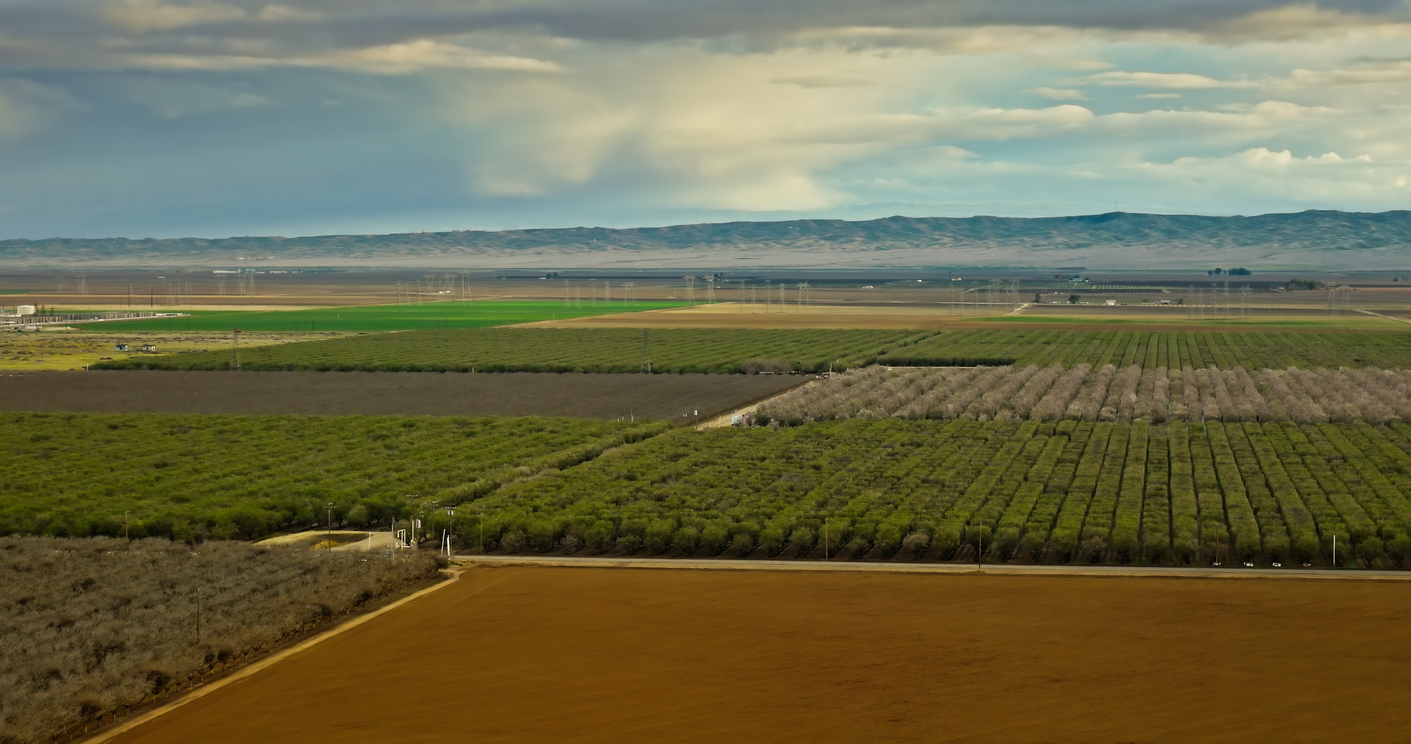
More than 800 potential actions offer a path toward greater water supply reliability, flood resilience, and ecosystem protection.
 The San Joaquin Valley faces a defining water challenge: how to secure reliable supplies, manage flood risk, and protect ecosystems across one of California’s most productive regions. The Unified Water Plan (UWP) lays out a comprehensive strategy for the eight-county Valley—San Joaquin, Stanislaus, Merced, Madera, Fresno, Kings, Tulare, and Kern—spanning the San Joaquin River and Tulare Lake hydrologic regions through 2040 and beyond.
Congress directed the effort under Public Law 111-11, with funding from the U.S. Bureau of Reclamation. The California Water Institute (CWI) at Fresno State developed the plan in coordination with the Water Blueprint for the San Joaquin Valley.
The plan pairs a regional strategy for water supply reliability, flood management, and ecosystem needs with a sobering conclusion: even an estimated $18 billion to $33 billion in infrastructure investments and management actions would not fully close the Valley’s projected water supply gap.
THE CHALLENGE
The San Joaquin Valley is one of the nation’s leading agricultural regions, with communities and local economies closely connected to farming and related industries. The Valley also provides important habitat along the Pacific Flyway, including aquatic habitat for salmon and other anadromous fish and terrestrial habitat for native species.
The study area contains seven of the nation’s 10 highest-producing agricultural counties and grows more than 250 crops valued at approximately $24 billion annually. Within a 100-mile radius of Fresno, the region produces 74 percent of the world’s almonds, more than 95 percent of U.S. garlic and pistachios, and all U.S. raisins. Groundwater is the primary water source for more than 300 disadvantaged communities, including about 130 disadvantaged unincorporated communities. At the same time, approximately $112 billion in structures and about one million residents are located within mapped FEMA flood zones. The Valley has also lost about 94 percent of its historic wetlands, and 50 native plants and animals found on the Valley floor are listed under federal or state law. These conditions underpin the plan’s focus on ecosystem enhancement alongside water supply and flood management.
The stakes are increasingly urgent. SGMA implementation and other regulatory requirements are reducing access to groundwater and surface water, while climate change is increasing evapotranspiration, shrinking the snowpack, and intensifying drought. Without timely, coordinated action, these pressures place the Valley’s agricultural production, jobs, disadvantaged communities, flood resilience, and already diminished ecosystems at growing risk.
THE GAP
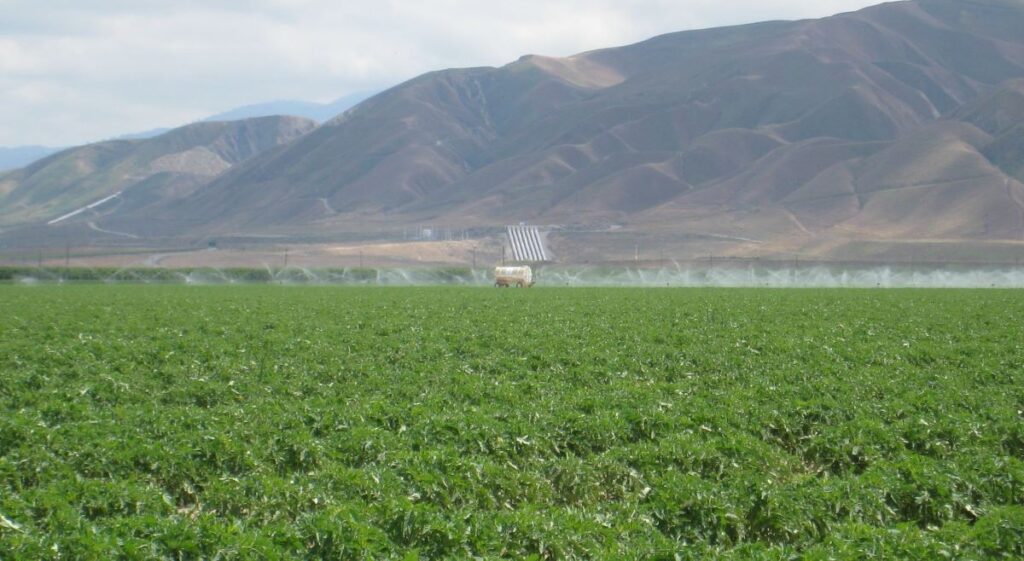
The Plan defines the scale of the challenge by accounting for groundwater overdraft, changing water demand, reduced Delta imports, environmental flow commitments, and the need to replenish depleted aquifers.
Together, these factors produce an estimated average annual supply gap of about 2.4 million acre-feet by 2040—and future regulatory constraints could widen it further. Closing the gap will require additional action and investment to protect the Valley’s water security, economy, communities, and environmental resources.
INVENTORY OF PROJECTS AND ACTIONS
Despite the scale of the projected gap, the Valley has a substantial range of options for responding. The Plan identifies more than 800 potential projects and actions, drawn from Groundwater Sustainability Plans (GSPs), other publicly available sources, and concepts developed by the Water Blueprint.
Projects are organized into five categories:
-
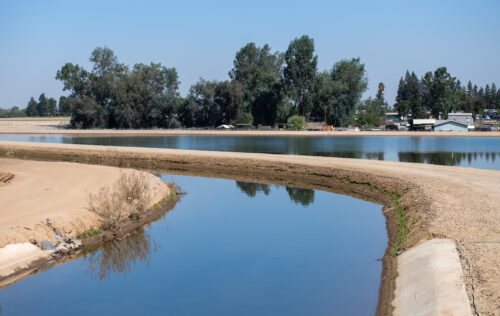
The Fresno Irrigation District’s Savory Pond Expansion project in Fresno was funded by California Department of Water Resources Sustainable Groundwater Management Grant Program and is the first project completed. Photo: DWR Groundwater recharge: Groundwater recharge is the largest strategy identified for helping achieve SGMA sustainability goals, with more than 300 recharge projects described in the GSPs. About 70 percent of the recharge projects listed for the Valley include construction cost estimates and projected annual yields.
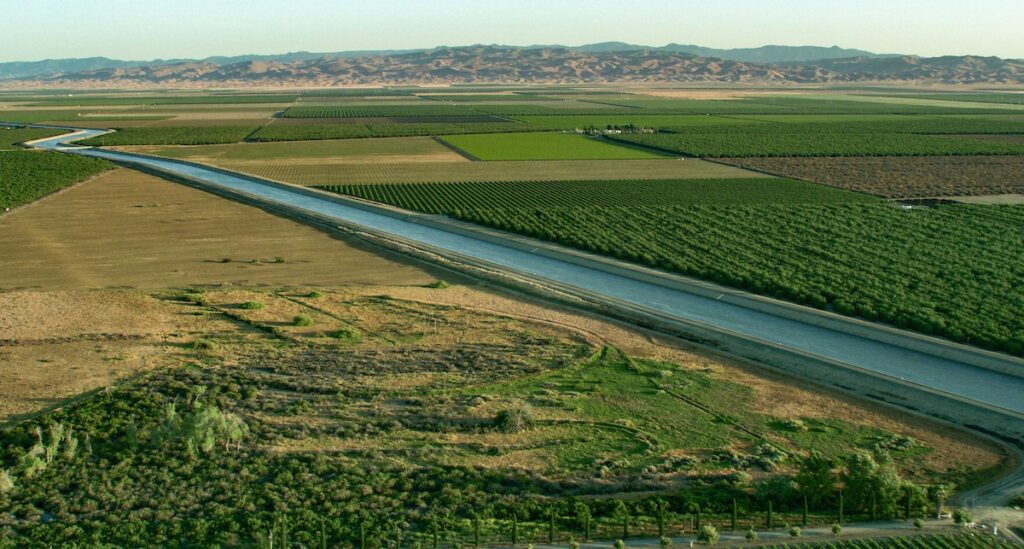
- Conveyance projects: The CVP and SWP form the backbone of San Joaquin Valley water delivery, but aging facilities and land subsidence have reduced capacity. Restoring and expanding the system would improve regional connections, move available surface water to underserved areas, and increase operational flexibility, but would not create new supply. Projects include reverse-flow canal modifications, five potential regional conveyance facilities developed by the Water Blueprint, and fish-friendly Delta diversion facilities.
- Water storage projects: These projects include new surface storage facilities, modifications to existing facilities to increase storage capacity, revised reservoir operations supported by improved forecasting, and new or expanded groundwater storage projects.
- Other water supply projects and actions: These projects include upper watershed management activities, along with recycled water, reclaimed water, surface water trading, and other actions that are largely implementable at the local level.
- Demand management: This category includes a broad set of policies and actions intended to reduce water use, rather than increase supply, such as irrigation efficiency, land conversion, land fallowing, pumping restrictions and related tools, and urban conservation.
As the Plan notes, the inventory “demonstrates that the Valley does not lack possible solutions; rather, the challenge is to prioritize, fund, permit, and implement them in a coordinated manner that produces meaningful regional benefit.” The central task, therefore, is to determine which combinations can be implemented effectively and provide the greatest regional value.
SCENARIO ANALYSIS
Because no single project can close the projected gap, the Plan groups projects and management actions into scenarios to show how combined investments could improve water supplies. The analysis estimates the likely water supply benefits of each combination while considering practical limits such as available water, cost, permitting, and technical feasibility.
The Plan evaluates three investment scenarios, each representing a progressively broader set of actions and a higher level of investment.
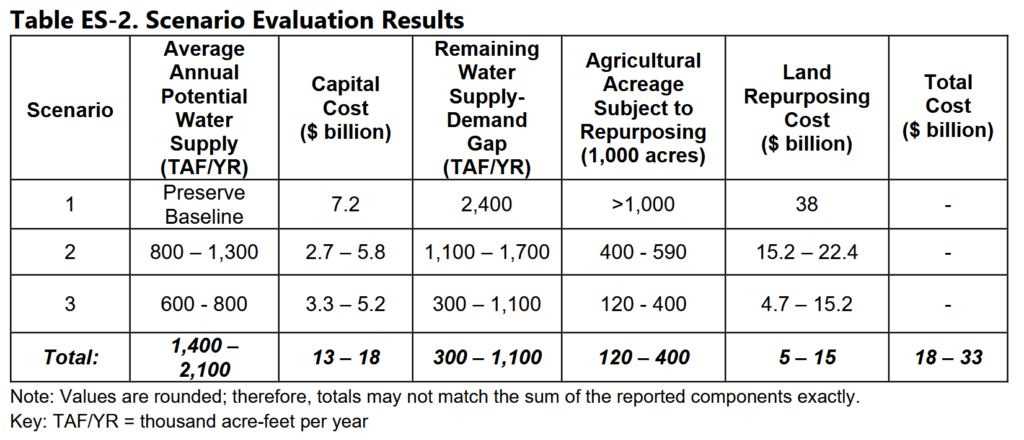
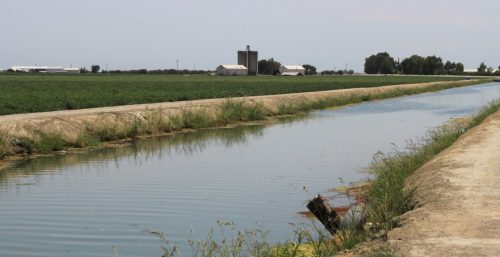 Scenario 1 – Restore Capacity of Existing Facilities. This scenario would restore the capacity of subsidence-impacted CVP and SWP canals and remove sediment from south Delta channels. These projects are needed to prevent the estimated water supply-demand gap from widening and to support implementation of other projects, although their direct effect on the gap has not been quantified. Capital costs for these projects are estimated to exceed $7.2 billion. Potential yield estimates, in acre-feet per year, have not been developed, so their effect on water delivery is not reflected in the supply-demand gap analysis. Projects in this scenario include restoring the design capacity of the San Luis Canal and California Aqueduct, the Delta-Mendota Canal, and the Friant-Kern Canal, as well as dredging south Delta channels.
Scenario 2 – Implement Non-Structural Actions and Local Water Supply Projects. This scenario adds non-structural actions to reoperate reservoirs to improve water management and reduce flood flows, non-structural actions in the Delta, and numerous projects within the Valley to make better use of available supplies through reuse, groundwater recharge, and local storage. These actions include upper watershed measures that could affect the timing and volume of runoff, reoperation of Valley reservoirs in combination with improved forecasting supported by monitoring programs, and changes to Delta export operations that could increase diversions to the Valley. Structural projects in this scenario include local conveyance, recharge, storage, and other water supply projects, as well as projects that would increase east-west conveyance capacity from the San Joaquin River to the Delta-Mendota Canal to support recapture of SJRRP flows and regional water transfers. Implementation of Scenario 2 is estimated to increase water supply by approximately 800 to 1,300 TAF/YR, at a capital cost of about $2.7 billion to $5.8 billion. The analysis indicates that these outcomes are constrained by available water supply rather than by a lack of projects, and that additional investments beyond those assumed in the simulation would be unlikely to produce further yield.
Scenario 3 – Implement Large Infrastructure Projects. This scenario builds on Scenarios 1 and 2 by adding large regional storage and conveyance projects. These include new or expanded water storage facilities north and south of the Delta, modified Delta conveyance and diversion facilities, and enlarged conveyance facilities within the Valley to move greater flows and increase Delta water supplies delivered to the region. According to the Plan, these larger infrastructure investments would be necessary to bring new or otherwise uncaptured water into the Valley and further reduce the water supply-demand gap beyond what can be achieved under Scenario 2. Projects in this scenario focus on increasing imports from the Delta and improving supplies to areas that do not have sufficient access to local water sources. Project types include modified diversion facilities in the Delta, increased north-of-Delta and south-of-Delta storage capacity, and expanded conveyance capacity within the Valley.
KEY CONCLUSIONS
Combined, the projects in Scenarios 1, 2, and 3 could provide an estimated 1.4 million to 2.1 million acre-feet of water supply benefits per year at a cost of $13.2 billion to $18.2 billion. Even at that level of investment, however, the Plan concludes that a substantial gap would remain.
The remaining unmet demand is estimated at approximately 300,000 acre-feet to 1.1 million acre-feet, requiring the repurposing of 120,000 to 400,000 acres. Full implementation of the three scenarios, together with the cost of repurposing the remaining land, would total approximately $18 billion to $33 billion.
RECOMMENDATIONS
The report concludes with a broad set of recommendations.
Recommendations for local and regional entities in the Valley: These include restoring and maintaining the conveyance capacity and delivery capability of existing subsidence-impacted CVP and SWP canals, removing sediment from south Delta channels, developing and implementing local conveyance, recharge, storage, and other projects identified in Groundwater Sustainability Plans (GSPs), leveraging partnership opportunities with urban water users outside the Valley to jointly develop groundwater banking, recharge, and conveyance projects, and establishing a structured, regionally coordinated plan for agricultural land repurposing to minimize community effects and support desired ecosystem and economic outcomes.
Recommendations for state and federal entities to help address needs in the Valley: These include restoring and maintaining the conveyance capacity and delivery capability of existing subsidence-impacted CVP and SWP canals, removing sediment from south Delta channels, establishing non-traditional federal funding mechanisms and a new Valley Water Supply Security program to provide assistance to agricultural water users, creating a long-term, sustainable state funding mechanism specifically for investments in water resources projects in the Valley, and supporting implementation of water supply projects by streamlining permitting processes and improving interagency coordination.
Recommendations for Unified Water Plan implementation: These include establishing a structured approach to build regional agreement and support for project recommendations, continuing coordination among regional and statewide partnerships to promote consistent messaging and help address permitting, funding, and other constraints, preparing regular updates to the Plan that document progress toward closing the supply-demand gap, and preparing an updated regional economic impact study that quantifies the potential effects of inaction and fragmented land retirement in the Valley, while also considering impacts on regions outside the Valley.

